

- Service
- Translated with AI
Certainly clean!
Hygiene-compliant signage in food production
Definitely clean!
Food safety must be continuously redefined. Controls and analysis methods are becoming more sophisticated, there are always new insights, and hygiene requirements for food producers' technologies are accordingly increasing. Not less strict are the hygiene regulations in cleanrooms of the chemical and pharmaceutical industries or during the manufacture of electrical components. This concerns both the employees working there and the machines, systems, and accessories used. Reliable hygiene standards and consistently implemented norms and guidelines are therefore becoming increasingly important from the design and planning stage of new equipment.
Hygienic Design: An Important Building Block for Ensuring Food Quality
In connection with food safety and product liability, "Hygienic Design" is gaining more and more importance. The requirements for a hygiene- and cleaning-friendly design of machines, systems, and components in the food sector are steadily increasing. "Hygienic Design" encompasses design principles to avoid structural weak points that could promote hygiene-related hazards or the risk of infection, disease, or contagion.
The cleanability of materials, surfaces, and structural elements is seen as a central point. Contaminants of all kinds must not settle or remain permanently, or they must be easily removable. This applies, among many other machine components, also to signal devices. These are essential for reliable visual and acoustic signaling of production states. If machine stops or errors are not detected in time, it often results in unused capital. For the food industry, signal devices must be developed and designed according to particularly high hygiene standards. They must not have uneven surfaces, grooves, elevations, or seams where dirt could accumulate.
Signal Towers Specifically Designed for Use in the Food and Cosmetics Industries
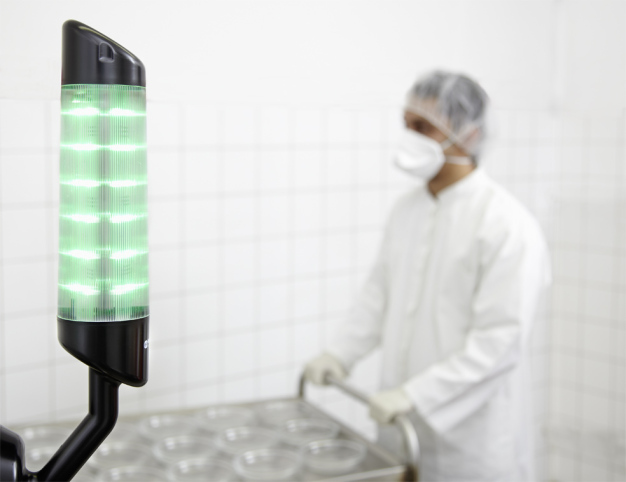
The topic of food safety has long played a major role in the field of optical and acoustic signal devices – these must also meet all standards. The challenge was taken on by the Swabian world-renowned company WERMA Signaltechnik, which found a suitable solution with flying colors: The LED signal tower "CleanSIGN" was specifically designed for use in hygienic environments.
This unique product meets the strict requirements of "Hygienic Design" thanks to its shape, smooth surfaces, and the materials used. The signal tower thus makes a significant contribution to the safe and clean production of food.
Design and Construction for Cleanability According to Strict Guidelines
During the development of the signal tower, the guidelines and standards of the European Hygienic Engineering & Design Group (EHEDG) were incorporated into the product – especially noteworthy for signal devices are Document 8 – "Hygienic equipment design criteria" and Document 13 – "Hygienic Design of equipment for open processing".
EHEDG is an expert community of machine and component manufacturers, professionals from the food industry, research institutes, and health authorities. The organization was founded in 1989 with the aim of increasing awareness of hygiene in the processing and packaging of food. This has led to a certified and consistently well-thought-out result in the field of "Hygienic Design".
Furthermore, the developers of the signal tower were proud to draw on the expertise of specialists from the "Fraunhofer Institute" and the "Technical University of Munich". With their support, a signaling system was designed that is crucial for hygienic production and meets the requirements for energy efficiency and safety. This cooperation ultimately marked a milestone in the world of signal devices.
Durable in Hygienic Design
To meet safety standards in hygienic environments, the signal tower must fulfill special requirements regarding technology, construction, design, and materials. For example, the 3º slant required by EHEDG is exceeded by implementing a 30º slant. This angle is necessary to ensure immediate drainage of liquids, precise cleaning, and good visibility.
In addition, the product was made using a corrosion-resistant and food-grade polyamide housing. This high-quality material has been approved and certified by the Food and Drug Administration (FDA), so it can be used in hygienic environments without concern.
The compact design of the signal tower was also developed according to the "Hygienic Design" standards, avoiding uneven surfaces, elevations, or depressions. All connection points are flush to prevent dirt and bacteria buildup. Furthermore, the connection element of the signal device and the mounting bracket are made as a single piece: additional joints where dirt could settle are avoided. The mounting and connection of the tower are also done from the back, ensuring the housing is completely sealed and no unnecessary holes are required.
Clean Solutions for Cleanrooms
In the manufacturing of electrical components, as well as in the cosmetic, pharmaceutical, and biotechnological industries, the increasing demands for cleanliness must also be met. In cleanrooms, hygiene plays an equally important role as in food technology – contamination and recall actions further reinforce the need for reliable standards and consistently implemented norms. This concerns both the employees working there and the machines, systems, and accessories used.
This makes it clear that the use of signal devices in "Hygienic Design" is indispensable here as well. Only in this way can it be ensured that contaminated food, cosmetics, or medicines do not reach the market or the hands of customers.
No Room for Bacteria
The primary responsibility for food safety lies with the food business operator. They are tasked with ensuring the safety and quality of their products and minimizing the risk of contamination. Hygiene is a matter of utmost importance, as it directly affects consumers' health. Biofilms can adhere to poorly cleaned surfaces, forming reservoirs for toxic substances and triggering allergic or even infectious reactions.
This can be costly for a company: the Research Circle of the Nutrition Industry (FEI) in Bonn reports that companies in the USA conduct recall actions worth $30 billion annually – at least a quarter of which is due to inadequate hygiene of the facilities.
Retrofitting to ensure safe and clean signaling is therefore worthwhile in any case, as besides the hygiene-oriented design of the special signal tower, its maintenance-free LED technology with a lifespan of up to 50,000 hours is also convincing.
Image: The "Hygienic Design" constructed signal light for use in hygiene and food sectors. Thanks to its special shape, the LED light meets very high hygiene standards and makes a significant contribution to safety in the production facility.
WERMA Signaltechnik GmbH + Co. KG
78604 Rietheim-Weilheim
Germany