

- Translated with AI
Cancer diseases have a common "weak spot"
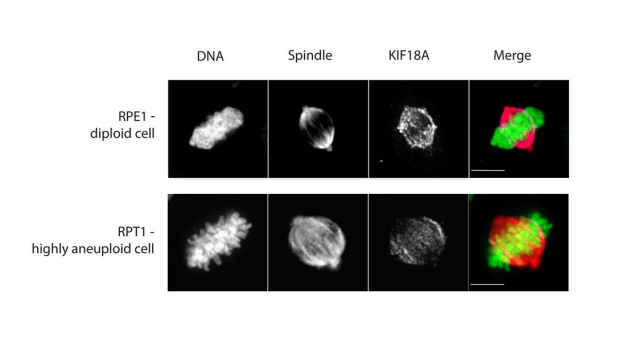
Division of a normal cell (above) and a cell with an abnormally high number of chromosomes (below). (from left to right): DNA, mitotic spindle structure, presence of the KIF18A protein, and everything together (DNA green, spindle red). Scale (white): 10 micrometers. (Sara Bernhard, TU Kaiserslautern)
An international research team under the collaborative leadership of the Technical University of Kaiserslautern has identified a universal vulnerability present in most cancer cells. The findings could contribute to the development of drugs that work against tumors regardless of the cancer type.
Cancer cells with an abnormally high number of chromosomes seem to rely on a specific protein for cell division. Most of them die when its production is blocked, report researchers from Germany, Israel, Italy, and the USA in the journal Nature. Since more than 90 percent of tumors, regardless of tissue type, contain additional chromosomes, this protein could represent an effective target for future treatments of a wide range of cancers.
Cancer has an Achilles' heel
Storchová and her colleagues conducted extensive experiments with nearly 1,000 cell lines from human cancer patients and lab-cultured model cancer cells. Ultimately, they identified a protein called KIF18A, which is essential for aneuploid cancer cells to undergo a critical process of cell division (mitosis), known as chromosome segregation. When too many errors occur during chromosome segregation, a checkpoint at the so-called spindle apparatus (which coordinates the separation of sister chromatids) is activated. This delays cell division until the errors are corrected. However, aneuploid cancer cells generally continue dividing despite the extra chromosomes, making more errors during mitosis. The researchers found that if this checkpoint malfunctions and cannot halt division, these cells seem to accumulate so many errors that they cannot survive. Additionally, they discovered that when the KIF18A protein is blocked, these cells are more likely to die than cells with a normal chromosome number.
“We were able to apply state-of-the-art tools to an age-old question in cancer biology: what is the Achilles' heel of chromosome number alterations in cancer?” says Dr. Uri Ben-David, assistant professor at Tel Aviv University in Israel and co-author of the study. “I am excited that our results, if confirmed in clinical settings, could open up various therapeutic avenues for cancer patients.”
KIF18A is a kinesin motor protein that binds to the mitotic spindle and regulates it; a molecular structure that enables correct chromosome segregation. The researchers do not yet know exactly what makes KIF18A different in aneuploid cells compared to normal cells, but they suspect it somehow helps dividing cells physically accommodate the abnormally high number of chromosomes. Imaging live cells shows that the mitotic spindle in aneuploid cells has a different shape than in normal cells. This will be a focus for further research.
“Currently, there are no inhibitors that block KIF18A in human cells. However, if we better understand the mechanism, we could potentially develop chemical molecules that target KIF18A itself or related processes,” says Storchová.
Accidental collaboration leads to success
Storchová investigates how extra chromosomes influence cell physiology, function, and development of cancer cells. A few years ago, she and her team observed that KIF18A seemed essential for model versions of aneuploid cancer cells, but at the time, there was no publicly available data to transfer this finding to human cancers. She set the finding aside until 2017, when she met Ben-David at a conference. During an informal conversation, he explained that he had examined nearly 1,000 cancer cell lines from patients to find a common vulnerability. She mentioned her work on KIF18A, and when he checked his data, he found that the protein was also highly significant for those cells. Further analyses conducted over the past years helped them exclude other proteins and genes and demonstrated that KIF18A is the key component.
“This reminds us how important informal exchange between scientists is,” says Storchová. “And it shows how complex science can be, and that sometimes we have to go a long way. It took some time until we had enough evidence to illustrate that this is not just a coincidental observation valid in our models, but a more general principle.”
Ben-David agreed and emphasized the importance of basic research, which can take a long time before leading to medical breakthroughs. “Clinical discoveries always stem from fundamental scientific insights,” he says. “Our results are based entirely on cell cultures, so we do not yet know how well they can be transferred to actual human patients. Nonetheless, they open promising research avenues that could ultimately influence cancer patient care.”
Research during COVID times
The coronavirus pandemic posed a major challenge to the project, as many laboratory facilities had to be temporarily closed. The first author of the paper, Yael Cohen-Sharir, completed the key experiments at Tel Aviv University two days before Israel went into a one-month lockdown. The research team, which included the University of Milan, the European Institute of Oncology in Italy, the Broad Institute of the Massachusetts Institute of Technology and Harvard University, the Dana-Farber Cancer Institute, and the University of Vermont in the USA, supported each other—whoever had access to a lab conducted the necessary tests. “At any given time, we had at least one laboratory somewhere in the world that was open and ready to help us,” said Ben-David.
Storchová especially praised TUK doctoral student Sara Bernhard and student Lisa-Marie Stautmeister for their “absolutely great work” in conducting additional measurements necessary for completing the study during the pandemic.
Notes on the original publication:
Yael Cohen-Sharir et al., “Aneuploidy renders cancer cells vulnerable to mitotic checkpoint inhibition,” DOI: 10.1038/s41586-020-03114-6.
https://www.nature.com/articles/s41586-020-03114-6
Technische Universität Kaiserslautern
67663 Kaiserslautern
Germany