



- Buildings & Rooms
- Translated with AI
Ulrich Kaufmann
Biotest New Level
With the baton to the goal
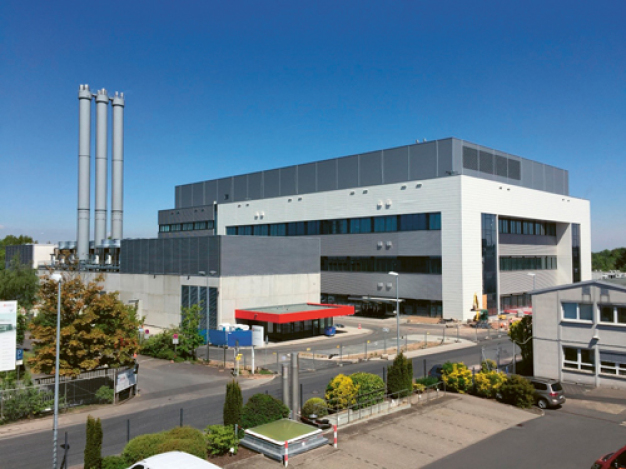
This building must be very versatile: in addition to production, there are also office, laboratory, and storage areas here. (© Biotest AG)
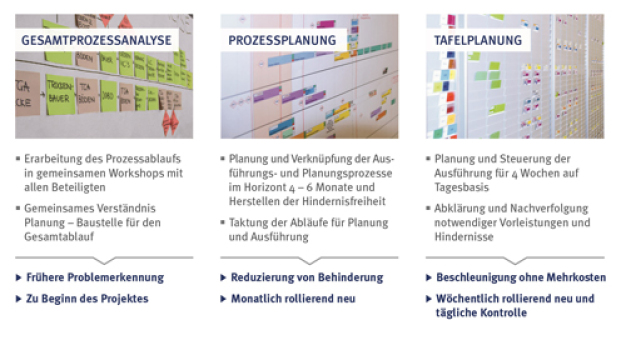
From overview to daily routine: With a systematic approach, the Lean method offers many advantages for life sciences projects. (© Drees & Sommer)
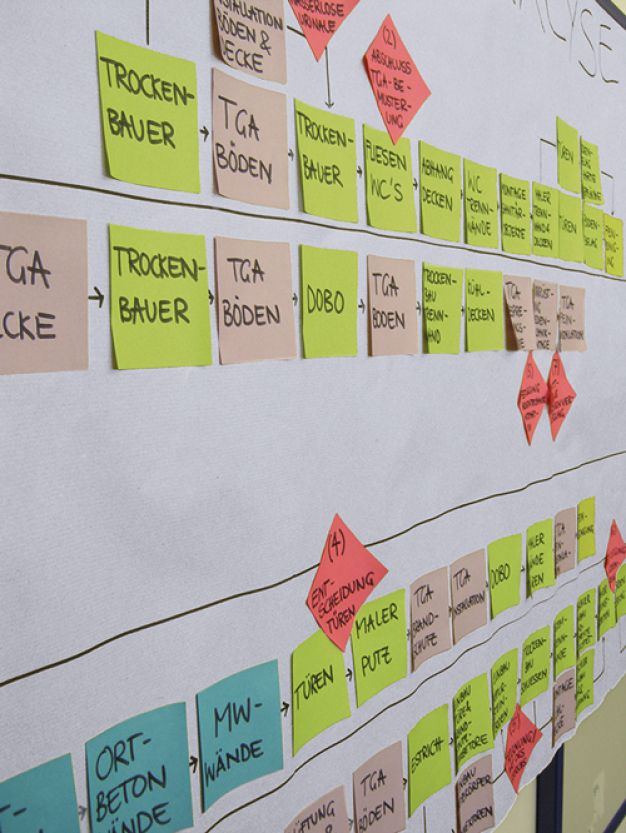
In the first step, all activities and their dependencies are identified in a comprehensive process analysis. (© Drees & Sommer)
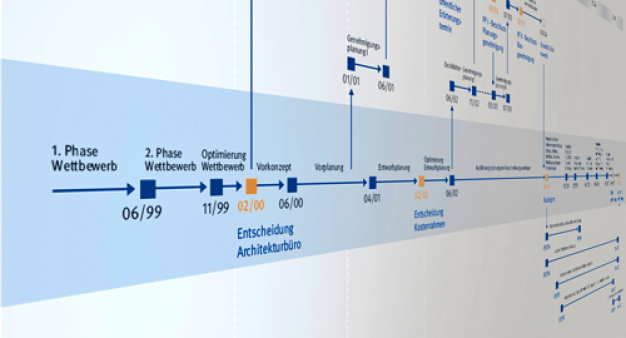
This analysis forms the basis for the process planning. It is translated into a schedule and supplemented with the necessary execution durations. (© Drees & Sommer)
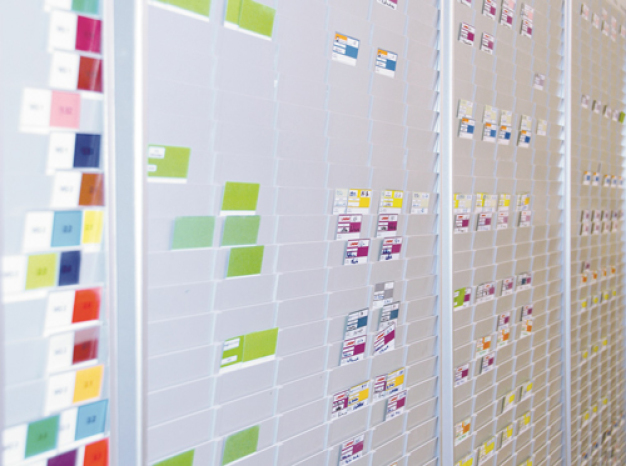
The detailed board planning helps organize the daily work on the construction site. (© Drees & Sommer)

Ulrich Kaufmann
The new 40-meter-high production building of Biotest AG in Dreieich, Hesse, houses three stacked production levels, office and laboratory spaces, extensive technical areas, and a deep-freeze storage for blood plasma. To complete this complex construction project on time and cost-effectively, the pharmaceutical company relied on the LSM method.
Biotest Next Level: This is the name of the investment program through which the blood plasma specialist Biotest plans to double its annual production capacity from 5.5 tons of immunoglobulins to around 13 tons and thereby increase its profitability. To achieve this goal, Biotest invested 300 million euros in expanding its production facilities. The focus was not only on a new five-story production building with a dedicated energy center but also on integrating office, storage, and laboratory spaces, as well as an elaborate cleanroom and sluice concept.
The extreme requirements that the group had to meet in implementing this organizational mammoth project are now commonplace in the life sciences industry: construction projects in this sector must not only meet high quality standards but are often also super-fast-track projects under extreme time pressure. However, the more complex the projects become, the greater the number of planners, specialists, consultants, and executing companies/ trades involved. This increases the risk of insufficiently coordinated collaboration, hampers workflow, and poses the danger of wasting resources and materials, thus delaying and increasing the costs of projects.
LSM for a smooth construction process
To prevent such dangers and generate a smooth construction process, companies in the pharmaceutical, medical technology, and medical biotechnology sectors are increasingly relying on integrated construction management with LCM support. Here, individual activities and processes are sensibly coordinated, with synchronized workflows and workdays relieving project participants and helping to accelerate work processes. This lean construction management method is relevant for almost all project phases — for example, as Lean Design Management (LDM) during planning and Lean Site Management (LSM) during construction execution.
In various projects where recurring functionalities occur, the use of the LSM method has proven very effective and has been practiced for some time. The so-called "trade sequence," i.e., the totality of all services in their defined order, is guided through the building. But even in more complex projects in the life sciences sector, it makes sense to use the LSM method to reduce buffer times and effectively sequence processes.
In three steps to the project goal
Biotest also chose Lean Site Management as the central control instrument for cross-interface communication between the individual trades as well as between planners and engineers on site. The group followed a structured, three-stage process with increasing levels of detail, focusing on the functionality of the building: The first step, with the overall process analysis, forms the basis of work. Step two involved process planning, and step three was the planning board.
In the first step, a team of construction management, planners, and Lean Site Managers defined the strategy and sequence of the project and the individual construction steps. Together, the team broke down the construction process into manageable units, identified weaknesses and risks, and created a reliable schedule along key milestones and intermediate goals of the project.
In collaboration with the commissioned contractors, the overall project was then subdivided into subprojects and work packages. Processes were assigned time and resource requirements, and the overall sequence was optimized through the pacing of trades. For example, deadlines for execution plans were clarified, delivery dates for process systems and media systems were set, and logistical questions were addressed: How many workers, how much material, and how many machines need to be available when and where?
The results were incorporated into a central planning board with index cards, where four-week schedules were planned in detail for each day. Based on this, each project participant could see their specific tasks in the coordinated workflow daily and verify them daily. The board also made immediately visible whether multiple trades were working on the same area or if delays were imminent. Thus, it served as an early warning system and accompanied the planning and trade sequence throughout the entire construction project.
Segmented pacing
In the context of the LSM method, the production building was also divided into several work areas at the start of construction. Rooms of similar size and function, such as laboratory areas or the technical center, formed each segment. All involved parties subsequently coordinated in weekly meetings. In these internal meetings, they agreed on much of the scheduling and control, thereby relieving the overall project.
Meanwhile, all company representatives and construction management teams met every morning at 8 a.m. in the Lean Management container to plan the day and upcoming tasks based on the central planning board: What tasks are scheduled for today? Who starts in which area? Are there interfaces with other trades? The goal of these meetings was informal coordination among the more than 60 companies involved in construction, typically with about 30 present on site at the same time.
Throughout the day, company representatives updated the board. When a task was completed, they changed the corresponding cards and checked whether other trades had already worked on the relevant areas. Based on this, they could reliably plan further services. The construction managers, in turn, gained an overview of activities that had just been completed and were ready for inspection through the daily-updated cards. Once a week, the team also held a more detailed meeting to coordinate the detailed activities on the planning board for the following week.
Conclusion
Thanks to this "day-by-day in rhythm" approach, potential collisions could be made visible and prevented in a timely manner. Under the motto "Transparency obliges," every participant in the construction project contributed to ensuring that others could carry out their work punctually and with the appropriate quality through daily and weekly coordination processes.
The success of this approach is evident: The new production building was completed on schedule, the qualification phase was finished on time, and the prerequisites were created for the timely commissioning of the structural and technical systems by Biotest AG. The LSM method played an important role in this success.

Drees & Sommer SE
Geisenhausenerstraße 17
81379 München
Germany
email: lifesciences@dreso.com
Internet: https://www.dreso.com/life-sciences