

- Products, devices, systems, plants for applications
- Translated with AI
Better safe than sorry: Additively manufactured custom products in medical technology
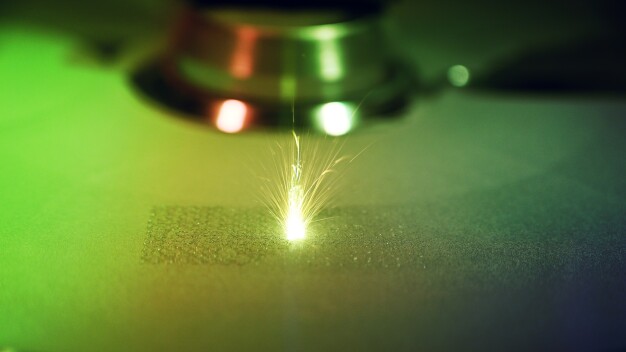
PBF-LBM manufacturing process with a titanium alloy. © Fraunhofer IPA / Photo: Christian Bay
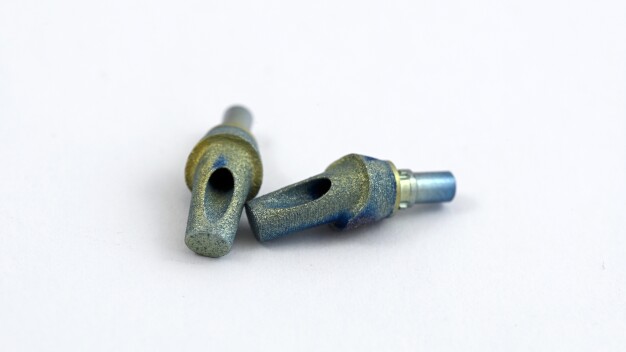
Abutments for connecting dental implants and dental prostheses. © Fraunhofer IPA/Photo: Hajo Groneberg
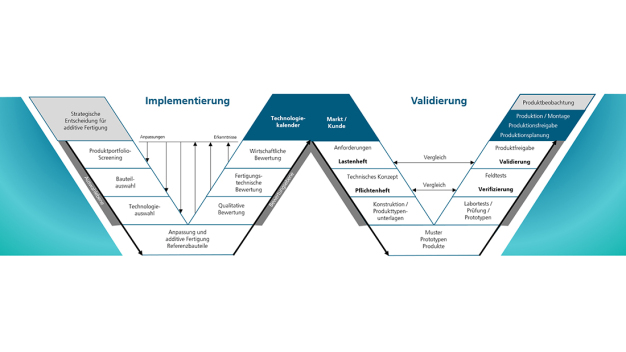
Implementation and validation of additive manufacturing. © Fraunhofer IPA/Graphics: Hajo Groneberg, Carolin Schulz
The regulatory framework in industries such as medical technology is well known to be strict; implementing new production processes requires a lot of know-how, and validation is labor-intensive. However, there is a high demand for patient-specific products such as prostheses or implants, whose complex geometries can be manufactured using additive manufacturing processes. Experts from Fraunhofer IPA facilitate medical technology companies' access to the production of additively manufactured custom products with the help of a guideline.
If warning symbols light up in a car, a trip to the workshop is often necessary. There, a faulty component may be identified as the cause, and a spare part is pulled from the drawer. What works for standard auto spare parts is difficult to transfer to living beings. Looking through a busy pedestrian zone quickly makes it clear that no two people are alike. The same applies to the appearance and anatomy of the human body. The workshop that helps with toothache is called a dentist's office, and the spare parts are not stored in a drawer. The dentition, teeth, and their arrangement are too diverse to replace a tooth exactly with standard products. In implant prosthetics, products tailored to the individual patient that provide the highest possible benefit are suitable.
Additive manufacturing prints individual products
For the production of patient-specific products, additive manufacturing processes are often better suited than conventional methods because they can produce different geometries through their layer-by-layer material deposition process without significant additional effort. For example, abutments, which serve as connecting pieces between a dental implant and the visible prosthetic tooth attached to it, vary in their angles for aesthetic and functional alignment of the dental prosthesis. In a printing process, additive manufacturing methods such as "Laser Powder Bed Fusion with Metals" (PBF-LBM) produce multiple individual abutments cost-effectively.
Safety comes first!
What can be technically implemented in production does not necessarily mean it is safe. With patient safety in focus, the goal is to minimize the risk to the patient. The process of additive manufacturing, with all its parameters, setpoints, and disturbance variables, is complex even for standard products, requiring appropriate technical risk management to meet customer and regulatory requirements (see ISO14971: Medical devices – Application of risk management to medical devices). For custom products, demonstrating safety is more complex due to potentially varying product properties caused by individual geometries.
No reason to be unsettled
Experts from Fraunhofer IPA and the Performance Center for Mass Personalization have developed a methodological approach for companies to implement additive manufacturing safely and cost-effectively, even in highly regulated industries, and to validate custom products. A guideline on this can be found in an open-access article. "The potentials of additive manufacturing for custom products are enormous. With a systematic approach, the suitable products and technologies can be identified, and their risks managed," explains one of the authors, Hajo Groneberg, providing context for the topic.

Fraunhofer-Institut für Produktionstechnik und Automatisierung IPA
Nobelstraße 12
70569 Stuttgart
Germany
Phone: +49 711 970 1667
email: joerg-dieter.walz@ipa.fraunhofer.de
Internet: http://www.ipa.fraunhofer.de