- Service
- Translated with AI
Dipl.-Ing. (FH) Claudia Pachl, VALTEC GmbH
Better qualification through optimal documentation
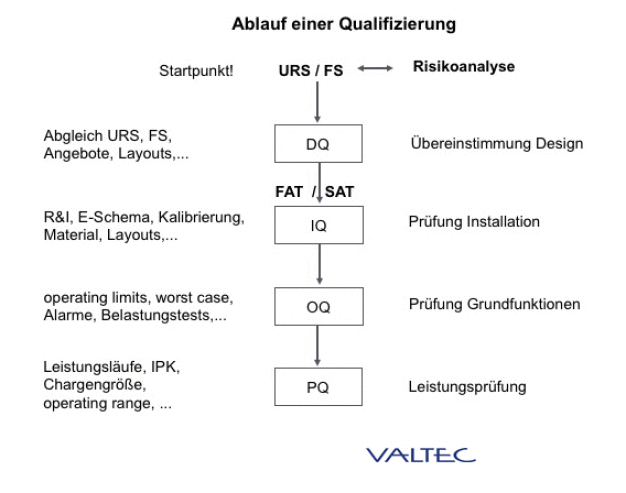
Fig. 1: Process of a qualification
Dipl.-Ing. (FH) Claudia Pachl, VALTEC GmbH
Qualified equipment, systems, and environmental conditions are fundamental in the manufacturing of pharmaceuticals and medical devices. They are a prerequisite for the validation of processes, procedures, methods, and systems. Through qualification, proof is provided that the used equipment, systems, and components are suitable for their intended and defined purpose and that products can be produced or processes operated with them that meet the specified requirements.
The basic approach to qualification is described in various regulations and guidelines, with Annex 15 to the EU GMP Guide being of particular importance here. Additionally, there is various literature on the interpretation of the requirements and implementation recommendations.
Qualification is generally divided into four phases: Design Qualification, Installation Qualification, Operational Qualification, and Performance Qualification (see Fig. 1).
In addition to adhering to the ideal sequence, there are still some other aspects necessary to conduct qualification and obtain meaningful results from tests and inspections, which collectively reflect the status of the system.
An important prerequisite is a living quality system that, among other things, includes requirements for risk management, document management—including the appropriate document templates—and regulates the handling of errors and deviations. The Validation Master Plan (VMP) describes the company's overall validation policy, outlines the contents and minimum requirements of each qualification phase, and defines the procedures for qualification and validation. Furthermore, the VMP typically includes an overview of all equipment, systems, and environmental conditions to be qualified, their current qualification status, as well as planned activities and intervals for requalification or periodic testing. The same applies to processes to be validated, which are also documented and managed within the scope of the VMP.
Another essential aspect is documentation. The approach of generating as much paper as possible to impress authorities and inspectors is of little use. Depending on the complexity of the qualification project, documentation can be kept relatively lean by, for example, consolidating multiple qualification phases into a single document and turning plans into reports through filling out and executing tests. This approach reduces not only the number of documents but also the associated signature workflows. The applicability of this approach depends on the complexity and planned duration of the project and is only partially suitable for very extensive and elaborate projects.
Qualification documents should ideally follow a "red thread" and be structured. This facilitates traceability and the assignment of requirements to tests and results. It must be clear why, when, how, and by whom something was checked and what the outcome was. When executing inspections and tests, the rules of Good Documentation Practice must be strictly followed.
A risk-based approach reduces the scope of qualification to what is truly necessary. Risk analysis or assessment should be used sensibly, and only what has been classified as critical and relevant should be verified within the qualification. Additional tests "just for safety" undermine this instrument and are a clear indication that processes are not understood or controlled. Understood and defined processes, critical process parameters, and quality attributes are only the basis for deriving requirements for a newly procured or modified system. A thorough understanding of the system technology, critical system parameters, and functions is again a prerequisite for deriving risk-mitigating measures and for the testing within qualification.
If an intensive and conscientious frontloading is carried out at the beginning of a qualification project, it has a positive and beneficial effect on the entire project course. This means that basic documents such as user requirements, functional specifications, and risk analysis should be given special attention, as these define the fundamental requirements on which the entire qualification is built. The more precisely and better these documents are developed at the start, the lower the likelihood of errors and deficiencies rooted in unclear specifications and requirements. The later a deviation from the desired state or specification occurs during the project, the more difficult and costly it is to correct. In the worst case, compromises must be permanently accepted, or the system to be qualified proves unsuitable for its intended use.
The involvement of supplier tests and documents can also significantly reduce the qualification effort. Inspections within the scope of Factory Acceptance Tests (FAT) and Site Acceptance Tests (SAT) can replace or supplement parts of the qualification tests. Deviations and deficiencies identified during FAT or SAT can usually be corrected early and with manageable effort. It is important that the procedures are coordinated and that the documents produced before and after execution are reviewed and formally approved by the client. The involvement of internal quality assurance is essential here.
Structured, well-thought-out documentation thus significantly contributes to the successful completion of a qualification project. A slightly higher initial effort in preparing the necessary documents pays off throughout the entire project and provides long-term benefits, e.g., during periodic verification of the qualified state and requalification. Existing systems and tools should be used sensibly—keyword: quality system and risk management. Qualification naturally requires a certain level of formality, but an appropriate degree of creativity should also be applied when designing documents, qualification approaches, and test procedures to achieve the best and most sustainable benefit.

ValTec GmbH
Zentralstrasse 100
8212 Neuhausen
Switzerland
Phone: +49 173 6983802
Fax: +41 52 6750001
email: claudia.pachl@valtec-gmbh.com
Internet: http://www.valtec-gmbh.com