



- Translated with AI
Avoid faulty operational and personnel hygiene
Already with the enactment of Regulations (EC) No. 852/2004, (EC) No. 853/2004, and (EC) No. 854/2004, a series of new requirements were imposed on food businesses through the new food hygiene concept. Due to their direct applicability, European food law is also directly applicable to small businesses. Since August 2007, the umbrella regulation for the national implementation of the new community food hygiene regulations, which have been in effect since 2006, has been in force.
In § 3 of the Food Hygiene Regulation, the general hygiene requirements are regulated in the three areas of operational, production, and personnel hygiene. "Food may only be produced, handled, or placed on the market in such a way that, when the necessary care is observed, it is not exposed to the risk of adverse influence." The focus of the general hygiene requirements is on personnel hygiene, which among other things determines the overall condition of the food. This establishes the requirement that persons handling food must maintain a high level of personal cleanliness. According to the circumstances of the operation, the properties of raw materials, product requirements, and hygiene-relevant conditions in the manufacturing process, measures in the area of hand cleaning and disinfection are particularly to be specified.
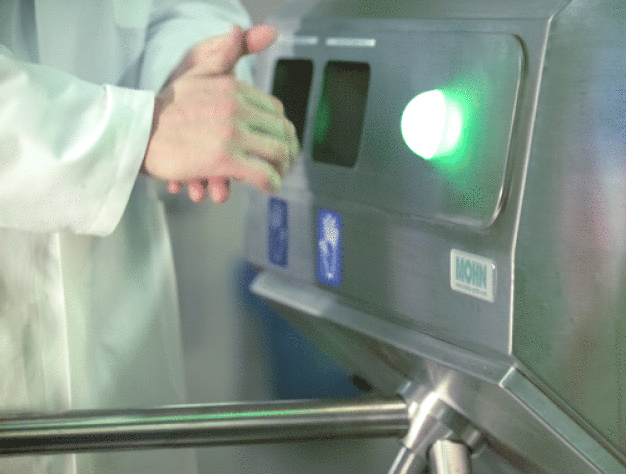
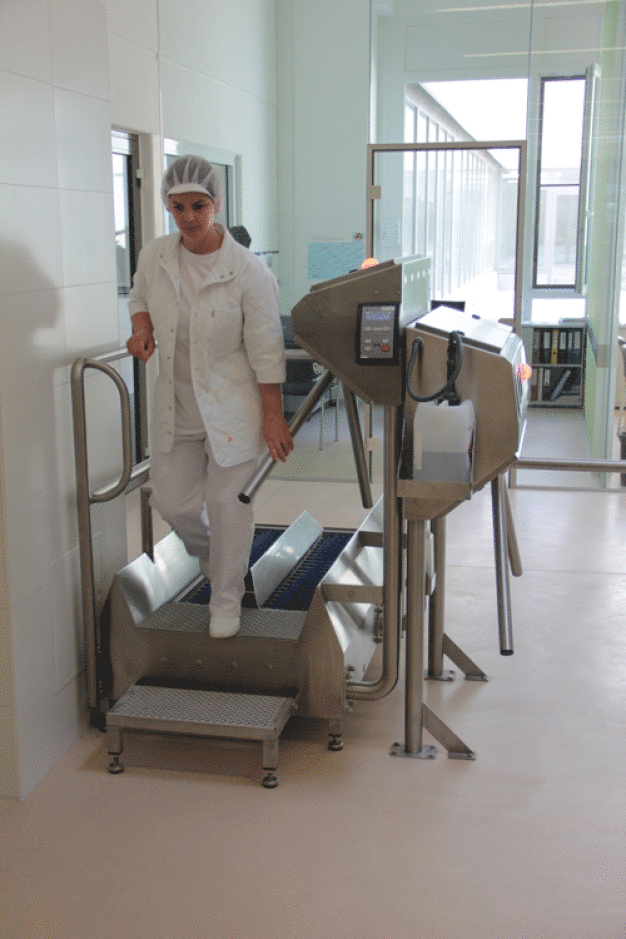
According to the interpretation guideline of the "Working Group for Meat and Poultry Hygiene and Specific Questions of Food of Animal Origin (AFFL)," good food hygiene is, among other things, ensured if a hygiene sluice is available when entering from outside or from a less clean to a cleaner production area. Ideally, this involves at least a non-avoidable facility for hygienic cleaning of shoes and washable work clothing, as well as for cleaning and disinfecting hands. It is not only about the presence of handwashing sinks and disinfection facilities; there is an obligation to use the cleaning facilities when passing through the hygiene sluice. If this is not done, the integrated turnstiles automatically block further passage.
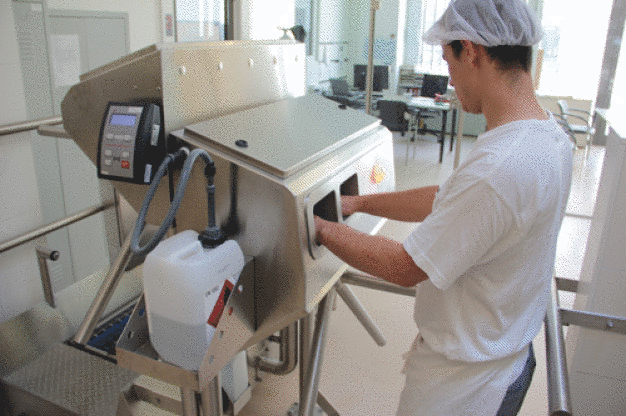
Both the soles of shoes, boots, or clogs, and the hands are cleaned and disinfected in a throughput process. Every employee who wishes to enter the production or clean rooms is guided through the system. Two horizontally arranged rotating sole brushes, covered by a stainless steel walkway, clean and disinfect the shoe soles. These are activated by sensors when entering the hygiene sluice. To ensure that the sluice can only be passed with disinfected hands, the hands are detected by two sensors and wetted with disinfectant solution for a predetermined time. Only when the prescribed amount of disinfectant has been applied is the turnstile at the end of the hygiene sluice unlocked.
Regarding reliability and quality of disinfection, there are significant differences among the hygiene sluices available on the market. The distinction between good and bad is already made with the use of brush rollers with a dense field of bristles for sole cleaning, which ensures much better removal of dirt and disinfection. It should be particularly noted that hygienic hand disinfection is the most important measure to prevent the further spread of pathogens. Through the use of a full-surface spray application, an even coating of the often alcohol-based hand disinfectant can be achieved, contributing to proper disinfection.
Hygiene sluices are currently only available in a few small businesses, cannot be fundamentally installed structurally, and are not always practical. Infrastructure and equipment are based on the requirements of buildings, rooms, and equipment; in terms of the new regulations and the goal orientation, these are based on appropriateness.
Mohn, as a provider of hygiene sluices, also offers tailored solutions to enable all small businesses to obtain EU approval.
MOHN GmbH
58540 Meinerzhagen
Germany