

- Robot
- Translated with AI
Autonomous Mobile Robots: Automation Potential Analysis for Intralogistics
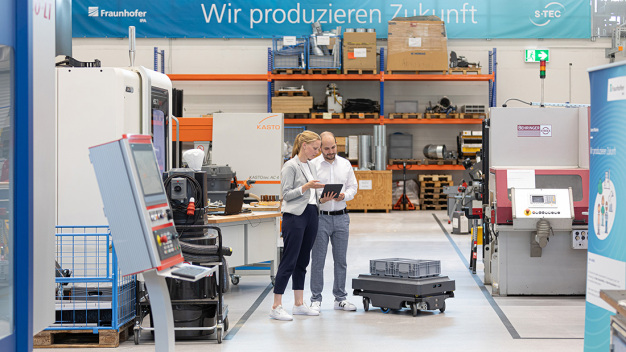
Either experts from Fraunhofer IPA conduct the APA on-site at companies, or companies can use it themselves with the help of an app. (Source: Fraunhofer IPA / Photo: Rainer Bez)
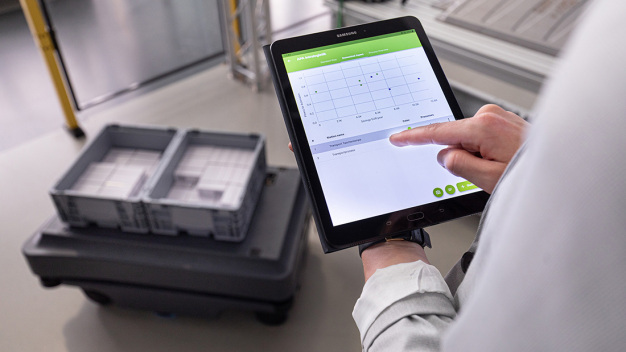
The automation potential analysis now also informs companies about meaningful application possibilities of mobile robots. (Source: Fraunhofer IPA / Photo: Rainer Bez)
The demand for increased automation in intralogistic processes is high. When and how exactly driverless transport vehicles or autonomous mobile robots are suitable for specific tasks in this environment can now be systematically determined by companies using the Automation Potential Analysis (APA) from Fraunhofer IPA.
Whether it's skilled labor shortages, demographic change, or the booming online retail sector: the drivers for increasing efficiency in warehouse logistics and order picking are numerous. Many companies see automation of transport routes as a sensible way to address these drivers. This can be implemented with driverless transport vehicles (FTV) or autonomous mobile robots (AMR), which operate in non-public indoor areas – the most significant segment in so-called service robotics. Around 40,000 of these AMRs were sold worldwide in 2021 – an increase of 47 percent compared to the previous year, according to the »International Federation of Robotics«.
However, companies often have many questions and uncertainties regarding the use of driverless transport systems, the overarching category of FTVs and AMRs, and need to avoid investment risks. Is it worth purchasing mobile robots? If so – how autonomous should they be, for example, in navigation, to achieve the best added value? Would existing processes need to be adjusted?
Further development of the Automation Potential Analysis
Through these and many other questions, experts from Fraunhofer IPA regularly engage with companies and share their experiential knowledge in mobile robotics from many years of development work. Now, they have incorporated this knowledge into the Automation Potential Analysis (APA). It is a procedure originally developed for evaluating automation in assembly processes. The institute has already advised over 500 companies on economically and technically feasible automation possibilities around welding processes.
Already this spring, the APA for welding processes with cobots was published. Now, the APA is also available for mobile robots in intralogistics, providing companies with a structured and systematic basis for decision-making regarding potential investments.
Keeping an eye on all transport processes
For the intralogistics APA, the development team visits the planned deployment environment for mobile robots and analyzes each individual transport process using a questionnaire. This is aligned with the VDI Guideline 2710 »Holistic Planning of Driverless Transport Systems (FTS)«. The team records the existing framework conditions and evaluates them. This includes criteria related to the transported goods, transport aids, handover and transfer of loads, transport routes, safety issues, and details about the deployment environment. Additionally, companies can decide whether all seven framework conditions are relevant to them or if they wish to exclude certain ones.
As a result, companies receive an assessment of the automation potential for each transport process and, derived from this, the overall automation potential of the entire intralogistics application. The assessment also indicates whether, for example, a driverless transport vehicle that navigates largely on fixed routes is suitable, or an autonomously navigating robot. The former offers high process security, while a mobile robot is more suitable for use among people, as it can recognize obstacles and dynamically adjust its route accordingly.
In addition to the three already developed automation potential analyses, the development team is currently working on a fourth variant. This APA will focus on machine loading and unloading and is expected to be available around the end of this year.

Fraunhofer-Institut für Produktionstechnik und Automatisierung IPA
Nobelstraße 12
70569 Stuttgart
Germany
Phone: +49 711 970 1667
email: joerg-dieter.walz@ipa.fraunhofer.de
Internet: http://www.ipa.fraunhofer.de