



- Translated with AI
Automation under cleanroom conditions
In its intralogistics equipment, the traditional company Leica relies on seven compact vertical lift and paternoster systems from Kardex, which demonstrate their efficiency at the camera manufacturer under cleanroom conditions.
Since spring of this year, Leica Camera AG, an internationally active premium manufacturer of cameras and sports optics products, has been based in Wetzlar with administration and manufacturing, customer service, and logistics. "The manufacturing conditions at the previous company headquarters in nearby Solms no longer met the increasing demands of high technology," explains Oliver Keiner, Head of Production Planning and Control at Leica. The traditional company in the optical industry in Germany faced the choice of modernizing the old production buildings or constructing a new facility at the historic founding site of Ernst Leitz.
According to designs by the Frankfurt architecture firm Gruber & Kleine-Kraneburg, a state-of-the-art new company building was created according to current energy standards. The new headquarters is heated with geothermal energy, photovoltaic panels on the 10,000 square meter roof cover the electricity needs, and with around 28,000 square meters, Leica has doubled its previous usable space.
Part of the investment was allocated to optimizing and automating logistics, which in Wetzlar supplies both production with necessary materials, auxiliary and operating supplies, and handles packaging. In addition to a new automatic small parts warehouse (AKL), Leica installed five compact vertical lift and paternoster systems from Kadex Deutschland GmbH.
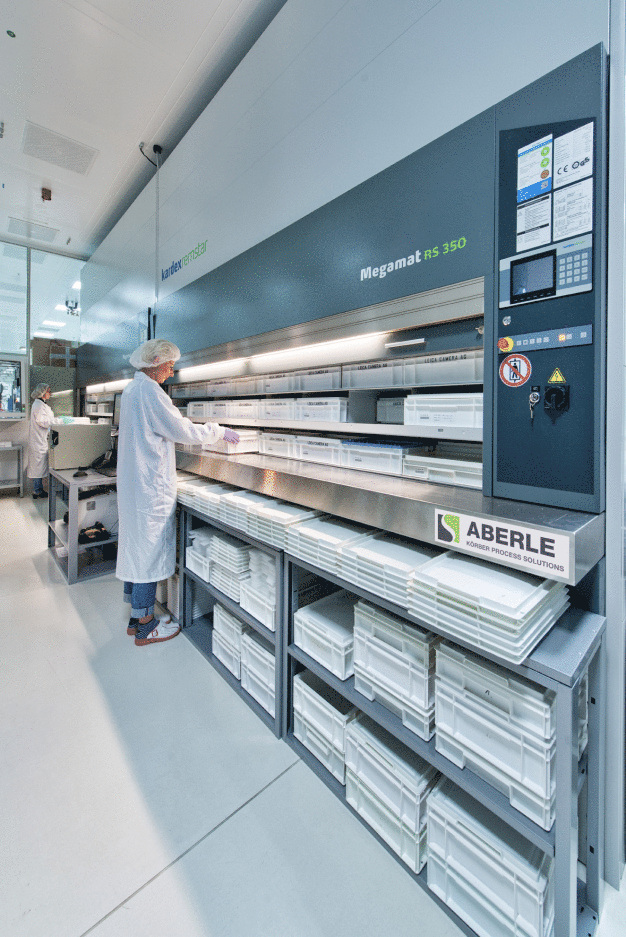
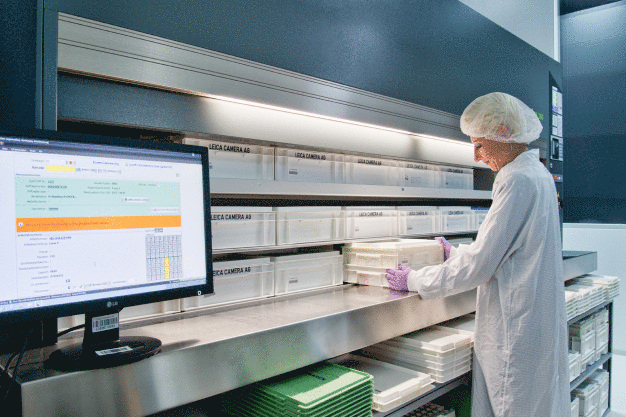
Special feature: The assembly, testing, and packaging of optical assemblies and components at Leica require largely specific cleanroom conditions to meet the quality standards of manufacturers and markets. The new intralogistics was designed around two paternoster circulating shelves, Megamat RS (3,875 x 1,671 x 3,560 mm). These two automated circulating shelf systems are installed in a cleanroom. On 14 carriers with intermediate floors, the lenses for current production and repair orders are stored—dust- and particle-free. Their picking strategy, based on the "goods-to-person" principle, makes the compact Megamats ideal storage systems for items and materials with high access frequency. Additionally, the perfect interplay of electric motor, high-efficiency gearbox, and finely tuned frequency converter ensures low energy consumption and significantly reduces wear and abrasion. This equally minimizes lifecycle costs (TCO) as well as fine dust and particle generation within the Megamats. "Already designed as closed storage systems, these systems are ideally suited for operations under conditions of multiple cleanroom classifications with controlled contamination levels—such as in research and production of optical and pharmaceutical industries or semiconductor manufacturing," explains Kardex project manager Joachim Schlierf.
For further logistics, a Shuttle XP (4,380 x 2,972 x 8,450 mm) is integrated into material flows and tray-supported storage processes. The vertical lift system stores small parts quickly accessible for production on 75 trays. It offers a total capacity on its approximately 13.5 m² footprint equivalent to a storage area of 180 m². "Optimal storage density, flexible, efficient storage strategies, and safe, fatigue-free work," summarizes Schlierf the system advantages.
Two additional Shuttle XP 500 units and two more Megamat RS support Leica's Customer Care (CC) division in storing spare parts and repair equipment. Leica customers can send in their camera and optics systems for inspection or repair. These devices, along with around 8,000 different spare parts—from miniature screws to housings for older camera models—are buffered or stored in the four Kadex automation systems installed in the Leica CC area. The modular design of the systems was particularly advantageous: it was not the building structure that had to be adapted to the storage units, but rather the Kardex systems could be flexibly integrated into the existing room heights. "Variable storage heights with minimal storage gaps, an electronic measurement system, and the intelligent system control Logicontrol 100 enable height-optimized storage and retrieval," summarizes Schlierf. "This ensures controlled access with maximum efficiency."
The project manager is also pleased with the collaboration with Aberle GmbH, which served as the general contractor for the intralogistics project at Leica. "The three Shuttle XP vertical lift systems and four Megamat RS paternoster systems were optimally integrated into the process and storage control through the process management system without interface conflicts," says Schlierf. "A harmonious project process with the best results for the customer."
Leica planning manager Keiner shares this view. "Thanks to the automation systems and the intelligent storage management and process control, picking has become significantly easier, faster, more reliable, and less labor-intensive for our employees, even with less space," summarizes Keiner. "The time savings already achieved have sustainably improved our delivery readiness. With the completion of all restructuring and automation processes, further optimization potentials are foreseeable. We are very satisfied with the solution."
Kardex Germany GmbH
86476 Neuburg / Kammel
Germany