



- Robot
- Translated with AI
AI-based Robotics: How a New Industry is Emerging Through Billion-Dollar Investments
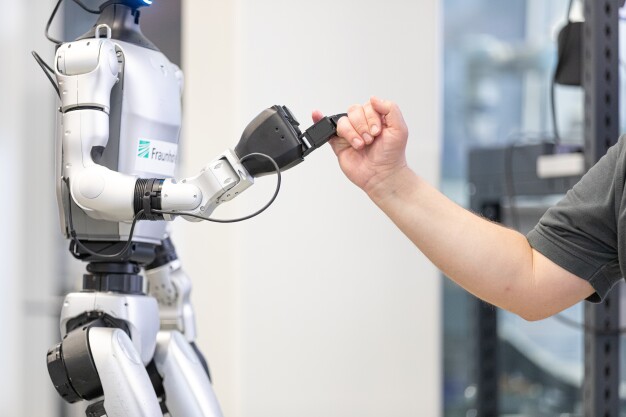
Humanoid robots are the most visible, but by no means the only form of AI-based robotics. © Fraunhofer IPA / Photo: Rainer Bez
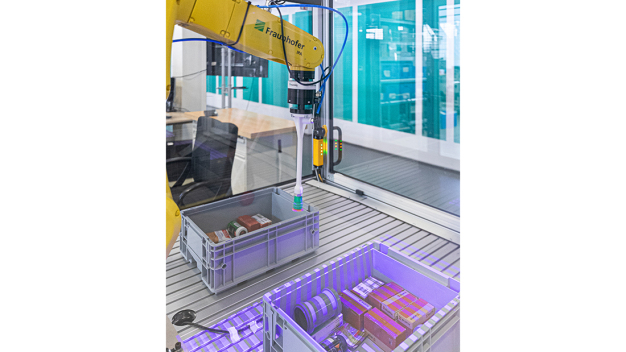
AI-based robotics, such as this pick-and-pack application, enables automation where it was previously technically or economically unfeasible. © Fraunhofer IPA/Photo: Rainer Bez
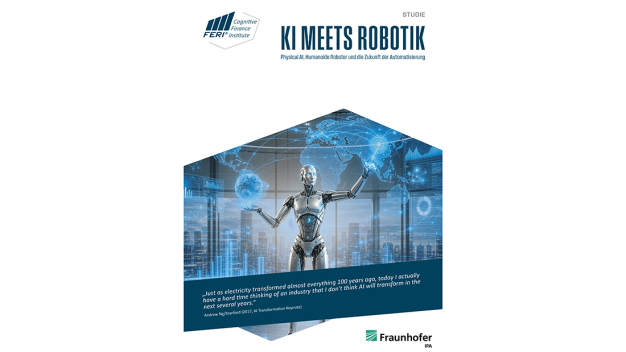
© FERI Institute / Image AI-generated with Firefly
A new study by Fraunhofer IPA for the »FERI Cognitive Finance Institute« classifies the boom around artificial intelligence (AI) and robotics: It is not only spectacular humanoids driving their convergence. In general, Physical or Embodied AI, i.e., AI integrated into robots or machines, is becoming increasingly important. Because it enables systems to learn continuously through interaction with the environment.
Humanoid robots dance on stages, billions of dollars flow into the sector, and the debate swings between utopia and skepticism. What is often overlooked: The actual transformation around AI-based robotics is happening in the background and affects far more than systems with human-like forms. It is shaped through the interplay of software, data, simulations, and hardware components with the goal of enabling companies to deploy intelligent systems economically and safely.
The Fraunhofer Institute for Production Technology and Automation IPA presents a comprehensive assessment with the study »Artificial Intelligence meets Robotics: Physical AI, Humanoid Robots, and the Future of Automation«. It analyzes the convergence of Artificial Intelligence and Robotics – Physical or Embodied AI – from technological, market, and investment perspectives.
Assessment is necessary
Demographics, skilled labor shortages, wage pressure, reshoring, and sustainability requirements create a structural need for automation, primarily in manufacturing and logistics, but also in entirely different areas such as healthcare and services. At the same time, AI methods that make robots more adaptable are maturing, and the combination of high available computing power along with efficient hardware and software offers disruptive potential.
»Many decision-makers currently see humanoids mainly in shows or demonstrations at trade fairs and rightly ask: How ready for deployment are these?«, says Dr. Werner Kraus, Head of the Automation and Robotics Research Department at Fraunhofer IPA. »Our study separates hype from reality and shows where value is already being created today. Especially with humanoids, much is still about piloting, benchmarking, and developing clear application possibilities that are technically and economically feasible.«
Embodied AI is larger than humanoids
The central message of the study: AI-based robotics is not synonymous with humanoid robots. AI can be integrated into industrial robots, mobile systems, cobots, and service robots to make them more autonomous and capable of learning. Humanoids are the most visible manifestation but still only a part of the ecosystem. The real disruption occurs deep within the value chain: in foundation models, sensors and actuators, simulation and data platforms, as well as in integrators who translate technology into processes.
Nevertheless, the substantial investments in humanoids are proof that developments in this segment are progressing massively. Venture capital here jumped to around $6.1 billion in 2025. This is four times the investments compared to the previous year.
Humanoids: complementary use instead of short-term replacement
»It is unlikely that humanoids will replace existing robotics solutions in the short term«, explains Simon Schmidt, Head of Automated Systems at Fraunhofer IPA. »Industrial robots, cobots, and autonomous mobile robots remain superior in many applications in terms of productivity and costs. More likely, humanoids will complement tasks that have been difficult to automate so far due to flexibility requirements or human workplace design.« Demonstrations should not be confused with mass adoption. Success depends on diffusion, safety, regulation, and integration.
A particular bottleneck for broader deployment is the data basis, through which intelligent robots can learn certain tasks on their own within the context of powerful AI models (foundation models, vision-language-action models, etc.). The generation of this important data is therefore currently a focus area around the development of AI-based robotics.
What decision-makers can derive from this
AI-based robotics is already market-ready in certain applications today. If companies are interested in these technologies, they should first identify specific »pain points« for increased automation. Then, they need to find suitable mature solutions, pilot them initially, and only then scale up.
Investors should differentiate along the value chain: Direct bets on individual humanoid manufacturers are risky because the market is still very dynamic. Providers of key components, AI infrastructure, simulation, and data ecosystems can participate earlier and more broadly. Specifically regarding humanoid robots, the »Humanoid Capabilities Navigator« and a modular benchmark from Fraunhofer IPA support objective testing of industrial suitability – from potential analysis to integration in manufacturing and intralogistics, for example.

Fraunhofer-Institut für Produktionstechnik und Automatisierung IPA
Nobelstraße 12
70569 Stuttgart
Germany
Phone: +49 711 970 1667
email: joerg-dieter.walz@ipa.fraunhofer.de
Internet: http://www.ipa.fraunhofer.de