



- Translated with AI
Advantages of comprehensive logistics solutions in the pharmaceutical industry: Automation? Absolutely!
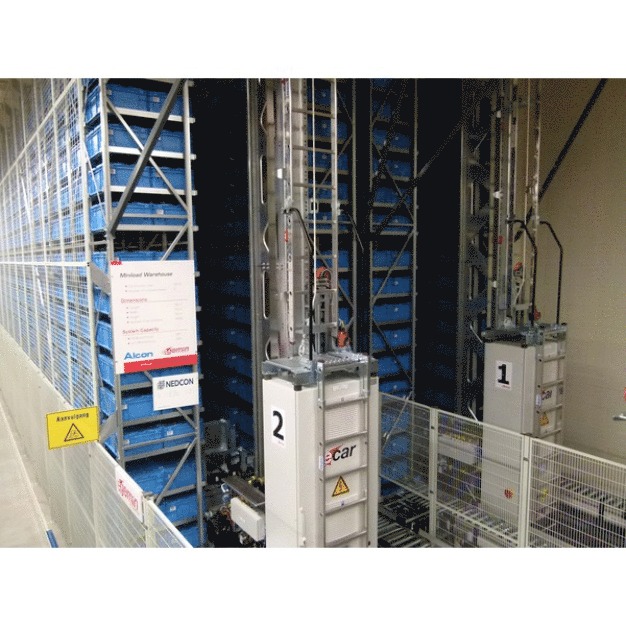
Legal regulations and savings in healthcare ensure that the issue of cost pressure is also playing an increasingly important role in the pharmaceutical industry. For companies, therefore, optimizing their own supply chain is becoming more and more central—from procurement through manufacturing to the distribution of sensitive products. In this context, automated logistics systems in the pharmaceutical sector offer many advantages: from adapting material flow processes and increasing efficiency in production to resulting cost savings and error reduction. The prerequisites for this: the highest reliability and accuracy of logistics systems. Only when intralogistics systems reliably perform their assigned tasks can companies benefit from automation in the long term. The focus is primarily on the high safety and hygiene regulations as well as the quality standards that must be met. How these challenges can be mastered is known to Egemin Automation.
One thing is certain in pharmaceutical logistics: the trend is moving towards automation of production and distribution processes, and not without reason. Automated storage systems reliably and accurately perform their tasks 365 days a year and 24 hours a day—provided that a sustainable and comprehensive analysis of the conditions, requirements, and automation goals has been carried out beforehand by a specialist. "The central challenge is to integrate intralogistics systems into the material flow in such a way that they accurately, repeatedly, and continuously reflect and document the company's processes," explains Stephan Vennemann, Managing Director of Egemin GmbH in Germany. "Especially in pharmaceutical production, it is about getting the right goods to the right place at the right time in the right quantity. Because transporting or assembling incorrect substances can not only significantly impair medication production but, in the worst case, also have far-reaching consequences."
Analysis, Concept Development, Planning
Before integrating automated storage technology, an analysis of current and future business processes is essential: Is it a distribution warehouse or production logistics? How are the distribution processes organized? Which substances are stored? Are there different temperature or hazardous material zones? "It is essential to document the analysis results in a concept," emphasizes Stephan Vennemann. "Because these serve as the basis for the subsequent simulation of material flows." This is particularly necessary in the pharmaceutical sector. The simulation practically tests and verifies the planning of material flows and all transportation movements in the warehouse or production based on the original layout for their effectiveness. "Customer requirements serve as the basis, for example, to determine the number of autonomous transport vehicles (ATV) and thus ensure production capacities," explains Vennemann. These offer decisive advantages, especially in pharmaceutical environments, as they can actively take on tasks in production: transporting various substances to manufacturing machines and independently preparing finished goods for pickup. With the use of ATVs, not only can humans and machines work seamlessly together, but also driving and walking paths remain passable, ensuring smooth workflows in production. "As part of integrating an autonomous transport system (ATS), the simulation also includes determining the vehicles' travel speed and setting routes from one production machine to another or from the warehouse to the shipping area," Vennemann explains. "In this context, it is possible to test how the logistics system reacts to different specifications." If multiple simulated models arrive at the same result, it can be assumed that it reliably performs its tasks and, considering production and logistics processes, delivers the planned performance. Based on a simulation, further adjustments can still be made at a later stage. This allows future processes and their impacts on the overall system to be considered and evaluated in advance. Additionally, compared to fixed conveyor technology, ATS are so flexible that production changes or recipe switches can be easily implemented in just a few steps.
Temperature Control and Hazardous Materials
Not only is the precise planning of material flow a challenge in pharmaceutical logistics, but the often very broad product range also presents a critical parameter for logistics systems. For example, it is necessary to log different temperature zones or consider segregation prohibitions with hazardous materials. A simulation beforehand provides a good solution to ensure the reliable consolidation of substances from different areas. The planning of material flows can then be based on recipes. For this, a faultless interface communication between warehouse management software, production, and the recipe database must be guaranteed. The interfaces between the individual software modules, which assign tasks to each other and provide completion reports, play a particularly important role. Depending on the type of production, many different systems and process components need to communicate with each other. In this case, the simulation quickly reveals where potential capacity bottlenecks exist or where continuous processes are not taking place. "In pharmaceutical production, as system integrators, we intervene very deeply in the manufacturing process because we know the exact workflows and need to analyze the communication between individual systems," continues Stephan Vennemann. "This is necessary to ensure the continuity and process safety of logistics systems."
Hygiene Standards, Safety Measures, and Legal Requirements
To accurately reflect material flows in pharmaceutical production or distribution, it is important to validate automated logistics systems. "This topic is crucial at Egemin. Therefore, the company has its own division dedicated solely to validation in the life sciences sector," reports Stephan Vennemann. Validation means: the strict legal requirements, hygiene and quality standards, and various procedures for cleaning containers between production stages are critically analyzed beforehand. Only if these processes and functions are tested and documented according to established standards and pass these tests can the system be considered valid. This means it can perform its tasks reliably according to applicable regulations and standards. Especially regarding hygiene measures, automation offers a decisive advantage: while personnel would have to take extensive protective measures, such as wearing protective clothing, an automated logistics system—once validated—performs its assigned tasks reliably, continuously, and independently. "Here, both process safety and the factor of time come into play," Vennemann explains. "Protective measures that personnel must take take a very long time. Once a system is validated, it responds automatically to deviations with the stored procedures—and this 24 hours a day, 365 days a year."
Transport Security in Focus
Transport security and careful handling of pharmaceutical products are further challenges before implementing automated storage technology. Not all pharmaceutical items are solids; some are liquids, requiring special containers depending on customer needs to enable transport via automated conveyor systems or pickup by autonomous transport vehicles. When planning material flow, it is also necessary to consider the permissible vibration tolerances for individual substances. Accordingly, factors such as travel speed or floor conditions must be taken into account or adjusted. "From racks and standard pallets to containers permitted for hazardous goods: for us as a system integrator for pharmaceutical logistics, it is essential to be flexible in meeting requirements and to simulate various scenarios before automation," emphasizes Stephan Vennemann from Egemin. "Only then can the best, safest, and most sustainable solution be found."



