

- Buildings & Rooms
- Translated with AI
600 sqm cleanroom for titanium implants
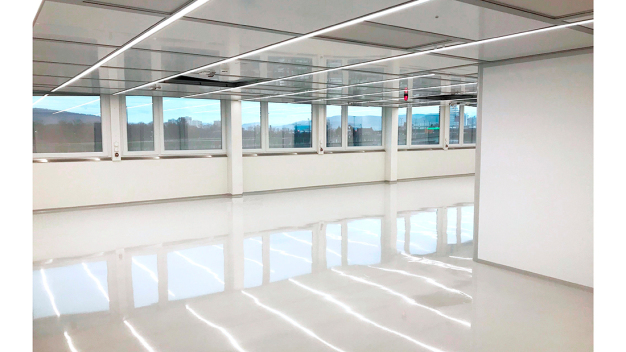
The cleanroom just before completion. The windows of the existing building were sealed and integrated into the cleanroom to save space.
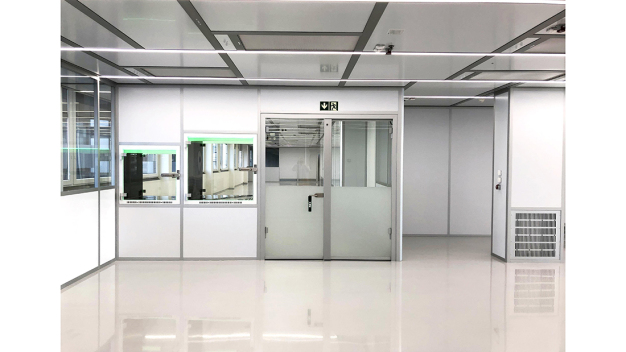
The implants are safely transported from the cleanroom zone ISO 7 to the cleanroom zone ISO 8 via multiple color-coded material sluices.
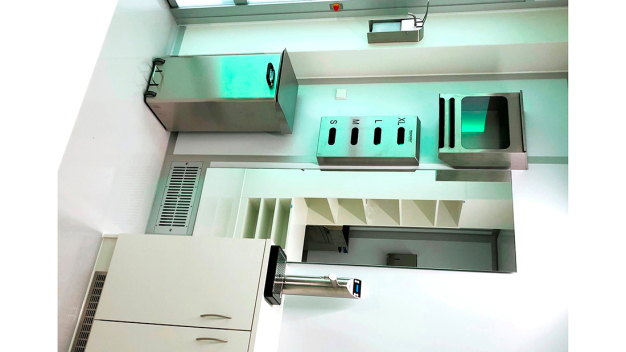
Lock gate facilities made of stainless steel with water dispenser.
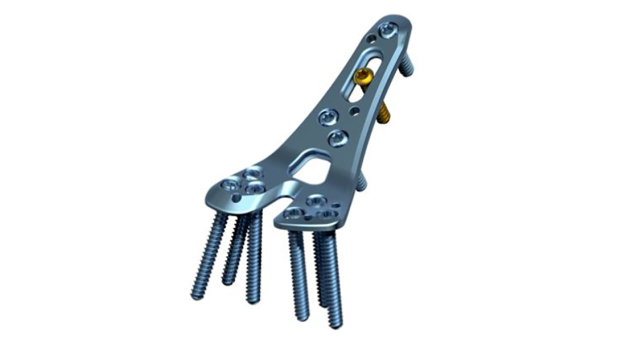
Titan implant with movable screws for surgical procedures in wrist fractures.
Medartis AG specializes in high-precision implant systems for bone fractures and deformities. The Swiss company has now invested in a 600 sqm cleanroom built to the latest standards to ensure safety standards for medical devices.
Medical products for osteosynthesis
In osteosynthesis surgeries, parts of a broken or injured bone are repositioned and stabilized. The Swiss company Medartis is among the world’s leading firms supplying implants for these surgical procedures. The high-tech company develops, in close collaboration with surgeons and universities, technologies for titanium implants that are unique on the global market in this form. The titanium screws and plates are tailored to individual anatomical requirements, feature rounded and smooth surfaces, and can be optimally positioned during surgery thanks to a swiveling screw mechanism. Medartis aims to improve treatment options for surgeons and enhance healing and quality of life for patients through highly precise manufacturing quality. With this approach, the Swiss specialists are very successful, employing around 600 staff worldwide with an annual growth rate of over 10%.
Andy Schwammberger, as Head of Packaging and Labeling, is one of the specialists in the team of the ambitious Swiss company. Like many of his colleagues, he is enthusiastic about the high-tech products: “Our anatomically precisely adapted titanium plates and screws are used in surgical procedures to fix bones. Especially in hand and foot fractures, the freely swiveling and fine-tunable positioning of the screws facilitates patient mobility and regeneration. It’s very rewarding to receive positive feedback and to know that we are restoring a piece of quality of life to people.”
Packaging and labeling in modern cleanroom systems
In the production process of these sensitive products, Andy Schwammberger is responsible for final packaging. The implants are sealed and labeled in cleanrooms to ensure error-free and, above all, safe delivery to hospitals and doctors at all times. Because a product that is directly implanted into the body must meet all hygienic standards without exception. Not only do the legal requirements of the new EU Medical Device Regulation (MDR) mandate this, but it is also an inherent quality standard adopted by the Swiss company for the benefit of patients. Only packaging under controlled cleanroom conditions can guarantee that the titanium implants leave the factory free of any contamination by germs or disturbing particles. Due to growth, a new 600 sqm cleanroom, CleanMediCell®, has now been invested in at the Basel site, meeting the requirements of ISO 7 cleanroom class according to DIN EN ISO 14644-1. The choice of cleanroom provider fell on the Baden-Württemberg-based company SCHILLING ENGINEERING, which has its headquarters near the Swiss border and operates a subsidiary in Swiss territory. But as Andy Schwammberger recalls, proximity was not the only decisive factor:
“We compared several offers for the cleanroom and were very impressed by the quality and especially the modular, flexible construction of the CleanMediCell® system. The location posed some spatial challenges, as the new cleanroom had to be built around the existing staircase. Different ceiling heights also had to be considered. The engineers from Schilling developed very precisely tailored and functional concepts for us. The system’s alignment with the requirements of medical technology also convinced us.”
To make optimal use of the limited space, an existing exterior wall with a window façade was integrated into a cleanroom zone of class ISO 8. The windows were specially sealed and screwed to achieve the necessary airtightness. Existing cable ducts were also smoothed and made easy to clean on the supporting columns between the windows. The existing building was thus utilized extremely space-efficiently.
Washers integrated into the cleanroom walls
The titanium implants are manufactured outside the cleanroom and introduced via two material sluices, one equipped with roller shutters. The transfer of materials between the cleanrooms occurs through two washing stations and 1m³ large material pass-throughs. The condition of the sluices is visually monitored via intelligent LED light indicators in the glass. The medical plates and screws are delivered contamination-free into the cleanroom. There, they are individually packaged in a cleanroom zone of class ISO 7 and later labeled in a zone of class ISO 8 before being safely passed out of the cleanroom via material sluices and leaving the facility. Three personnel sluices ensure functional and safe entry of staff into the different cleanroom zones. At Medartis’s request, cleanroom-compatible water dispensers were integrated into two sluices so that staff do not have to fully exit the cleanroom to refill their drinks.
In the cleanroom system, 78 filter fan units with ULPA15 high-performance filters have been installed, providing over 60 air changes per hour to ensure the supply of pure air to the clean areas and workstations. The CleanMediCell® modular cleanroom system can be flexibly expanded and reconfigured thanks to a silicone-free GMP sealing clip system.
Energy-efficient recirculation process
The entire cleanroom system is regulated for temperature and humidity. To reduce the high energy costs associated with operating a cleanroom, the system from SCHILLING ENGINEERING uses a particularly energy-efficient recirculation process, where already cooled air is circulated multiple times. An individually controlled decentralized cooling system is employed, which supplies cooling selectively to areas where increased heat is generated. GMP-compliant LED light strips provide pleasant and energy-saving lighting. The Head of Packaging and Labeling is very satisfied with the benefits brought by the installation of the modern cleanroom system:
“Thanks to the new cleanroom, we can now perform the washing processes ourselves that we previously outsourced. This allows for much more flexible and faster processing of individual orders. We are very satisfied with the workflows and the function of the cleanroom system. With the washing stations, sluice systems, precise climate control, and necessary monitoring, the cleanroom system is quite a complex setup that must be perfectly coordinated. We were glad for the support and expert guidance from the specialists who accompanied us through the entire process up to qualification.”
GMP monitoring
A special feature of the cleanroom system is the integrated GMP-compliant monitoring. Medartis decided on this extra level of safety, which not only meets the EN ISO 14644-1 standards but also the stricter pharmaceutical GMP guidelines. Temperature, humidity, and air pressure are continuously monitored and recorded for the necessary documentation. The control system for the cleanroom and climate technology is the user-friendly CR Control®, which regulates and monitors all setpoints, including climate control, and is operated via a central touch display. The control system is connected to an app, allowing responsible personnel to check the system’s status at any time via smartphone. The qualifications were also carried out according to GMP standards and meet all specified requirements.

Schilling Engineering GmbH
Industriestraße 26
79793 Wutöschingen
Germany
Phone: +49 7746 927890
email: info@schillingengineering.de
Internet: http://www.schillingengineering.de