
- 3D printing
- Translated with AI
1-to-1 produces ultra-lightweight support frames for autonomous flying objects using FDR technology by Festo
3D printing specialist produces precise, ultralight, and stable 3D-printed components in series quality
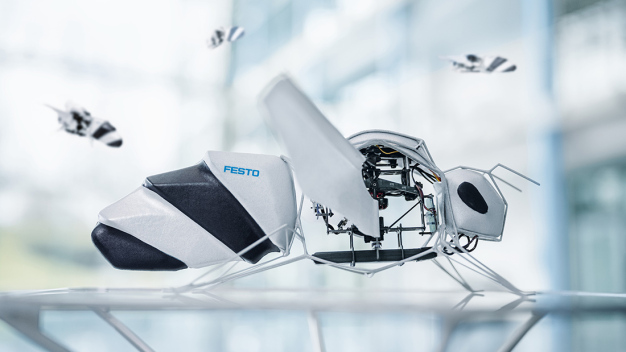
The BionicBee from Festo makes the dream of autonomous flying come true. The flying object weighs – not least thanks to 3D-printed components from 1zu1 – only 34 grams. (Photo: © Festo SE & Co. KG, all rights reserved)
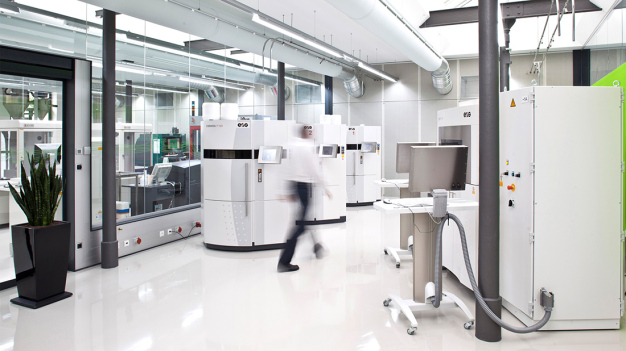
1-to-1 produces highly precise plastic components with powerful 3D printing systems – from high-end prototypes to series products. (Photo: Darko Todorovic)
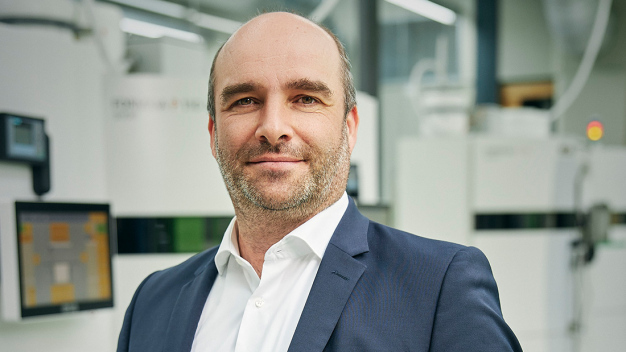
Thomas Kohler is CEO of 1zu1. (Photo: Darko Todorovic)
With the 3D printing technology Fine Detail Resolution (FDR), 1zu1 produces fully functional plastic parts with a detail resolution of 0.05 millimeters. The Dornbirn-based high-tech company harnesses the full potential of this innovative manufacturing process, creating not only complex miniature parts such as connectors, sieves, or filters but also larger components. For the "BionicBee" by automation specialist Festo, 1zu1 created a 20-centimeter-long, lightweight, flexible, and stable frame. The basic structure of the autonomous flying object weighs only 3 grams – as much as a sugar cube.
1zu1 manufactures practical plastic parts with delicate structures and strong mechanical properties using high-resolution Laser Sintering technology FDR. The combination of geometric freedom and tool-free production with lightweight, stability, and flexibility is especially economically attractive for millimeter-sized components in small series. Additional benefits come from customization. "FDR is the perfect solution for electronic connectors, filters, sieves, and complex geometries in manageable batch sizes, as well as for personalized medical technology products," emphasizes Thomas Kohler, CEO of 1zu1.
1zu1 is now applying this innovative process to larger components. For the BionicBee by automation specialist Festo, the company created a frame approximately 20 centimeters long and 9 centimeters high and wide. With the BionicBee, Festo mimics the swarm behavior of bees and draws conclusions for automation technology from the "Bionic-Learning" project. Thanks to lightweight construction, generative design, and 3D printing, the artificial bee weighs only 34 grams overall. Just 3 grams of that are the support frame produced by 1zu1 with FDR – the weight of a sugar cube.
Feather-light, flexible, and stable
Every gram counts in the air: The design leverages the freedom of additive manufacturing and the advantages of FDR technology. Using the material Polyamide 11 (PA1101), thinner yet load-bearing structures are possible. 0.9-millimeter-thin struts ensure an ultralight support structure. "The results are visually equivalent to highly detailed stereolithography but significantly more robust. The feather-light and flexible parts withstand takeoff and landing without issues," explains Mattias-Manuel Speckle, Head of Additive Manufacturing Prototyping at Festo.
The family-owned company from Esslingen am Neckar has been relying on collaboration with the Dornbirn-based 3D printing specialist for years. "Innovations only succeed with reliable partners. At 1zu1, high quality, punctuality, and clear communication go hand in hand," reports Speckle. In addition to FDR technology, 1zu1 has been offering another additive process for the production of sterilizable and flame-retardant series parts since fall 2024: Cubicure's Hot Lithography. The range is rounded out by three high-performance SLS machines P500 from EOS, chemical smoothing systems, automated blasting systems, and fast injection molding with aluminum tools. "Whether high-end prototype or series product: we are a reliable partner for the production of 1 to 1,000,000 high-quality plastic components," says Thomas Kohler.
1zu1scale GmbH
6850 Dornbirn
Austria