

- Furniture
- Translated with AI
Work environments under the highest demands: How design supports people in cleanrooms
Cleanrooms are among the most demanding work environments of all. Controlled conditions, sensitive processes, and high requirements for materials and equipment define daily work. At the same time, humans remain a central part of many processes. For designing workplaces, this means: technical requirements, ergonomics, and design must be considered as a complete system. How this approach is reflected in product development is demonstrated by the long-standing collaboration between Bimos and the design studio PHOENIX.
Whether semiconductor manufacturing, microelectronics, medical technology, or other high-tech fields: even the smallest influences in a cleanroom can impact sensitive processes and products. Accordingly, the requirements for all components of the work environment are very high.
But despite all the technology, one factor must not be overlooked: the human. Employees must be able to work focused, precisely, and as ergonomically as possible even under controlled conditions. Therefore, designing a cleanroom workstation always involves balancing process safety with human needs.
Design starts with the work environment
Good product design for the cleanroom does not start with the external shape. Instead, initial questions concern the specific application: How do employees move during their tasks? What working positions do they adopt? What requirements exist regarding particle emission, cleaning, or electrostatic discharge? And which materials are suitable for the respective controlled environment?
Especially a work chair is in immediate proximity to the person and the work process. Every movement of the user also affects the chair. Surfaces, padding, mechanics, and structural details must therefore be adapted to the special conditions of the work environment.
Design thus becomes the interface between human, product, and process.
When industrial workplaces become high-tech environments
The requirements for workplaces have changed significantly over the past decades. Technological developments, automation, and increasingly sensitive production processes have created new work environments.
This development can also be traced through the long-term collaboration between Bimos and PHOENIX. When the development of NEON began in 2008, ergonomics and individuality at industrial workplaces increasingly came into focus. NEON resulted in a work chair that combined functional requirements with ergonomics and a distinctive design language.
More than a decade later, the development of TEXON again raised the question of what people need at the high-tech workplaces of a new generation.
It was not about simply further developing an existing solution. Design, engineering, mechanics, and technology were considered together from the start—with the goal of integrating the diverse requirements of specialized work environments into a cohesive concept.
Every detail in the cleanroom is functional
What might initially appear as a design decision in other work environments takes on an additional functional significance in the cleanroom.
Surfaces and transitions should be designed for easy cleaning. Materials must be compatible with the intended application. Even structural areas that are hardly noticed in normal work environments can become relevant under controlled conditions.
At the same time, suitability for the cleanroom is not determined by a single product feature. The interplay of various factors is crucial—from construction and material selection to suitability for the required cleanroom class. In areas with electrostatically sensitive components, additional requirements for ESD protection are added.
For product design, this means: design and technical function cannot be separated.
Ergonomics remains crucial even under controlled conditions
The technical requirements of a cleanroom do not change the fundamental needs of humans. Employees may sit for extended periods, perform precise tasks, or work in concentrated postures.
Especially with fine motor tasks, forward-leaning or relatively static working positions can develop. Therefore, a suitable work chair should allow freedom of movement and support the body according to the activity.
Intuitive operability also plays a role. The easier seat height, back support, or other ergonomic functions can be adjusted for different persons and tasks, the better the chair can integrate into existing workflows.
Ergonomics and process requirements are not opposites. The challenge is rather to combine both.
High-tech must work for humans
Cleanrooms exemplify a work environment where technology and human labor are closely intertwined. Systems and controlled processes create highly precise conditions. At the same time, it is often people who monitor, inspect, assemble, or perform other sensitive tasks.
This also influences the design of work tools. High-tech products do not need to appear complicated or technologically distant. Clear design language and intuitive functions can help integrate complex technical requirements into daily work as seamlessly as possible.
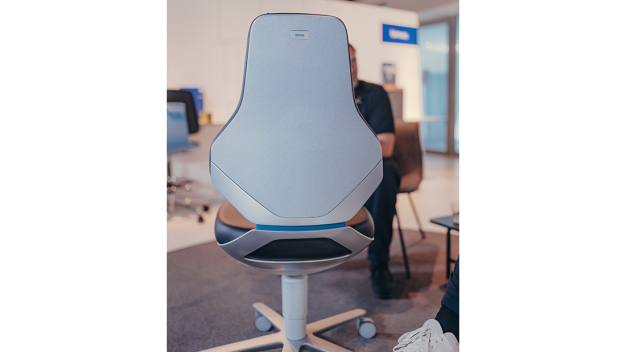
TEXON exemplifies this design philosophy. The product family was developed for various specialized work areas and applies a common design approach to different requirements—from production and laboratories to ESD and cleanroom applications.
Material and construction become part of the design
In the cleanroom, it becomes particularly clear that material development and construction are essential parts of product design.
Materials must be selected according to their application and be compatible with cleaning and controlled environments. At the same time, they should provide appropriate comfort where humans come into direct contact with the product.
Constructive solutions also gain importance. Enclosed and easily accessible surfaces can facilitate cleaning and help reduce areas where contaminants could accumulate.
This way, good design is not created solely on the drawing board. It develops from the interplay of design, engineering, material expertise, ergonomics, and the technical requirements of the environment.
Design means considering the entire lifecycle
Long-term use is also part of a modern design philosophy. Especially specialized workplace equipment is an investment meant to function reliably for many years.
Questions about durability, component interchangeability, cleaning, and adaptability are already relevant during development. At the same time, products must continue to meet the requirements of their application over the long term.
Design thus becomes an attitude that considers not only the form of a product but its entire use in daily work life.
The future cleanroom remains a workplace for humans
Automation, robotics, and increasingly precise technologies will continue to change controlled production environments. Some tasks will be automated, others will evolve or be newly created.
However, a fundamental challenge remains: where humans are part of sensitive processes, the work environment must consider both technical requirements and human needs.
For Bimos and PHOENIX, product development therefore means not viewing technology, construction, materials, ergonomics, and design in isolation. Only through their interaction can a solution be created that can be meaningfully integrated into a demanding work environment.
Because the more complex and technological the work environment becomes, the more important a simple question is: How can it be designed so that it functions for both the process and the human?
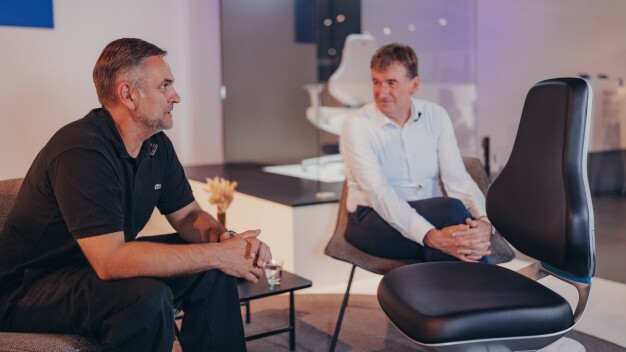
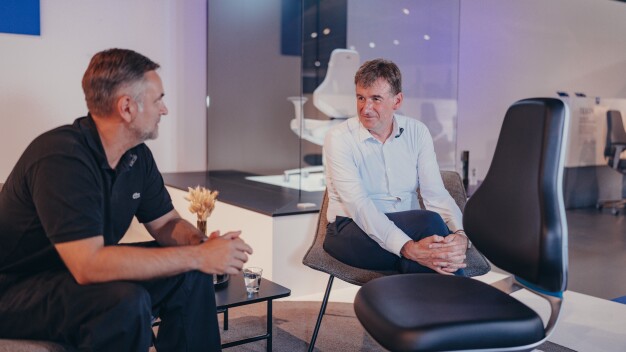
Helmut Link, Managing Director of Interstuhl Büromöbel GmbH & Co. KG (to which Bimos belongs as a brand), and Andreas Diefenbach, designer and managing partner at PHOENIX, discuss how this shared design philosophy has developed and what ideas are behind NEON and TEXON in a joint interview.
The full interview is available on the Bimos YouTube channel.
https://www.youtube.com/watch?v=-0oyljIpA2U

Bimos - eine Marke der Interstuhl Büromöbel GmbH & Co. KG
Brühlstraße 21
72469 Meßstetten-Tieringen
Germany
Phone: +49 7436 8710
Fax: +49 7436 871110
email: bimos@bimos.com
Internet: http://www.bimos.com