



- Buildings & Rooms
- Translated with AI
Kathrin Kutter
The process is at the center – also when selecting the cleanroom floor.
nora systems
Cleanroom Suitable Materials
Table
For product quality as well as the success of research work, contamination control in cleanliness-critical areas is crucial. Areas of application, processes, and products must be considered in the individual design of the cleanroom, thereby influencing the selection of production equipment and materials used.
From the planning stage of the cleanroom, materials should be selected with as low a contamination potential as possible. The production process should be at the center of planning, and the requirements for floor coverings and systems should be defined process-specifically.1
Initial guidelines for selecting suitable materials for cleanrooms are provided by the internationally recognized standards ISO 14644 and the GMP guideline. Surfaces such as floor coverings must, according to ISO 14644-4, exhibit low particle emission behavior and a pore-free surface. They must be slip-resistant and resistant to static and dynamic stresses as well as to the process media, cleaning, and disinfectants used. Furthermore, they should possess appropriate electrostatic properties.2 The GMP guideline supplements the requirement profile with a smooth surface free of cracks and open joints, which can be easily cleaned and disinfected if necessary.3
This property profile can only serve as a guideline. The distinction between suitability for cleanrooms and purity of materials, as shown in VDI 2083 Sheet 17, considers additional relevant criteria.
Suitability for Cleanrooms and Purity of Materials
Cleanroom suitability considers exclusively the particulate contamination of materials and substances. This is not sufficient for life science industries' cleanrooms. Additional criteria must be considered there. This is where the concept of purity suitability begins. It focuses on the manufacturing process and also considers molecular contamination, cleanability, chemical resistance, and metabolizability of cleanroom-compatible materials.
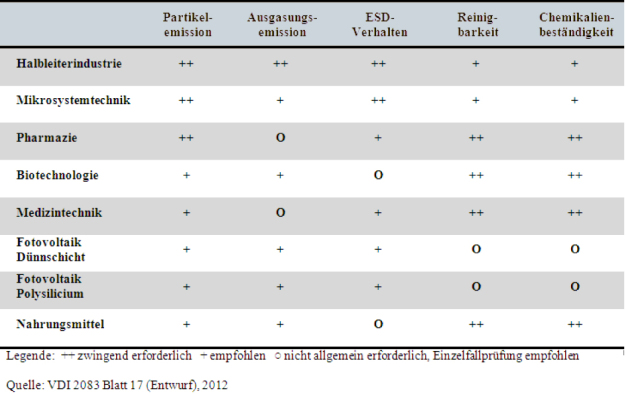
The definition of relevant criteria is made individually, taking into account the specific manufacturing process and product. The requirement catalog created in this way should be considered already during the planning of the cleanroom. Depending on the industry, different priorities are set regarding critical types of contamination:
Process-specific Floor Selection
For selecting the floor covering, it means comparing different types of floors to determine the best solution. This is generally challenging because a wide variety of floor coverings and systems made from different materials with various technical properties are available.
It goes without saying that the wall connection of the floor in the life sciences industries must be executed in a way that ensures perfect cleanability, for example with coving. Open joints should also be avoided, as they pose a hygiene risk. The range of floor systems that meet these requirements varies significantly from one another.
Coating-free Surfaces
An important criterion is the nature of the surface of the floor. Additional surface coatings, sealants, or varnishes are generally considered critical because they represent weak points. Under tribological stresses (e.g., rolling transport containers, staff traffic), they usually detach from the substrate and cause airborne particulate contamination.
Partially dissolved or damaged coatings also pose the risk of microbial colonies forming in hard-to-reach areas, which cannot be adequately disinfected or cleaned. Nora rubber flooring does not require a coating. Due to the manufacturing process, they have an extremely dense surface that is highly abrasion-resistant and offers a permanently high hygiene standard. Thorough disinfection is possible, as well as cleaning without residues.
Another safety risk comes from cracks in the surface. Even hairline cracks can accumulate biological contamination that cannot be adequately removed. Sometimes, these cracks are not caused by surface damage but result from movements in the subfloor. Unlike rigid, fixed coatings, permanently elastic rubber floors can compensate for these movements to a certain extent.
ESD Protection for the Most Sensitive Products
In the semiconductor industry and microtechnology, ESD protection is of great importance. When on-site mixed floor coatings are used, conductive additives are incorporated during the processing of the mixture. The long-term reliable functionality of the floor system then depends heavily on the craftsmanship skills of the installer. In other floor coverings, conductive additives are physically or chemically integrated into the material during the manufacturing process. They are evenly distributed throughout the floor covering and remain effective permanently. Surface sealants or coatings of any kind applied afterwards should be avoided, as they have a decisive impact on the system's functionality. Extended warranties on electrostatic properties, such as those issued for coating-free Nora rubber floors by nora systems GmbH, provide decision-makers with sustained functional security.
Walking and Standing Comfort for Employees
The ergonomic properties of the floor covering should not be neglected. Employees in cleanrooms often stand all day. A permanently elastic rubber floor contributes to increased walking and standing comfort. It relieves the body and results in less fatigue and pain compared to harder surfaces. This positively affects concentration and performance.
Uniform Testing Procedures Enable Comparability
The material properties mentioned above are examples of the criteria to be evaluated. Considering also the installation on screed, double or raised floors, the load-bearing capacity, and repair options, further increases the complexity of the selection process.
Until a few years ago, it was only possible to compare floor systems regarding their general suitability for industrial sectors based on the technical data provided by manufacturers. Selecting based on their suitability for cleanrooms was extremely difficult due to the lack of standardized testing procedures for determining cleanroom and purity suitability.
Within the framework of the CSM industry network, the Fraunhofer Institute for Production Technology and Automation, together with industry representatives, developed testing methods and evaluation schemes that allow materials to be compared with each other.
Under standardized testing conditions, materials are examined for their particle emission behavior, emissions of molecular contamination, resistance to biological contamination, and chemical resistance.
Surfaces such as floor coverings are tested under identical conditions, and their results are documented uniformly. This facilitates the comparability of the offered systems for decision-makers and, together with the previously mentioned properties, provides functional safety on site — important factors, as subsequent corrections are time-consuming and costly.
Technical literature:
[1] Dr.-Ing. Dipl.-Phys. Udo Gommel, Dipl.-Ing. (FH) Frank Bürger: VDI Society Building and Building Services Engineering: Cleanroom Technology: 14th VDI Conference, Nürtingen, October 26-27, 2011, Düsseldorf: VDI Publishing, 2011 (VDI Reports 2125)
[2] DIN EN ISO 14644-4:2003-06
[3] EC-GMP Guideline (Good Manufacturing Practice Guideline) Part 1: 2006

nora systems GmbH
Höhnerweg 2-4
69469 Weinheim
Germany
Phone: +49 6201 2743934
Mobile radio: +49 172 6330484
email: frank.baehr@nora.com
Internet: http://www.nora.com



