


- Knowledge & Events
- Translated with AI
Prof. Dr. Markus Lehmann, Prodekan der Fakultät Life Sciences; Stefanie Iftode, Dekanatsreferentin
The cleanroom and the Albstadt-Sigmaringen University of Applied Sciences
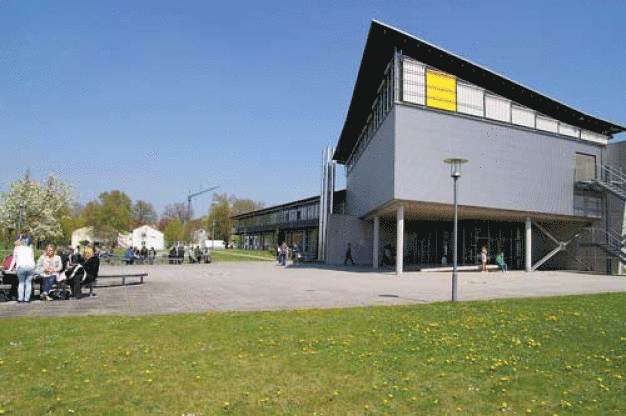
Campus Sigmaringen
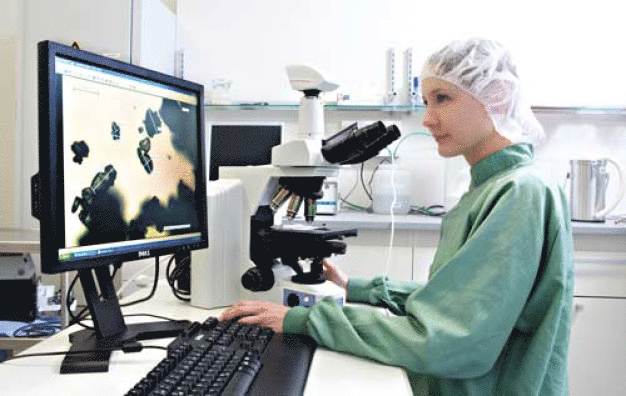
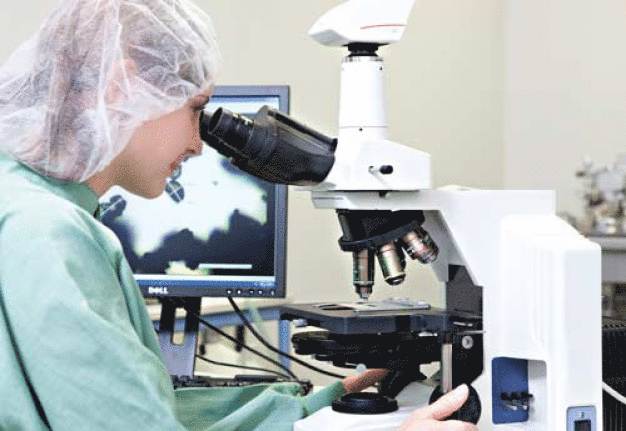
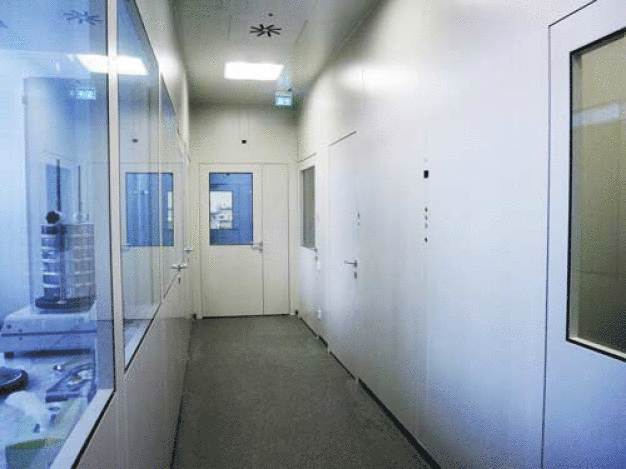
Pharmatechnikum
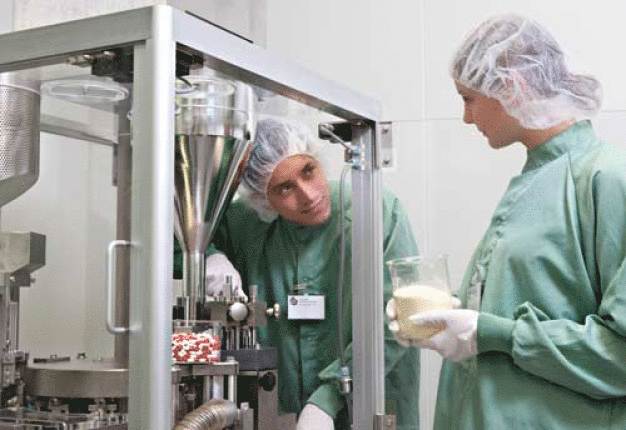
Tablet manufacturing in the cleanroom
The cleanroom is a central subject of teaching and research in the Faculty of Life Sciences at Hochschule Albstadt-Sigmaringen. This article demonstrates how the topic of cleanrooms is addressed in practical-oriented teaching and applied research. It particularly highlights the close cooperation with the relevant industry. The university as a whole, the Faculty of Life Sciences, and its study programs are briefly characterized first.
The university and the Faculty of Life Sciences with their study programs
Modern laboratories, close contacts with companies, active exchange between students and professors—these are the hallmarks of Hochschule Albstadt-Sigmaringen. The university of applied sciences places particular emphasis on practical and service orientation. At the two campuses, with a total of 90 professors and 180 staff members, approximately 3,500 students are trained in 22 study programs (11 bachelor's and 11 master's programs) with modern technical equipment and personalized support, leading to professional qualifications.
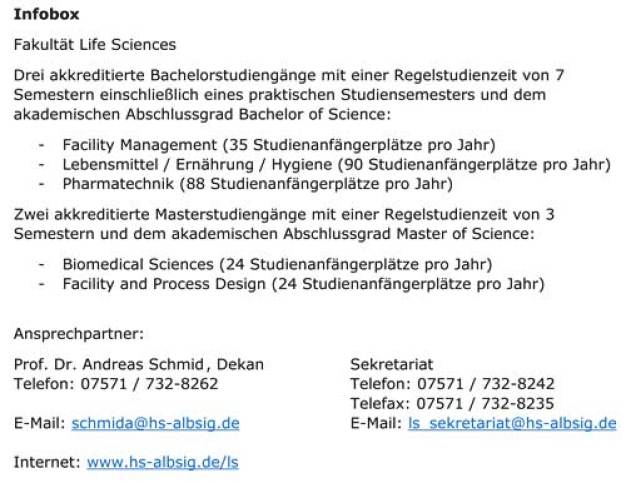
The Faculty of Life Sciences is one of four faculties at the university and offers three bachelor’s and two master’s programs, providing suitable preparation for entering the workforce in various sectors of the economy, especially in the life sciences industry.
Students in the bachelor’s program Facility Management are trained as interdisciplinary, technically-economic generalists. They learn to optimize the economic efficiency and value preservation of buildings and technical systems throughout their lifecycle and to ensure smooth and energy-efficient operations. As facility managers, graduates have a broad range of career opportunities—from operational facility management overseeing large facilities to strategic roles as project developers or consultants.
In the bachelor’s program Food / Nutrition / Hygiene, students are trained to develop, produce, and market food and dishes considering nutritional, ecological, technological, hygienic, legal, and economic aspects. Additionally, students delve deeper into questions of cleaning and hygiene requirements in companies. Typical fields of work include product development and quality management in the food industry, planning and operation of large kitchens, and the cleaning and hygiene services sector.
The third bachelor’s program, Pharmaceutical Technology, deals with plant design, operational technology, and process workflows in the pharmaceutical industry. Bio-engineering is another focus area, with modules on micro- and molecular biology, clinical drug research and diagnostics, as well as qualification and validation. This enables students to undertake responsible roles in industry, such as in production management, process development and optimization, and quality management.
Graduates of the presented bachelor’s programs, as well as graduates from other universities, can deepen their knowledge in two consecutive master’s programs (each three semesters).
The research-oriented Master’s program Biomedical Sciences addresses interdisciplinary questions at the interface of biology, medicine, and technology. Examples include medical biotechnology and management systems in biomedical research. The fields of activity range from product management to industrial research and basic university research.
The more application-oriented Master’s program Facility and Process Design imparts the necessary knowledge for planning and managing industrial facilities, especially in the life sciences industry. Master’s graduates undertake conceptual and leadership roles in a wide range of companies as well as in planning and consulting firms. These include site analysis, factory planning, logistics and production process optimization, as well as product and process innovation.
The cleanroom in practical teaching and applied research
The topic of cleanrooms is particularly significant in the study programs Food / Nutrition / Hygiene, Pharmaceutical Technology, and Facility and Process Design. About ten professors teach and research with different specializations in this field. The university’s laboratories are equipped with class C cleanrooms, including a negative pressure safety cabinet. Young academics have the opportunity to familiarize themselves with the entire spectrum of cleanroom technology. The specific teaching and research topics related to cleanrooms can mainly be assigned to the three areas of operational planning, production, and quality assurance.
Practical teaching
Modules on the fundamentals, functions, and application areas of cleanroom technology, contamination types, cleanroom classes, as well as media, supply, and installation technology form the basis for developing cleanroom concepts and for industrial planning of efficient and energy-optimized cleanrooms.
Lectures and laboratory practicals on pharmaceutical production in cleanrooms, aseptic process design and filling, air filtration, water quality, and pure media, as well as economic and legal requirements, and qualification and validation measures in hygienic food and pharmaceutical production are other important components of academic training.
Quality assurance particularly includes hygiene in cleanrooms, sluice concepts, particle measurement, material and personnel flows, occupational safety, standards and legal regulations, and proper cleaning of cleanrooms.
Applied research
Applied research begins in the fifth semester of bachelor’s programs, with the integrated practical semester, and continues in the bachelor’s thesis and, if applicable, in the master’s thesis. Both internships and final theses are conducted independently on current issues in relevant companies, often in project form. While the bachelor’s thesis is limited to three to four months, the master’s thesis allows for a period of six months.
Considering the scientifically demanding topics of the often publicly inaccessible work, it becomes clear that the field of cleanroom technology offers many attractive tasks.
In the area of operational planning, work can be found on topics such as:
- Concept study for a vaccine production facility based on a standardized cleanroom system design
- Development of a rough layout for a cleanroom facility for hormone production
- Planning of a new construction of a mixing and milling center, considering GMP requirements
- Setup and commissioning of a cleanroom operation for vial packaging, adhering to GMP guidelines
Similarly, the topics in the area of production within cleanrooms are quite diverse:
- Process planning for a Chinese pharmaceutical manufacturing plant with cleanroom modules
- Development of a logistics concept for material preparation and post-processing during capacity expansion of a pharmaceutical production plant
- Re-development of a sterilization process for a freeze-drying system using vaporized H2O2
- Microbiological investigations in cleanrooms for packaging meat products and re-conception of the rooms
Quality assurance also offers numerous challenging tasks:
- Room air supply and room hygiene in cleanroom installations
- Optimization and implementation of a cleanroom cleaning concept, exemplified by two model projects
- Development of a procedure for on-site calibration of particle counters
- Optimization of a test stand for standardized, quantitative determination of the barrier effect of cleanroom textiles
Further research projects can emerge from the exemplary theses presented. Implementation is possible in companies or in laboratories of the university.
Intensive cooperation with industry
The visible expression of the close ongoing relationship with industry is the VIP 3000 Award, initiated by the Association of Pharmaceutical Construction Interest Group 3000 e.V. (VIP 3000) and Hochschule Albstadt-Sigmaringen. Outstanding project work by student teams is awarded after evaluation by a panel of experts. In mid-January 2016, this year’s prize was awarded to Sigmaringen students Martin Faigle, Markus Haas, Simon Lewald, and Milan Rauschecker for their project “Planning a production site for filling biopharmaceutical products in vials for clinical trials.”
Due to the close cooperation with industry through academic competitions like the VIP 3000 Award, practical semesters and theses, excursions, trade shows, and conferences, participation in professional committees, as well as teaching assignments and guest lectures, education remains at the cutting edge.
The smooth transition of graduates as Bachelor or Master of Science into attractive careers is a positive consequence. Industry companies, service providers, and engineering and planning offices offer graduates of Sigmaringen’s life sciences programs challenging technical and leadership positions.
It is in the interest of both industry and the university to continue this successful path together.

Hochschule Albstadt-Sigmaringen
Fakultät Life Sciences
Anton-Günther-Str. 51
72488 Sigmaringen
Germany
Phone: +49 7571 7328242
Fax: +49 7571 7328235
email: schmida@hs-albsig.de
Internet: http://www.hs-albsig.de/Seiten/homepage.aspx