

- Science
- Translated with AI
Student team from TU Kaiserslautern scores in international competition on systems biology
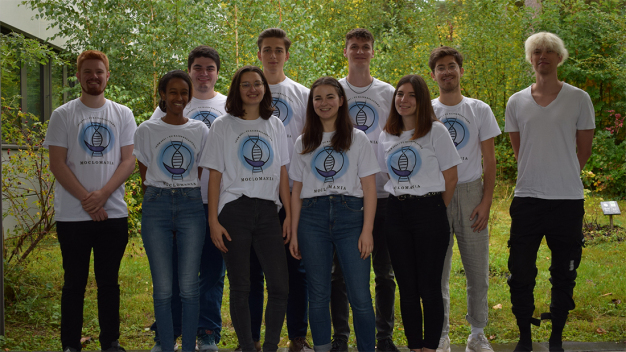
The iGEM team of TU Kaiserslautern (Photo: Justus Niemeyer)
A student team from the Technical University of Kaiserslautern (TUK) convinced the jury with their method at the international iGEM competition (International Genetically Engineered Machine): They received a gold medal and were nominated in the "Foundational Advance" category for the best project. The team adapted a genetic modular system for the microorganism Leishmania tarentolae, which allows it to produce human-like proteins. This technology is particularly interesting for the production of medicines and vaccines. The competition focuses on projects from synthetic biology and is aimed at young scientists.
In the final of the competition, which took place online from November 4 to 14, the Kaiserslautern team presented their project "MoClo Mania" to the international competition. Over the past few months, the students at TUK have been working on a method to make the production of human-like proteins more efficient. The demand for such proteins has increased significantly in recent years. These are particularly relevant for the development of medicines and vaccines.
The Kaiserslautern team relies on a modular system in their method, where genetic "building blocks" can be assembled similarly to Lego bricks to synthesize the desired protein in a microorganism. The organism used here is Leishmania tarentolae, for which the team has adapted the modular system. It is of interest for research because glycosylation, a biochemical reaction that plays an important role in protein production among other processes, closely resembles the processes in humans.
The iGEM team from TUK consists of ten members, all of whom are undergraduate students. The competition required a lot of time. Not only does the project in the lab need to be completed, but also a number of other tasks must be done in advance. These include convincing sponsors of their idea, managing finances, and documenting all expenses. They have to finance their work themselves and rely on financial and material donations. The team also engaged in extensive public relations work, for example, to contribute to public understanding of genetic engineering.
Overall, more than 370 teams from around the world participated in the competition this year.
The students received strong support from Professor Michael Schroda, Junior Professor Felix Willmund, Professor Nicole Frankenberg-Dinkel, and Dr. Gerhard Erkel from the Department of Biology, as well as Professor Marcel Deponte from the Department of Chemistry.
The research work of the iGEM teams does not end with the competition, but some members of the Kaiserslautern team will continue to work on the topic as part of their bachelor theses. For example, just before the end of the competition, the students succeeded in producing the so-called receptor-binding domain of the SARS-CoV-2 virus. This protein binds to human receptors during infection with the SARS-CoV-2 virus and is therefore of interest for protein-based vaccines.
Questions answered by:
iGEM TU Kaiserslautern 2021
Phone: +49 (0)17682917488
Email: igem@bio.uni-kl.de
www.uni-kl.de/hochschulgruppen/iGEM/
Technische Universität Kaiserslautern
67663 Kaiserslautern
Germany