




- Translated with AI
SmartGAS supports Mars expedition
Sensors monitor project for obtaining oxygen as fuel and for respiration
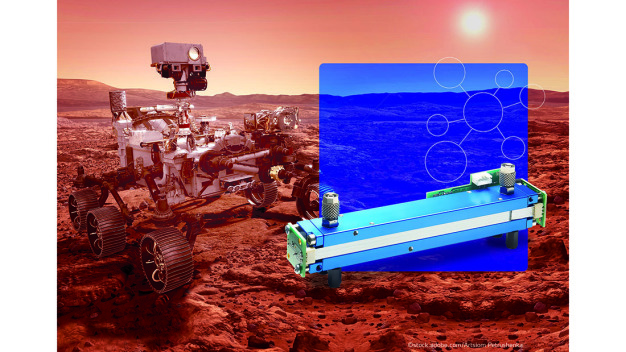
Sensors from smartGAS continuously monitor the functionality of the MOXIE module.
In the Mars mission 2020, researchers aim, among other things, to test whether oxygen (O2) can be produced from the planet's extremely CO2-rich atmosphere for respiration and as fuel for spacecraft and rockets. A special module onboard the Mars rover "Perseverance" is designed to split oxygen from the CO2 compounds in the Martian atmosphere, which can then be used as fuel. CO and CO2 sensors from the smartGAS Flow EVO series enable scientists to continuously monitor gas concentrations in a dedicated experimental module.
The contact with the Mars mission was established through the Jet Propulsion Laboratory (JPL), which develops the propulsion technology for the spacecraft and rover and works closely with the Massachusetts Institute of Technology (MIT). "Around 70 CO and CO2 sensors were requested from us for the project," reports Volker Huelsekopf from smartGAS. "Most of them were used in tests on the module prior to the mission, while others will directly monitor the module's function on Mars." The sensors from smartGAS measure the CO and CO2 levels inside the module and thus control the process of O2 extraction. Ground personnel can then determine from the gas concentrations whether the process is proceeding as planned.
For the tight space of the rover, engineers from MIT developed a compact so-called MOXIE module (Mars Oxygen In-Situ Resource Utilization Experiment) about the size of a car battery. It separates oxygen atoms from the CO2 compounds in the Martian atmosphere. If the tests are successful, a similarly sized module, about a hundred times larger, will produce oxygen on Mars. This oxygen will then serve to supply future missions and as fuel for spacecraft.
The project is fundamentally important for the realization of manned Mars missions, as these are currently unfeasible due to the enormous distance between Earth and Mars. The amount of fuel needed to cover the return trip would be so large that the rocket could not carry it. With oxygen production on Mars, the rocket would only need to be fueled on Earth with a fraction of the fuel required for the return journey, which offers significant technical advantages.
The mission launched on July 30, 2020 (https://mars.nasa.gov/mars2020/). The rover will conduct further experiments on the Martian surface and also collect rock samples. The researchers hope to gain new insights into the geology of the Red Planet.
smartGAS Mikrosensorik GmbH
74080 Heilbronn
Germany



