

- Planning
- Translated with AI
Smart working and the future of the workplace

Flexible space concepts support the new way of working. (Photo: Ecophon, Getty Images/Hero Images/Studio-e.se)

Acoustic measures prevent disturbances caused by office noise. (Photo: Ecophon, Teddy Strandqvist/Studio-e.se)
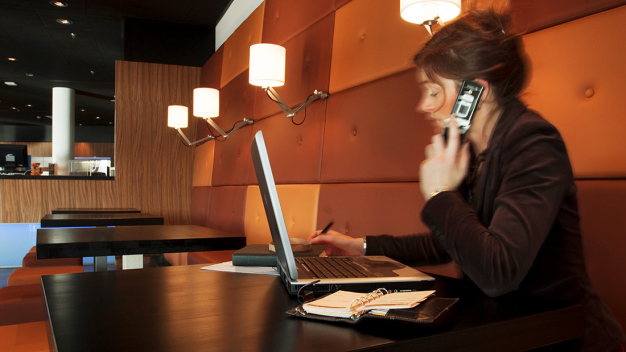
Flexible workplaces - whenever and wherever. Acoustic measures prevent disturbances caused by noise. (Photo: Ecophon, Peter Bliek Photography Nijmegen)

Andy Lake (Photo: Private)
Is the Corona pandemic a death sentence for the office as we know it? Probably not. But it accelerates the trend towards more decentralization and more flexible working, according to British workplace consultant Andy Lake. Additionally, he raises the question: What is the workplace for?
The British workplace consultant Andy Lake published his book "Smart Flexibility" in 2013. Since then, he has worked intensively with large organizations to support them in modernizing working methods and workplaces. He also developed guidelines for "Smart Working" for the UK government and the British standards "PAS 3000: 2015" – "Smart Working Code of Conduct".
"Smart working is about modernizing work practices with new technologies and new types of workplaces. The focus is on using work methods based on trust and oriented towards results."
Do we need shared workplaces?
The rapid development of new technologies and digitization affecting all aspects of society make almost everything possible regarding organization and work practices. Is there therefore a paradigm shift from a focus on the workplace to a process- and practice-oriented discussion that is not tied to specific locations?
"As the current model of the workplace developed in the 20th century, it was of great value to focus on people, resources, documents, etc. But in the digital world, the added value lies in decentralization, moving work to people, and dematerialization, where products become services. In this context, people can work in many different ways. This raises the question of why one should even come to the workplace. These are fundamental questions. A large part of knowledge work can be done anywhere, just as much collaboration can increasingly be virtual. So why do we even need the workplace? There are organizations like WordPress, with revenues in the hundreds of millions of dollars, spread across the world, but they hardly use any physical spaces."
Other spaces besides offices
But Andy Lake does not believe in the demise of the office. Like probably most of us, he is convinced that we still need to come together to some extent. However, he says, the concept of the workplace developed during the industrial age is fading.
"This raises a big question for me: What is the social infrastructure of work anyway? People in the 'office business' tend to focus only on the office. I mean, if many people work from home or in cafes, what about these other spaces? How should they be designed and maintained?"
"I think it’s a major political issue to counter the trend of increasingly smaller apartments. The possibility to work from home is not sufficiently provided in most modern living spaces. For example, if you run a business and want to receive visitors, the appropriate spaces are missing. For multi-family buildings, local work centers within the building could be considered. I believe that co-working spaces emerging in cities are part of this changing infrastructure, but we still have a long way to go. Both policymakers and developers need to catch up."
Corona will be a catalyst
This interview took place at the end of May 2020, when countries around the world were gradually reopening society after the first phase of lockdowns during the COVID-19 pandemic. Twitter had just announced that employees could work from home forever if they wished. Andy Lake believes that the COVID-19 pandemic could be the trigger to push the development of entirely new work practices forward.
"I believe the pandemic has changed people's thinking and attitudes. Traditionally, there has always been a lot of resistance to these developments, justified by the view that personal meetings are necessary, that we need to see facial expressions and gestures. But this is changing right now. People realize that much more is now possible. This gives a big boost to the trend of decentralization. I think Twitter is a very good example of this. It is certainly true that smart organizations were much better prepared to adapt to increasing remote work."
More outdoor workplaces
Currently, the pandemic influences our offices through the necessity of social distancing and lower personnel density. Andy Lake sees this as a transition phase but expects lasting changes as a result of the COVID-19 pandemic.
"Over time, office designs will adapt to much smaller offices that are used more intensively but with fewer employees than before. I believe these changes will be implemented over the next five to ten years."
Good acoustics are one of the keys
According to Andy Lake, acoustic aspects also play a central role in meeting the demands of this new, decentralized, and dematerialized context of smart working.
"Our goal of creating excellent places for smart working and good acoustics is one of the keys to success. Usually, this is neglected in workspace design and is still considered a kind of luxury. I often see workplaces with poor acoustics, which then need to be improved to alleviate problems. But this is changing right now. It’s important to consider that people should be able to control their acoustic environment. The design must evolve towards spaces suitable for various activities with different sensory environments, where people can make decisions that match both the activity and their personal preferences."
"The office is not dead yet – but it is becoming more diverse and opening up its traditional boundaries," summarizes Andy Lake.
Ecophon Deutschland
23556 Lübeck
Germany