


- Translated with AI
Risk solutions are ready
Additive manufacturing of metal components
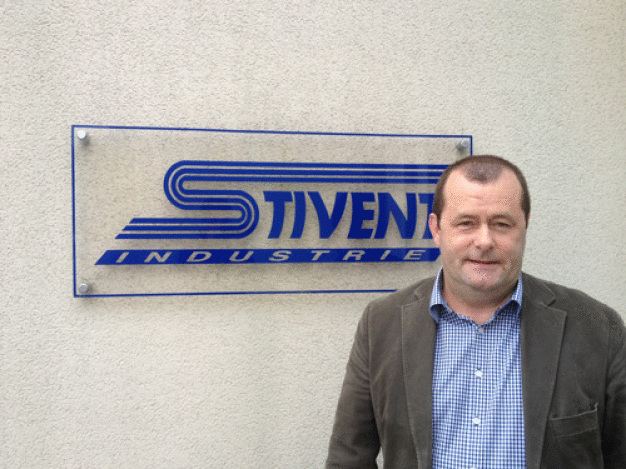
Philippe Becel, Managing Director of the company Stivent
The French company Stivent designs and supplies extraction tables for many industrial processes, especially when it comes to extracting smoke or particulate emissions. Now, this medium-sized company also offers special extraction tables for the 3D printing of metal parts.
For the protection of the operator
Sometimes, one might get the impression that these new devices can be installed anywhere, which is absolutely not the case. A specific room must be designated, as additive manufacturing uses very fine powders with particle sizes ranging from 10 μm to 100 μm. Metal powders are not only carcinogenic but also highly explosive, especially when titanium or aluminum is used. This risk is even higher if the device is not properly sealed or poorly ventilated. Health and risk prevention are absolutely necessary.
Handling after completion
Philippe Becel, Managing Director of Stivent, immediately recognized this challenge. The company's goal has always been the health protection of machine operators in general, but also the ergonomics of workstations. "Problems with additive manufacturing—whether involving polymers or metals—have been recognized by the manufacturers of these devices, and they have a legal obligation to inform customers about installation aspects. However, standards and guidelines are not yet sufficiently developed, as this technology is evolving very rapidly," states Mr. Becel. But there is another aspect that is often underestimated. "3D printing is carried out in a closed housing. The device deposits the metal powder, which solidifies with the workpiece up to nearly 100%. But a small percentage remains in powder form on the workpiece, and we have addressed this issue. Once the part is finished, the operator must handle and clean it. There are not many options: cleaning can be done by blowing out, shaking, or rinsing. The advantage of blowing with compressed air is that it is more efficient than the other methods, as the air jet reaches even the smallest cavities. But in all three processes, it is absolutely necessary to protect the operator from these highly explosive and carcinogenic particles."
And this is where Stivent's extraction tables play a crucial role. All industrial companies working in high-risk sectors are familiar with the important role of so-called glove boxes or "Glove Boxes." These are sealed enclosures that allow work in specific environments.
The solution found by Stivent is described by Mr. Becel: "Our glove box extraction tables enable the operator to work safely. These sealed installations are equipped with glove ports fitted with explosion-proof latex gloves; all handling with compressed air or extraction technology is carried out under hermetic protection. These devices will very soon establish themselves as an industry standard."
Stivent limits its activities not only to designing and selling its installations. Each application has specific requirements, and during consultations with customers, custom solutions are developed. Here is a particularly interesting case: one of the three largest clients in the French aerospace industry decided to use these extraction tables, but it turned out that the exhaust air could not be vented outside the building, which is essential when dealing with carcinogenic particles. It was necessary to design a special filtration system.
Using ATEX guidelines (ATmospheres Explosibles), Stivent developed a highly efficient H14 filter system according to the EN 1822-1 standard, incorporating an ATEX particle probe for seamless particle monitoring after filtration.
Of course, Stivent's extraction tables can also be used in polymer additive manufacturing, as well as for numerous industrial applications where dust or smoke pollutes the air.
STIVENT INDUSTRIE
86110 Mirebeau
France