



- Translated with AI
Urs Grütter
Precise logistics for pharmaceutical preparations
Stöcklin Logistics AG hands over turnkey high-bay warehouse to EVER Pharma Jena
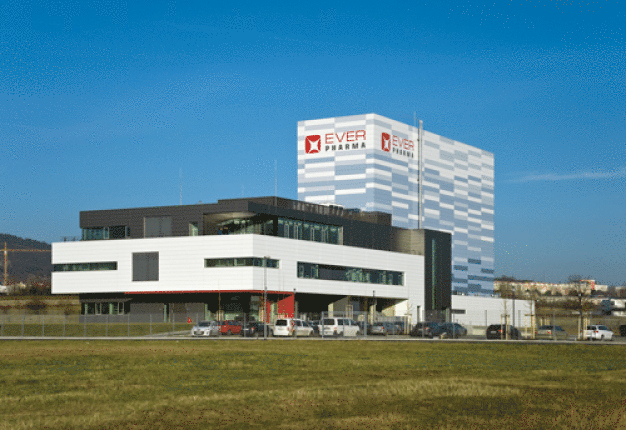
The HRL is directly connected to the manufacturing hall and, despite its height of around 38 meters, blends harmoniously into the landscape. (Copyright I. Scheffler)
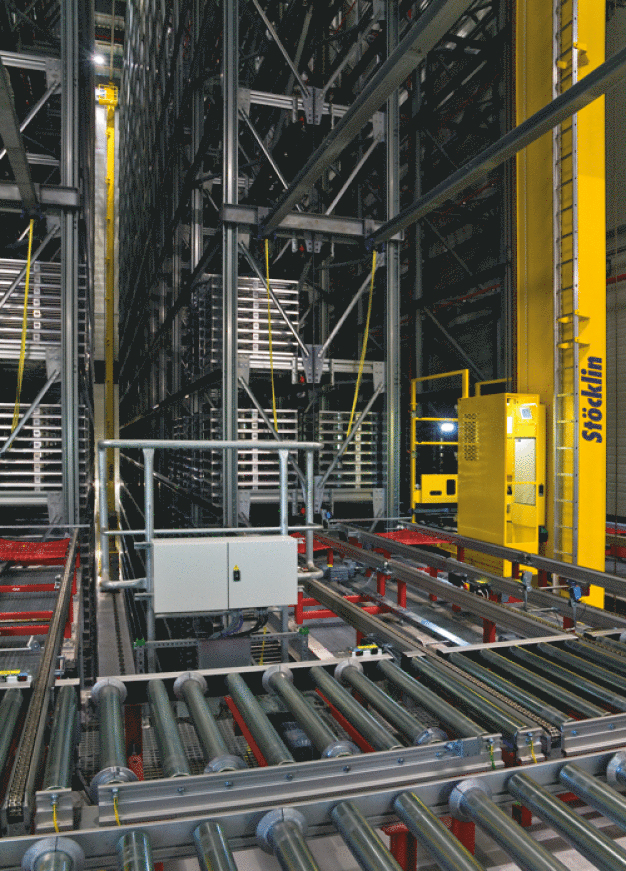
The RBG from the MASTer series by Stöcklin Logistik AG takes over the pallets from the main lines in the HRL pre-zone. (Copyright I. Scheffler)
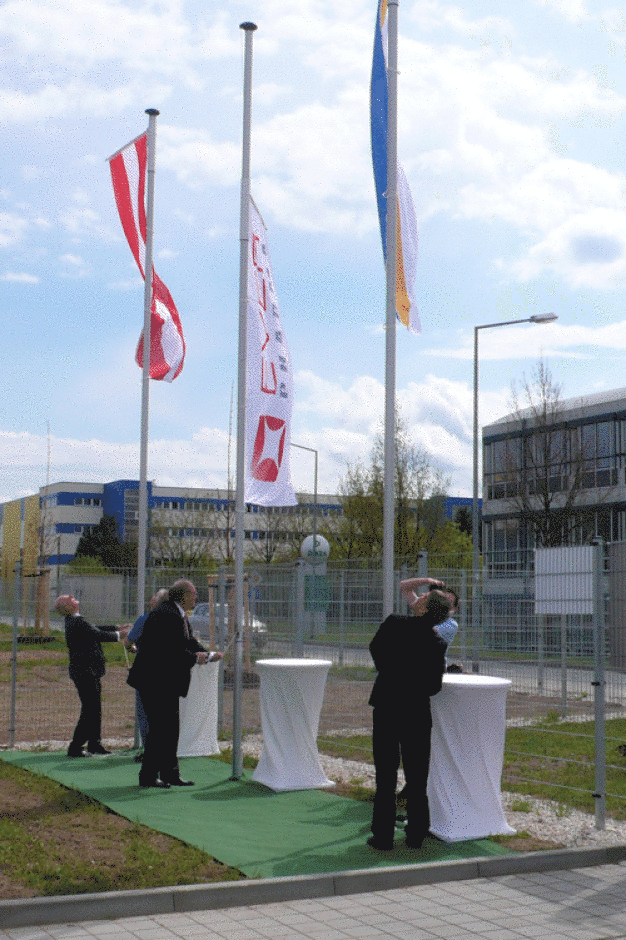
On the occasion of the opening celebrations on April 27, 2015, the flags were raised. (Copyright Stöcklin Logistik AG)
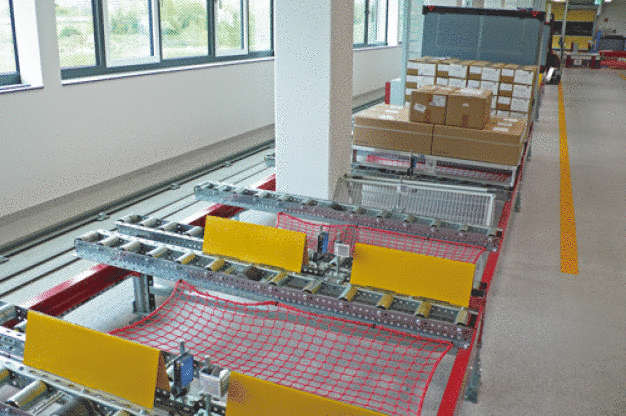
The packaging lines are equipped with three stations, each consisting of six buffer or delivery stations designed as roller conveyor belts. (Copyright Stöcklin Logistik AG)
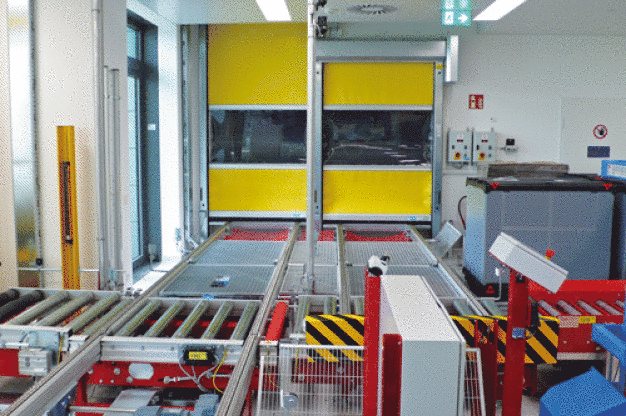
The rapid doors serve as climate barriers and prevent unauthorized persons from entering the warehouse. (Copyright Stöcklin Logistik AG)
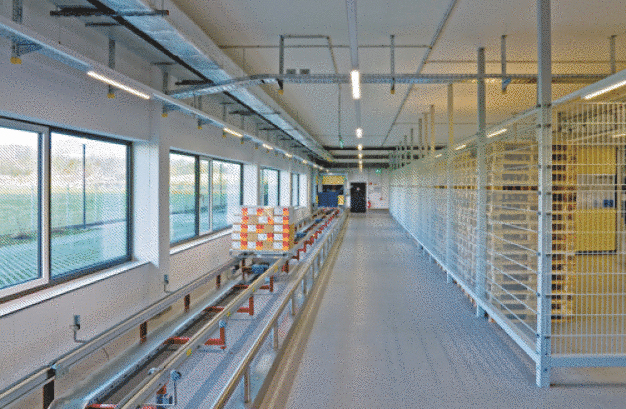
The goods are delivered either directly to the high-bay warehouse (HRL) or initially to the manual storage area via the conveyor systems installed on the ground floor (GF). (Copyright I. Scheffler)
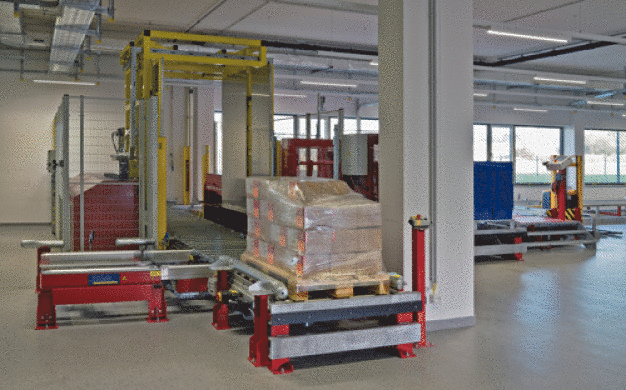
For hygienic reasons, the goods to be stored are moved from a wooden pallet to an aluminum pallet using the pallet changer. (Copyright I. Scheffler)
For EVER Pharma Jena GmbH, Stöcklin Logistik AG has implemented a new fully automated high-bay warehouse, which will serve as a logistical hub in the future and support the expansion of the internationally operating pharmaceutical company. Prior to commissioning, the integration of intralogistic elements, as well as the necessary GDP-compliant auditing and validation of the warehouse management system, were carried out.
Overall, approximately 20 million euros have been invested by EVER Pharma Jena GmbH in the construction of a new production building and a fully automated high-bay warehouse. The new construction project is a significant milestone in the implementation of a master plan that envisioned the consolidation of manufacturing and logistics capacities at the newly developed site in Jena Lobeda. "With this investment at the highest technical level, we are further advancing our expansion activities in the field of parenteral drug manufacturing for global markets," emphasized Dr. Friedrich Hillebrand, owner of the Austrian EVER Pharma Group, during the opening celebrations on April 27, 2015.
The German subsidiary of the internationally active pharmaceutical group employs around 280 staff members in the Thuringian university city. Here, the company specializes in the development, manufacturing, and packaging of sterile dosage forms that help improve the well-being and quality of life for patients—especially for people after a stroke, with dementia, or traumatic brain injury. The production capacity amounts to up to 130 million units per year. EVER Pharma is certified according to EU GMP regulations, which demand the highest quality standards and require carefully monitored, perfectly coordinated production processes under cleanroom conditions.
Functionality meets Aesthetics and Sustainability
After nearly two years of construction, the new central production and logistics site in Jena was officially handed over at the end of April 2015. A few months earlier, project managers received an award—the "Special Energy Prize" of the Jena Facade Award. The facade design of the production section was recognized in connection with the achieved energy efficiency. The high-bay warehouse is directly attached to this building mass and, despite a height of around 38 meters, blends harmoniously into the landscape. The reason is an unusual color scheme, where the intensity of the color decreases upward. The effect, according to the responsible architecture firm Heene + Pöbst, is that the upper boundary of the warehouse building visually transitions smoothly into the sky, regardless of weather and lighting conditions.
The processes inside the new landmark are also harmoniously coordinated. Responsible for this is the Swiss intralogistics provider Stöcklin Logistik AG. The scope of work included steel construction for the rack system, the pallet conveyor system, three fully automatic rack handling machines, a new warehouse management system including material flow computer and visualization, equipment such as shelves, pallet wrappers, and pallet changers for manual storage areas, as well as additional measures around adequate fire protection.
Special temperature requirements for storing sensitive pharmaceutical products were also a focus during implementation. "We decided on passive cooling," says Dr. Adalbert Lembcke, managing director of EVER Pharma Jena GmbH. "To this end, the concrete basin of the high-bay warehouse was embedded six meters into the ground, allowing the cooling system here to be used in conjunction with other climate control measures."
Pallet changers as a central element in material flow
Goods to be received are usually delivered on Euro pallets and placed on the conveyor line by staff. These load carriers are recorded using handheld scanners and transmitted directly to the warehouse management system (WMS). Since, for reasons of hygiene, no wooden pallets are permitted within the system cycle, they are fed into a pallet changer. First, an empty aluminum pallet enters, followed by a wooden pallet with load. The transfer process is triggered when double sliding bars above the target pallet close, forming an optimal sliding surface. The electric drive is activated via the control system, gently pushing the goods unit from three sides onto the lowered target pallet.
Both empty wooden and aluminum pallets are served by a pallet dispenser. Such a pallet collector can hold up to 12 load carriers simultaneously. When this number is reached, after a height check, the stack is automatically transported toward the removal area. Once the dispenser is empty, a new stack of pallets is fed in. The identification of the aluminum pallets, which now form a load unit together with the goods, is done by reading the fixed barcode labels attached to the middle of the pallet using integrated, fixed scanners in the conveyor technology. The clearly identified data are then forwarded via the control system to the material flow computer (MFR).
Via the conveyor lines installed on the ground floor (GF), goods are optionally directed either directly to the high-bay warehouse (HRL) or initially to the so-called manual storage. In the manual storage, pallets are manually loaded and unloaded with the help of pallet stackers. There is also a picking workstation equipped with a scissor lift table to facilitate the picking process and to make the workplace as ergonomic as possible overall.
Dynamics and safety in the pharmaceutical high-bay warehouse
The three-aisle high-bay warehouse (HRL), built at level -5.0 meters, is designed for single-depth storage and provides space for approximately 5,200 aluminum pallets (1,250 x 850 mm - LxB) with a maximum total weight of 800 kilograms. The three fully automatic rack handling machines (RBG) from the MASTer series by Stöcklin Logistik AG handle the pallets from the side aisles into the HRL pre-zone. The 38-meter-high single-mast devices are equipped with telescopic forks as load handling devices and operate over a length of 43.5 meters.
In- and outloading into the HRL occurs both at level 0.00 m and 4.50 m. For this purpose, a conveyor system has been installed in the rack area.
The dynamic performance values of the travel and lift axes are not only matched to the dimensions of the warehouse but are also set by the RBG software before each movement to enable maximum energy exchange between the axes (inter-circuit coupling). The axis with the lower priority is operated only as fast as necessary. In summary, the software ensures that the RBGs always operate with maximum energy efficiency without negatively affecting pallet throughput.
A separate fire compartment has also been established in the pre-zone of the HRL. In case of an alarm, these gates automatically close. Fast-acting doors prevent unauthorized access to the warehouse and also serve as climate barriers. Each conveyor line has its own dedicated door, which only opens when pallets pass through.
While the actual picking and outbound shipping are located on the ground floor, the packaging and pre-picking are carried out on the first floor (1st OG). The packaging lines are equipped with three stations, each consisting of six buffer or delivery points designed as roller conveyors. Their supply and removal with aluminum full pallets are managed via a transfer cart with a slightly inclined roller conveyor. When all three stations are operated in parallel, the transfer cart covers a total distance of 28 meters within 31.8 seconds. Pallet removal is monitored by a sensor, allowing the process to be directly reported to the MFR.
Documented quality through GDP validation
“The main challenge in this project was designing the warehouse management system (WMS) in accordance with GDP,” reports Oliver Vujcic, responsible project manager at Stöcklin Logistik, alongside Matthias Föchner and Roland Eberhard. "This involved both conception and development, as well as validation." The background: the guidelines of "Good Manufacturing Practice" that apply to pharmaceutical companies like EVER Pharma Jena state that quality assurance of GMP-regulated products does not end with manufacturing but extends across the entire supply chain. These specific requirements are defined in the GDP guidelines ("Good Distribution Practice"). The necessary quality level of the products must be documented and verified from production to the end customer.
This also affects logistical processes such as storage. "This quasi-mandated safety along the entire supply chain is absolutely necessary to protect patients," says Oliver Vujcic. "It must be ensured that no negative influences occur on the products, which could potentially harm people."
Nevertheless, implementing a GDP-compliant or GDP-validated WMS involves enormous effort. Test management is a crucial part of the quality management system and covers the entire WMS development process. "With the validation, we have achieved the goal that our application meets all criteria," says Oliver Vujcic. The set objectives have been met, including comprehensive coverage of requirements, consistent system availability, and guaranteed high reliability in daily operation.
"From the very beginning, we were confident that we had chosen the right partner with Stöcklin Logistik," summarizes Dr. Adalbert Lembcke. "Our expectations were fully met. In every phase of the project, the team led by Mr. Vujcic and Mr. Föchner demonstrated great commitment and proved their competence and experience," continued the managing director of EVER Pharma Jena GmbH. The foundation for growth and further expansion has been laid.
Stöcklin Logistik AG
4143 Dornach
Switzerland



