



- Translated with AI
Now into orbit
Small satellite "TechnoSat" from TU Berlin launched on July 14, 2017 at 8:36 AM CEST from the Baikonur spaceport / Broadcast via live stream
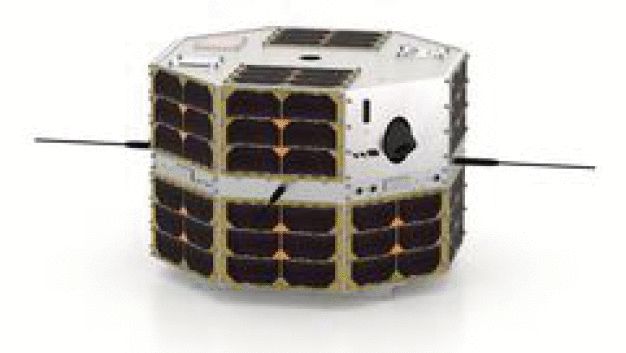
The small satellite "TechnoSat" measures 305 x 465 x 465 millimeters. (© TU Berlin/ILR)
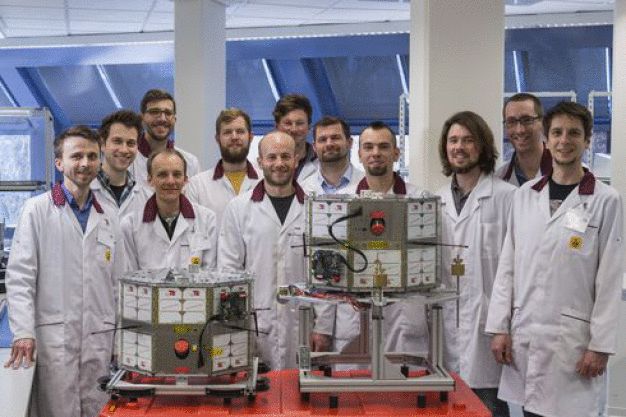
The "TechnoSat" project team at the Department of Aerospace Engineering at TU Berlin. (© TU Berlin/ILR)
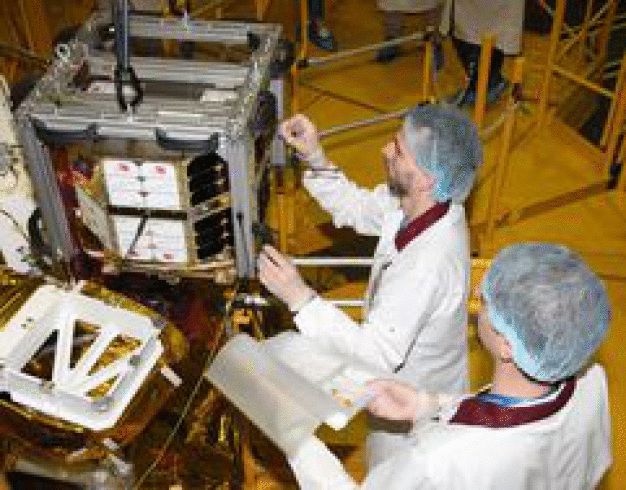
Scientists from TU Berlin are assembling "TechnoSat" on the upper stage of the three-stage Soyuz rocket in Baikonur. (© TU Berlin/ILR)
On Friday, July 14, 2017, the twelfth small satellite of TU Berlin was launched. "TechnoSat" was placed into an orbit 660 kilometers high at 8:36 a.m. Central European Summer Time (CEST) from the cosmodrome in Baikonur, Kazakhstan, aboard a Soyuz rocket. The separation in the target orbit occurred after 8,794.2 seconds, approximately 2 hours and 26.5 minutes. Space enthusiasts could follow the launch via live stream. "TechnoSat" was developed by the Spacecraft Engineering department led by Prof. Dr.-Ing. Klaus Brieß at the Institute for Aeronautics and Space Flight of the Faculty V - Transport and Machine Systems. The project is funded by the German Aerospace Center (DLR) with resources from the Federal Ministry for Economic Affairs and Energy.
Technology testing mission with seven experiments
The octagonal and approximately 20-kilogram "TechnoSat" is intended to test new technologies under space conditions during its minimum one-year mission. The 305 x 465 x 465 millimeters satellite contains a total of seven experimental payloads, whose functions and performance are to be tested in orbit. "TechnoSat" includes, among other things, a fluid dynamic actuator. This is an innovative concept for satellite orientation," explains project manager Merlin Barschke. "The actuator is not equipped with a conventional electric motor but with an electromagnetic pump. This pump guides a liquid metal through a ring-shaped channel, generating a high torque. This allows the satellite to be quickly and precisely aligned. A key advantage of this concept is that it requires no moving mechanical parts, which need to withstand the stresses of rocket launch."
"TechnoSat" also tests laser retro-reflectors as a joint experiment involving TU Berlin, the Helmholtz Centre Potsdam, the Austrian Academy of Sciences, and the German Space Operations Centre. Laser reflectors are used on satellites for highly precise measurement of the satellite's orbit from the ground. A laser beam is directed at the satellite, and the time it takes for the beam to be reflected back to Earth is measured. The information obtained can, for example, be used to evaluate onboard position sensors or to precisely determine the orbits of satellites that are no longer operational.
"For the experiment, we are using 14 small, inexpensive, commercially available reflectors," explains Barschke. "We want to demonstrate that these relatively inexpensive and not specifically designed-for this-application reflectors can still be used for this purpose."
These and the other five experimental payloads are operated by the institute's own space flight control center in Berlin-Charlottenburg. "As soon as the satellite is within the reception area of our ground station, we will begin retrieving telemetry data. Afterwards, we will check all systems and perform functional tests before proceeding with the experiments," summarizes Merlin Barschke the planned steps.
Student training with practical relevance
With the development and operation of "TechnoSat," the Institute for Aeronautics and Space Flight at TU Berlin has further expanded the practical relevance of its student training. The project was developed, built, and qualified for spaceflight by doctoral students and student employees. Additionally, students supported the project through their theses.
Technische Universität Berlin
10587 Berlin
Germany