- Translated with AI
No chance for the germs
New research project develops energy-efficient ventilation in multifunctional operating rooms
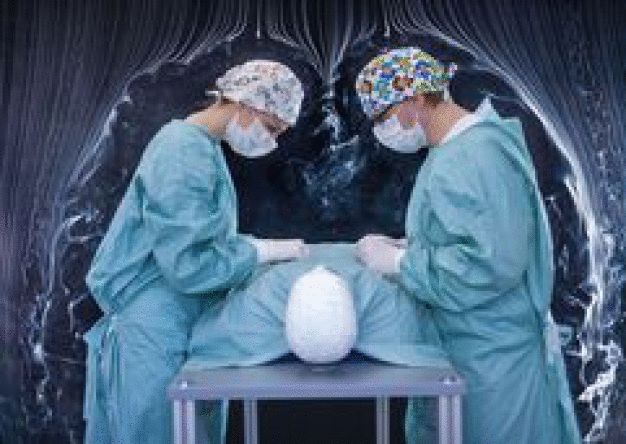
To prevent a wound from becoming infected, it is important that the air above the surgical site is sterile. (© HRI)
In operating theaters with the highest purity requirements, a so-called TAV ceiling panel of ten square meters is prescribed for ventilation. Additionally, the air must be exchanged one hundred times per hour. In office rooms, this is only done three to six times. These ceilings are intended to ensure that the space below is reliably supplied with germ-free air. TAV stands for vertical turbulence-reduced displacement airflow. However, despite high energy expenditure for air supply, humidification and dehumidification, as well as air temperature control, these ceilings are not capable of providing the necessary protection during operations at the operating table. There is a risk of wound infection.
To enable the highest protection against germs in operating theaters, the Hermann Rietschel Institute of TU Berlin, under the leadership of Prof. Dr.-Ing. Martin Kriegel, has launched a three-year research project on energy-efficient ventilation of multifunctional operating rooms. The project is funded with approximately 800,000 euros by the Federal Ministry for Economic Affairs and Energy (BMWi).
"The reason why the TAV ceilings fail to keep the underlying surgical field germ-free," says Martin Kriegel, "is the technical equipment of the operating rooms." Lamps, ceiling supply units, the elaborate medical equipment including imaging procedures, but also the operating staff itself disturb the room air flow. "Due to these many geometric and thermal obstacles, the displacement airflow in the wound area above the operating table breaks down. "Protection against the ingress of germs and particles is no longer guaranteed," Kriegel explains. In Germany, around 16.2 million operations are performed annually, resulting in approximately 225,000 cases of postoperative wound infections. That’s 1.9 percent. Besides the health impairment of the patient, the increased treatment effort causes annual additional costs of around three billion euros for the healthcare system.
To meet the increasing requirements for the universal use of operating rooms, suitable ventilation protection concepts with maximum protective effect (minimal risk of postoperative wound infections and improved occupational safety for the operating staff) are to be developed with lower energy consumption. This is the goal of the project. The basis is a hazard analysis: potential sources of germs, their emission and dispersion characteristics, as well as the pathways of germ entry into the operating room air are systematically investigated. Through optimized air guidance systems, it is possible to reduce the amount of air in operating rooms to one-third of the current volume while simultaneously increasing protective effects. With 4,800 operating rooms in Germany, this would result in a theoretical energy saving of 84 gigawatt-hours per year solely in electrical energy for air transportation. This corresponds to five times the electrical energy consumption of the entire rail transport in Germany per year.
Together with the Robert Koch Institute (RKI) and Charité – Universitätsmedizin Berlin, as well as with support from companies in the medical and ventilation technology sectors, detailed implementation and action recommendations are being developed based on the study results, with the aim of transferring the research findings into practice.
Technische Universität Berlin
10587 Berlin
Germany