



- Buildings & Rooms
- Translated with AI
Dipl.-Ing. (FH) Michael Kuhn
Methodology for flow visualization clearly defined
STZ EURO offers insights and training on VDI 2083, Sheet 3
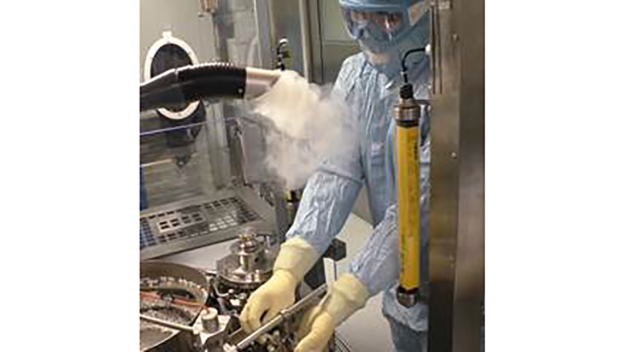
Smoke studies within the framework of VDI 2083-3 also include detailed analyses using test smoke during personnel interventions.
GMP and FDA inspectors have been demanding proof of airflow visualization in cleanrooms for years, also known as Smoke Studies. The extent of flow visualization, the respective reporting, and the key data for qualification were not specifically regulated. With the newly revised VDI Guideline 2083 Part 3, this gap has been closed since February of this year. The STZ EURO offers insights and training to implement the new requirements in compliance with regulations.
Flow visualization with smoke, or better with test fog, is a qualitative method for assessing airflow conditions in systems built in real environments. It aims to convince authorities that the airflow conditions under all relevant operating conditions are such that the required protective functions are fulfilled. The newly published draft of VDI 2083 Part 3 now clearly regulates flow visualization:
Not only is the methodological approach newly described and clearly outlined, but there is also an extensive description of acceptance criteria for product protection requirements.
Even the test fog generated by fog generators is defined. The equipment is also described. This is to ensure that fog supply systems and test fog do not distort the airflow in an unacceptable manner. The goal is primarily to clearly understand the airflow conditions in critical areas.
The procedure for flow visualization is systematized to identify fundamental airflow problems in advance. Time-consuming follow-up steps are only carried out afterward. First, the system setup and its boundary conditions are checked. Subsequently, an isolation test is performed with and without door openings. Then, a grid test of the general airflow and a detailed test of critical areas—'at rest' and 'in operation'—are conducted. Finally, personnel interventions for R&D and routine processes are evaluated. This methodology provides conclusive data for interim assessments together with the customer before the final documentation with menu-driven film editing is created.
"VDI 2083 Part 3 provides a common basis and assessment security for both the executor and the customer," says Michael Kuhn, head of STZ EURO and active contributor to the revision of VDI 2083, Part 3. The contents and methodology of the new VDI 2083 Part 3 are not only professionally implemented by STZ EURO but are also conveyed through (in-house) training sessions to interested parties.
The flow visualization according to VDI 2083 Part 3 is also important for criteria used in planning cleanroom technology. Optimal, according to Michael Kuhn, is the combination of test fog and CFD (Computational Fluid Dynamics). STZ EURO uses CFD simulations for planning and optimization, followed by flow visualizations with test fog to verify the real setup, starting from FAT (Factory Acceptance Tests) or at the latest during qualification (OQ/PQ).
"It makes sense to optimize airflow conditions during the design phase of the planned cleanroom system and then qualify the built system using flow visualization," says Michael Kuhn. "This should ensure that commissioning and qualification proceed smoothly and that no costly and time-consuming modifications are necessary."
In this way, the impact of later planned modifications can also be checked cost-effectively and quickly through flow visualization.

STZ EURO Steinbeis-Transferzentrum
Energie-, Umwelt- und Reinraumtechnik Offenburg
Badstraße 24a
77652 Offenburg
Germany
Phone: +49 781 20354711
email: mkuhn@stz-euro.de
Internet: http://www.stz-euro.de