

- Robot
- Translated with AI
Florian Kohut
Medication: personalized – Filling: automated
Pharmabotix uses Hygienic Design Robot Motoman HD8 from Yaskawa for filling smaller batches
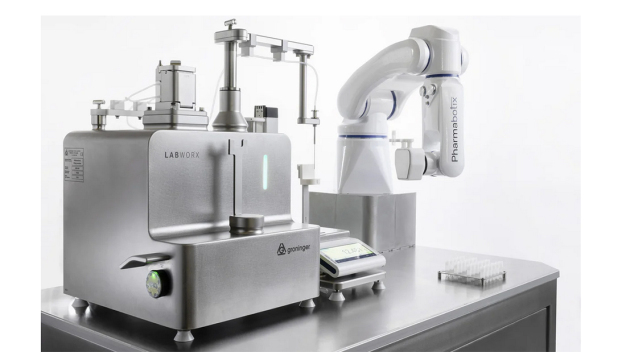
The new development can be automated to fill up to seven bottles per minute, and in the future, even more.
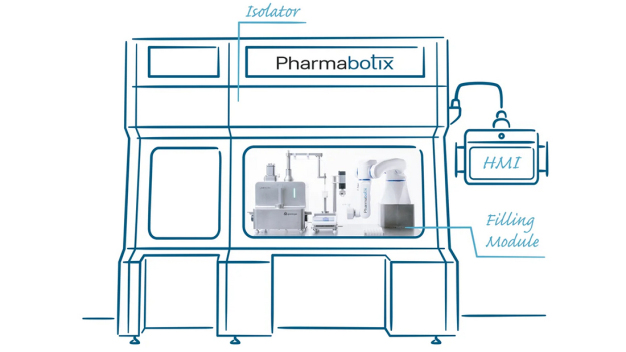
Pharmabotix has developed a concept for automated filling of cryo vials for the cell and gene therapy sector with the CryoFiller module.
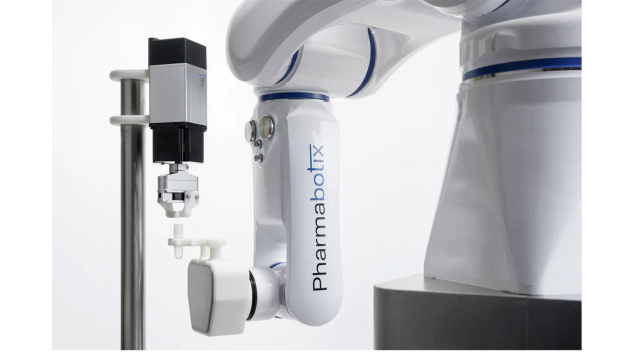
The handling of the cryo vials is performed by a hygienically suitable industrial robot, the Motoman HD8 from Yaskawa, equipped with an electric gripper.
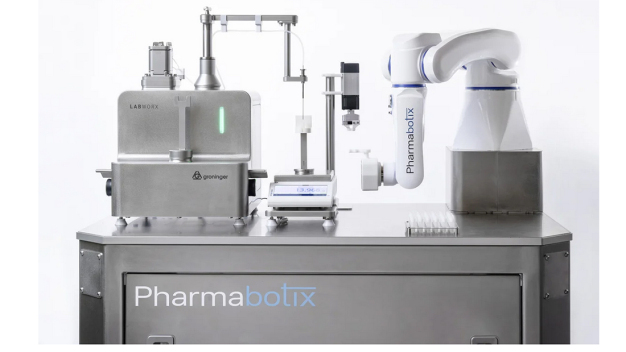
The Cryo Vials are supplied in a rack or via a flexible feeding system and handled by the robot.
Personalized medicine represents a fundamental shift for the pharmaceutical and biotech industry, which has traditionally focused on large-scale production. Pharmabotix develops automation and robotics solutions for filling smaller batches, such as those used in cell and gene therapy. The Swiss company also relies on a hygienically designed industrial robot, the Motoman HD8 from Yaskawa.
The advances in cell and gene therapy enable treatments – and thus also medicines – to be tailored individually to each patient. This is called Advanced Therapy Medicinal Products – or ATMPs – or medicines for innovative therapies: Living cells or defective genes are taken from the patient, processed in the laboratory, and then re-administered. This allows diseases to be treated or prevented, and even damaged tissue or organs to be regenerated and replaced.
“Personalized medicine means that the batches of biopharmaceutical products are increasingly smaller and are not always filled into traditional vials or syringes,” explains Fabian Stutz, CEO of Pharmabotix. His company, based in Seengen, Switzerland, specializes in robotics and automation solutions for the pharmaceutical industry. Under the brand name “Sally,” Pharmabotix markets various modules for the cell and gene therapy market and laboratory sector.
Automated filling of up to seven Cryo Vials per minute
For small batch sizes, the pharmaceutical industry largely relies on manual processes. This is labor-intensive. The complex process also requires highly trained staff, and the quality heavily depends on the individual operator. “Furthermore, these production processes are difficult to scale commercially and transition into mass production,” explains Fabian Stutz.
Therefore, Pharmabotix developed a concept for Sally to automate the filling of Cryo Vials for the cell and gene therapy sector. The requirement: The CryoFiller module should be able to fill up to seven vials per minute automatically.
Cryo Vials are containers made of temperature-resistant plastic, used to store biological samples or cells in liquid nitrogen at temperatures as low as -196°C to ensure the stability and quality of the samples. Unlike traditional vials, they are sealed with a screw cap instead of a stopper and metal cap.
The correct closure for each vial
The basis of the CryoFiller is a Labworx tabletop filling system from Groninger, one of the world's largest manufacturers of filling equipment. The Cryo Vials are supplied in a rack or via a flexible feed system. One or more screw systems – depending on cycle time requirements – open the vials, which are then filled automatically and resealed. The handling of the Cryo Vials is performed by a Yaskawa Motoman HD8 with an electric gripper.
The entire cell complies with the strict regulations for cleanrooms of GMP classes A and B, making it suitable for the production of aseptic products. The Cryo Vials are also sterile. This posed a particular challenge for the developers at Pharmabotix: “For the integrity of the product and traceability, the corresponding closure must be screwed back onto each vial after filling,” explains Fabian Stutz.
Hygienic design for the highest cleanroom class
The Pharmabotix team had clear requirements for the robot used in the CryoFiller. Among other things, it should be possible to clean it with standard industrial cleaning agents and to decontaminate it with hydrogen peroxide (H2O2). “Only the Yaskawa Motoman HD8 was suitable for us. We contacted Yaskawa directly, which led us to the Swiss distributor SwissDrives, who supplied the robot,” reports Fabian Stutz.
With the new Motoman HD series, Yaskawa recently introduced two 6-axis high-performance robots that meet the high standards of the pharmaceutical industry and similar hygiene-sensitive sectors: They are suitable for use in hygienic environments up to the highest cleanroom class GMP Class A.
The HD stands for “Hygienic Design.” This was developed together with the German Fraunhofer Institute for Production Technology and Automation IPA. All application cables and media lines run inside the housing. The design is also rounded and free of dead spaces, external screws, gaps, or undercuts. This makes the Motoman HD8 easy to clean with all common disinfectants and cleaning agents. The durable surface is also particularly smooth to prevent dirt particles and microorganisms from settling. Thanks to protection class IP69K, it is ideally suited for laboratory, wet, and cleanroom environments.
User-friendly interface
Pharmabotix relies on the SRCI Standard Robot Command Interface for automation. The interface enables quick and straightforward programming of robot movements directly in the PLC. This allows users to operate the robot without specialized knowledge of robot control in the familiar IEC-61131 environment, using the same user interface. At the same time, all the genuine advantages of robot control are preserved: The robot controller calculates the motion kinematics and guarantees high movement quality. SRCI is not limited to a specific PLC or fieldbus.
Pharmabotix uses the Siemens WinCC Unified platform. “Therefore, it was an important requirement that the Motoman HD8 be compatible with Siemens control systems. Because the operation of Sally should be as simple and intuitive as possible, and be managed via a single panel. In regulated environments, this also has the advantage that only one control system needs to be tested – reducing effort and costs,” says Fabian Stutz.
Getting closer to the vision with the Motoman HD8 for Sally
The concept of the CryoFiller module for Sally was presented as a “Proof of Concept” to potential users during a workshop. The feedback was generally very positive. Pharmabotix is now further developing the system to meet, among other things, the requirements of EU GMP Annex 1, which specifies the standards for manufacturing sterile medicines in the EU.
Pharmabotix aims to position Sally as a modular platform for various automated processes in the cell and gene sector, with robots as the central handling element. “Together with Yaskawa and SwissDrives, and with the use of the Motoman HD8 in the CryoFiller module, we have taken a significant step closer to this vision,” concludes Fabian Stutz.
YASKAWA Europe GmbH
85391 Allershausen
Germany