
- R+D & Community of Interest
- Translated with AI
Maintenance networks for urban electromobility
Research Project AddRE-Mo
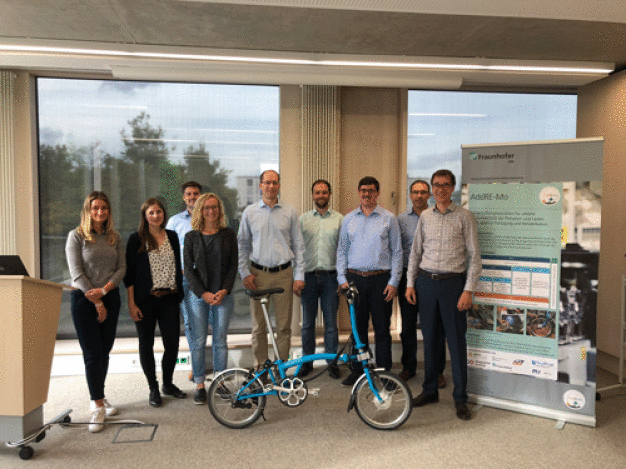
The project partners at the kick-off meeting in Bayreuth (from left): Natalia Morkwitsch (O.R. Laser Technology GmbH), Carina Koop (Wuppertal Institute), Christopher Häfner (Fraunhofer IPA), Laura Jantz-Klinkner (Environmental Cluster Bavaria), Philipp Walczak, Abraham Flothow (Electric Bike Solutions GmbH), Jan Koller, Oliver Oechsle, Professor Frank Döpper (Fraunhofer IPA). (Photo: Fraunhofer IPA)
How can additive manufacturing and local refurbishment succeed in conserving resources and unlocking new usage cycles in urban e-mobility? Researchers from the Fraunhofer Institute for Production Technology and Automation IPA, together with partners from science and industry, are investigating this in the AddRE-Mo project.
According to a United Nations study, the proportion of the world's population living in urban areas will increase from about 55 percent in 2018 to approximately 70 percent in 2050. Particularly, the increased traffic volume for passenger and freight transport poses new challenges to existing infrastructure. Electric bicycles can offer a solution here, with local value chains becoming increasingly necessary to ensure operational readiness. In addition to repairs as a temporary remedy for breakdowns, it is also essential to ensure their long-term preservation of value.
Unlike the conventional product lifecycle, components can be restored through refurbishment, enabling another complete cycle of use. Instead of the currently centralized processing, local refurbishment at the urban mobility hub is made possible through additive manufacturing. To thoroughly evaluate this new approach, economic and ecological analyses are necessary.
Resource efficiency throughout the entire product life
The goal of the AddRE-Mo project is therefore to conceptualize and pilot resource-efficient value preservation networks for the urban e-mobility of the future. Through needs-based analysis and development, closed product cycles for components of urban e-mobility are tested, incorporating refurbishment and additive manufacturing. This increases resource efficiency over the entire product life and achieves a decoupling of resource consumption (raw materials, energy, labor, etc.) from increasing product demand.
AddRE-Mo stands for "Value preservation scenarios for urban passenger and freight e-mobility through additive manufacturing and refurbishment." The project consortium is led by the Process Innovation Group at Fraunhofer IPA. Other partners include Electric Bike Solutions GmbH, O.R. Laser Technology GmbH, the Environmental Technology Cluster Bavaria e.V., and the Wuppertal Institute for Climate, Environment, and Energy gGmbH. The project has a duration of three years (07/2019 – 06/2022) and is funded by the Federal Ministry of Education and Research within the framework of the initiative "Resource-efficient Circular Economy – Innovative Product Cycles (ReziProK)" under the program "Research for Sustainable Development – FONA3."

Fraunhofer-Institut für Produktionstechnik und Automatisierung IPA
Nobelstraße 12
70569 Stuttgart
Germany
Phone: +49 711 970 1667
email: joerg-dieter.walz@ipa.fraunhofer.de
Internet: http://www.ipa.fraunhofer.de