



- New building
- Translated with AI
High-tech by Hand - 1500 sqm Cleanroom for 190 seamstresses
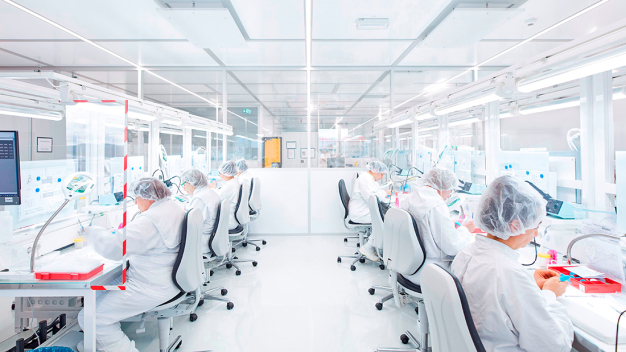
Near-workplaces in the ISO8 cleanroom class. (Image rights: Artivion)
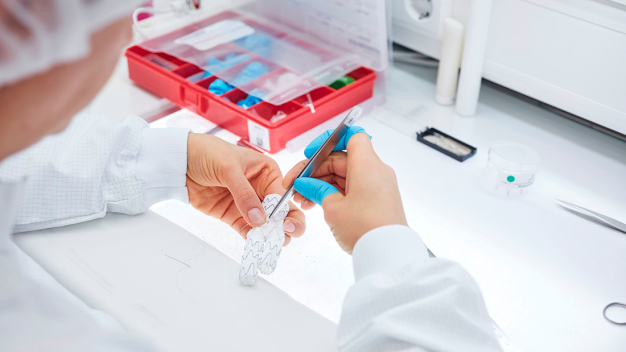
The stent prostheses are partly sewn by hand. (Image rights: Artivion)
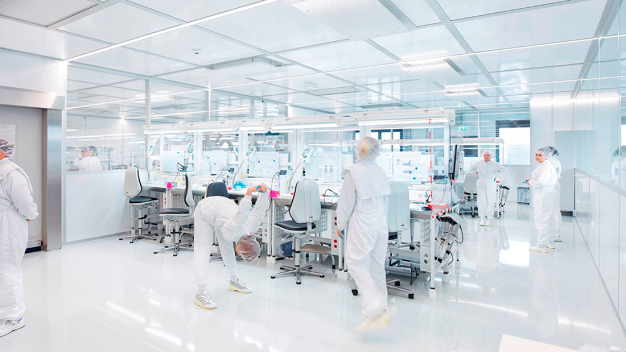
Gymnastics at the workplace. The seamstresses loosen up their tense muscles together in between. (Image rights: Artivion)
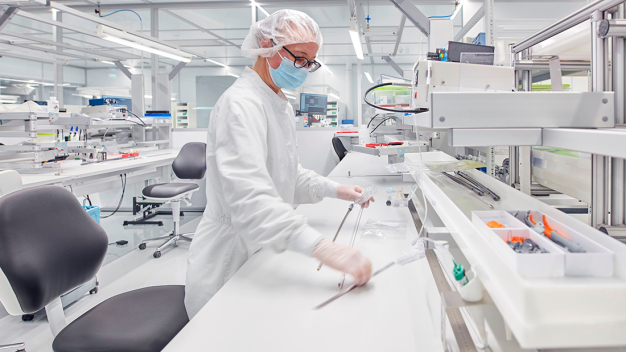
The implants are inserted using minimally invasive disposable delivery systems and prepared for surgical use. (Image rights: Artivion)
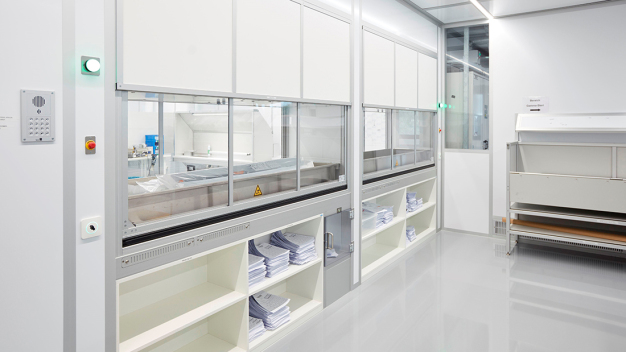
As a custom-made item, wide material gates for the packaged stent prostheses, including disposable insertion systems, were delivered. (Image rights: Artivion)(Image rights: Artivion)
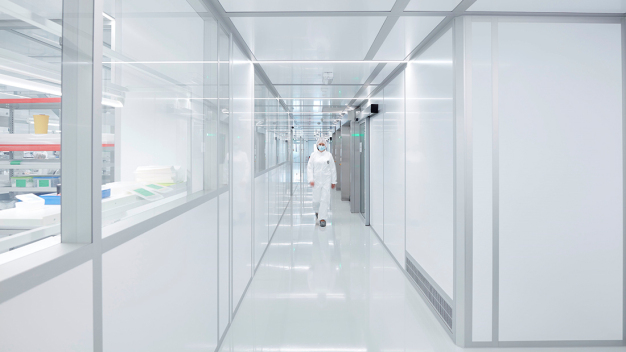
A corridor inside the cleanroom connects the personnel doors with the work areas. (Image rights: Artivion)
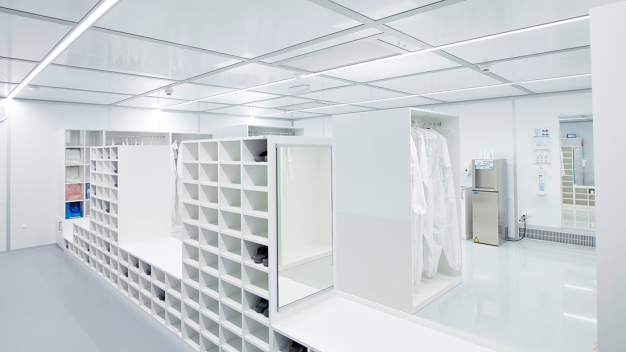
Three large personnel turnstiles ensure the quick processing of the 250 employees. (Image rights: Artivion)
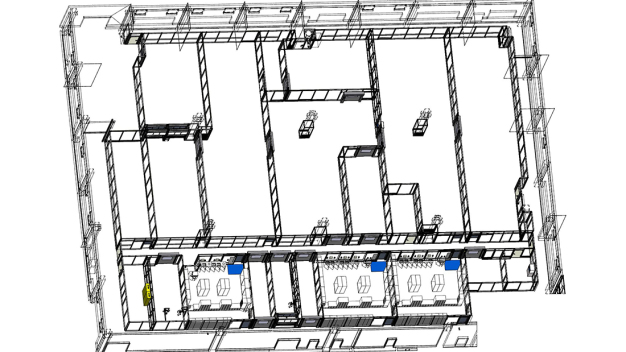
Floor plan of the 1500 sqm total facility. (Image rights: Artivion)
Artivion (Jotec) expands its manufacturing facility in Hechingen. The US company develops and produces vascular implants worldwide for the aorta. At the German site, patient-specific solutions for heart vessel enlargements are manufactured – and partly by hand.
If you think sewing is a somewhat antiquated craft, you haven't seen Artivion's new production site in Hechingen yet. The company expansion, commissioned in 2022, radiates modernity across almost 6,000 square meters.
The core of the facility is a 1,500 sqm cleanroom system where stent prostheses for minimally invasive vascular surgery are produced in a blend of high-tech and traditional craftsmanship. The implants consist of textile tubes, onto which stiffening wires are sewn – by hand, because no machine can do this yet. The stent prostheses are later inserted minimally invasively into patients' aortas suffering from aneurysms. Precisely implanted, they prevent a life-threatening rupture of the arteries. At the specialized site in Hechingen, up to 190 female (mostly female) seamstresses work in shifts to produce these implants according to a prosthesis plan tailored to each patient.
Production under cleanroom conditions
Florian Tyrs, one of the two managing directors in Hechingen, was involved in the development of these special implants. His enthusiasm is evident when he talks about the products:
"We have been producing these patient-specific solutions, sewn by hand, for 10 years. No machine can do that yet. Of course, it involves enormous personnel effort, but this allows us to deliver a highly functional product that can be used in vascular surgery without adjustments or complications. That is truly unique on the market. I am always very pleased that our innovative technologies help save lives."
To completely exclude contamination of the product and the associated risk to patients, the implants are produced and packaged under cleanroom conditions. The new cleanroom is the most important element of the production and, in the literal double sense, a matter close to the young managing director's heart:
"In our old production facility, we reached our capacity limits and wanted to strengthen our site and continue and expand our expertise in medical technology with the new building. We thought big and planned for the future. The cleanroom production of over 1,500 sqm is the heart of the plant. We placed great importance on functional workflows and the latest technology here and are very satisfied with how the production conditions have improved. This allows us to deliver even better quality and significantly reduce waste."
Cantilever construction with walkable ceiling
For planning and installing the entire cleanroom technology, the Baden-Württemberg-based company Schilling Engineering was commissioned, specializing in delivering cleanrooms precisely according to process requirements and conditions. For the medium-sized company, the order from Artivion was the largest in its history so far.
Ute Schilling, managing director of the family business, recalls:
"The order from Artivion was something very special. The layout was optimized and specified according to the product and process flow of Artivion. Thus, the cleanroom was aligned with the requirements and dependencies of the 22 rooms, considering the local conditions. The production area was to be fully preserved, and at the same time, no structural changes were to be made to the hall. An engineering study examined the technical implementation, designed the climate technology, and planned the installation site of the equipment with maintenance access. A walkable technical level was created above the airlocks, which does not require steel construction. This allowed the entire production area to be accommodated."
The cleanroom system is completely cantilevered and consists of 22 rooms divided into 12 work areas, 2 offices, personnel and material airlocks, and one each for technical and cleaning rooms. The entire area is designed for ISO 8 cleanroom class. 126 filter fan units purify the air in a recirculation process to keep harmful particles away from sensitive processes.
Effective airlock system
A particular planning challenge was the effective integration of the large number of staff members. More than 250 people work in shifts for various tasks inside the cleanroom. The personnel should be able to reach their workplaces without waiting, within a time window of just 20 minutes. The final solution involved planning three large personnel airlocks leading to a common intermediate corridor, which lies between the personnel airlocks and the work areas. 16 roller shutters and 12 sliding doors enable convenient and safe access via touchless switch controls to the individual areas.
In addition to functional workflows, Artivion also paid attention to a good working atmosphere within the cleanrooms. Florian Tyrs explains:
"The production of our stent grafts and the associated minimally invasive delivery systems requires individual steps that must be coordinated. Therefore, we planned various rooms within the cleanroom system where different teams work. Smaller units also promote a good working atmosphere. This was very important to us. The cleanrooms are bright, and above all, operate quietly with minimal air drafts. We have received very positive feedback from our employees. Working conditions have significantly improved compared to our old cleanroom."
Air conditioning and dehumidification
The primary purpose of a cleanroom system is, of course, the safety of the final product. All air is exchanged 20 times per hour in the cleanrooms, and disturbing particles are transported out of the room via laminar airflow. This guarantees compliance with the cleanroom classification at all times and enables the certified process required for manufacturing medical devices.
In addition to purity, climate control with temperature and humidity regulation must also be ensured. Most of the cleanrooms, which can house up to 95 assembly stations, operate at 21°C and 55% relative humidity. Additionally, a special work area "Coating" requires particularly high dehumidification because the coating solution used there reacts to moisture. This cleanroom area is operated with a maximum relative humidity of 35% using its own ventilation system.
In another work area, finished implants are loaded into minimally invasive disposable delivery systems. To ensure functionality, these mechanical parts must be sterilized and double-packaged in the cleanroom. Schilling Engineering supplied special exhaust hoods and material lock systems tailored to the size of the instruments for these requirements.
Ute Schilling describes the requirements her team had during planning:
"The overall planning of the cleanroom system was very complex. At times, ten of our engineers worked simultaneously on the project to implement the requirements into detailed design and meet the ambitious schedule of 10 months from order to qualification."
Timely delivery in five stages
Delivery and assembly were planned in five stages by the cleanroom company, allowing Schilling Engineering to pre-produce components for the next stage during the installation of each phase. Four climate control units were installed on the walkable overhead deck of the airlock area. Another main climate system is located outside the building. Additionally, there is fine regulation for individual rooms via nine decentralized ceiling units. The cleanroom system was qualified according to GMP standards, equipped with remote maintenance and monitoring from Briem. The cleanroom for product manufacturing was subsequently audited and approved by DEKRA.
The young managing director is visibly proud when she looks at the complex system, where one gear meshes with the other:
"We are very proud that we were able to implement the project with qualification within the desired timeframe, despite the challenging conditions of the pandemic, such as supply shortages and personnel absences. I would like to thank Artivion for the excellent cooperation. The challenges were overcome together through support and quick communication channels."

Schilling Engineering GmbH
Industriestraße 26
79793 Wutöschingen
Germany
Phone: +49 7746 927890
email: info@schillingengineering.de
Internet: http://www.schillingengineering.de