

- Science
- Translated with AI
From space for everyday life
A consortium involving TU Berlin is among the last six applications for two new billion-dollar large research centers in East Germany.
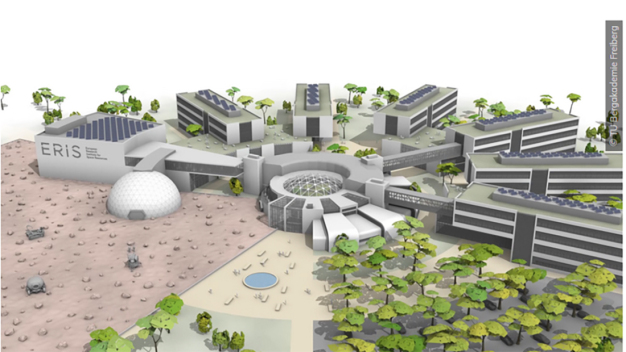
ERIS is to include, on the one hand, technology centers for robotics and In-Situ Resource Utilization (see text). These include a large simulator for planetary surfaces, capable of generating temperatures of +/- 150 degrees Celsius, a robotics testing hall, and an outdoor testing area. The third technology center, "Habitats," includes a test biosphere (with a glass dome in the center) as well as a simulator for habitat technologies with interchangeable modules and space for up to six people, where closed material cycles can be realized. Buildings for administration, as well as a visitor center and a mission control center, complete the ERIS research ensemble.
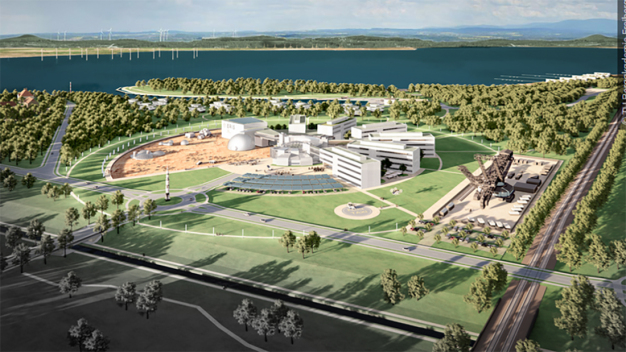
The ERIS Large Research Center is to be established in the Saxon Lusatia or in the Central German mining region. In addition to scientific buildings, an innovative residential park, as well as a Spacetech industrial park and a Greentech industrial park, are also planned nearby.
The Department of Aerospace Engineering at the Technical University (TU) Berlin is significantly involved in the planned Large Research Center European Research Institute for Space Resources (ERIS), which aims to develop new technologies for space and utilize them for sustainable living on Earth. The project proposal is now in the final round of the competition “Knowledge creates perspectives for the region!”. This competition was announced by the Federal Ministry of Education and Research (BMBF), the Free State of Saxony, and the State of Saxony-Anhalt. One large research center will be established in Lusatia, Saxony, and another in the Central German mining region. The funding amount is 1.1 billion euros per center. A decision is expected by the end of September.
Out of nearly 100 submitted concept sketches in the two-stage awarding process, the BMBF recommended the six most convincing for the next funding phase. These projects had the opportunity to develop a reviewable concept by the end of April 2022. Initiated by the TU Bergakademie Freiberg, the application for the large research center ERIS focused on space resources. The ERIS consortium currently includes 66 partners from research and industry and envisions 1,200 new jobs in the region. The goal of the project is to provide innovative solutions to current challenges on Earth through advances in space exploration. These include new resource-efficient production methods, sustainable supply for people, and the exploration of new raw material sources.
Aerospace technology is already part of everyday life
"High-tech from space exploration is already constantly used on Earth and shapes our daily lives," says Prof. Dr.-Ing. Enrico Stoll, head of the Department of Aerospace Engineering at TU Berlin and one of the four spokespersons for ERIS. This includes GPS navigation systems, smartphone cameras with CMOS sensors, infrared thermometers, as well as water filters and insulin pumps. Technologies and processes developed for building a research station on the Moon or Mars also have enormous transfer and innovation potential. "These techniques, such as 3D printing, cover entirely different application areas and could significantly improve our way of living," explains Stoll.
Experience in satellites, robotics, and 3D printing
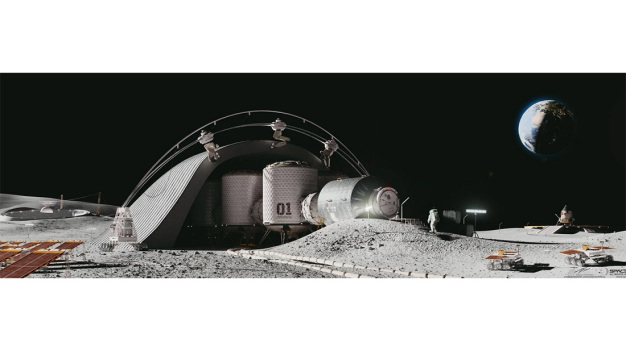
The Department of Aerospace Engineering contributes its expertise mainly in production technologies within the funding application and supports resource exploration and robotics, among other areas. With years of experience in satellite construction, the department also has a solid foundation for developing space systems for other celestial bodies. The working group "Exploration and Propulsion" researches technologies for utilizing resources found on the Moon, known as In-Situ Resource Utilization (ISRU). Primarily, this involves the ubiquitous lunar regolith (commonly called Moon dust) on the Moon's surface. Valuable elements such as metals or oxygen can be extracted from it, which are essential for building a research station. Other research projects at the department focus on creating structures and intermediate products from lunar regolith itself. Using 3D printing, it can be melted with laser or concentrated sunlight and could serve as a building material for constructing buildings and roads on the Moon in the future.
Space exploration is not a detour
"The planned large research center ERIS combines expertise from space research as well as resource, energy, production, and environmental technology, thus unlocking comprehensive development potentials," says Simon Stapperfend, the project manager responsible on behalf of TU Berlin. Space exploration is therefore not a detour but an inspiration for new technologies on Earth. "Because technology that enables human life on the Moon and Mars can also be used on Earth to minimize resource consumption, close material cycles locally, and save energy." Extreme environmental conditions on the Moon and Mars and the restriction to locally obtainable raw materials mean that all auxiliary materials must be regenerated and returned to the cycle, which has many parallels to societal challenges of the sustainability transition. Due to the hostile conditions on the Moon, many complex tasks would also need to be reliably performed by robots, which could give new impulses to this research area for applications on Earth.
TU Berlin
10623 Berlin
Germany