



- Translated with AI
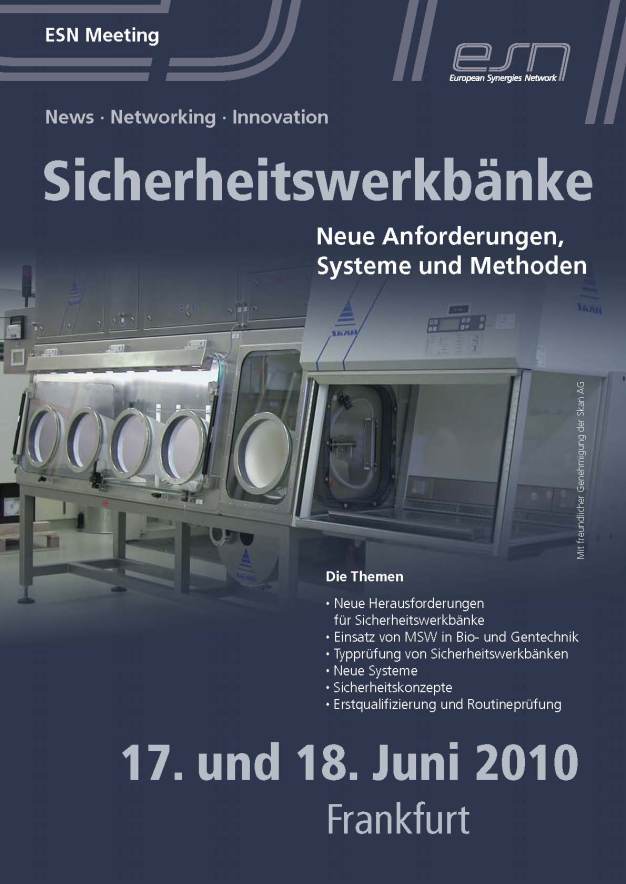
ESN Meeting Security Cabinets NEW Date
ESN Meeting Security Cabinets NEW Date
New requirements, systems, and methods
June 17 and 18, 2010, Frankfurt
reinraum-online discount of €250 for registration with the code: rron10
With this new meeting, the ESN Academy continues the very successful meetings held this year.
The meeting will inform users, manufacturers, authorities, and service providers about innovations in the field of safety cabinets and related barrier systems. Experts from all subfields will provide a comprehensive overview of the state of the art as well as new developments and will participate in two panel discussions.
The meeting offers a broad spectrum of knowledge with active information exchange and valuable impulses for the further development and application of safety cabinets. It supports users in implementing the expanded technical options for safety cabinets in practice, aiming at optimizing process and safety technology.
The topics in detail:
New challenges for safety cabinets
The traditional microbiological safety cabinet system faces new challenges. In addition to well-known microbiology applications, new applications in biology/genetics and pharmacy/toxicology have emerged. In the US standard NSF/ANSI 49, these applications are covered within a single regulation. New regulations from ISO and VDI categorize safety cabinets within the overarching system of different barrier systems. Improved testing techniques have now been developed for these new requirements. Traditional procedures to ensure safety functions rely on design specifications and semi-quantitative testing methods, such as microbiological procedures and the KI method for determining personnel and product protection. Newer methods aim to verify quantitatively defined requirements in the form of exposure limits (OEL) and to demonstrate these not only during type testing but also at the installation site. New control techniques also enable improved monitoring of the target values of safety cabinets during operation.
Use of MSW in bio- and genetic engineering
With well over 100,000 microbiological safety cabinets of class 2, this type of construction is the standard in bio- and genetic engineering applications in Germany. Various laws and regulations require minimizing or eliminating exposure to bioaerosols during practical handling of biological agents. These are specified in subordinate regulations and guidelines. The B 011 information sheet from BG Chemie provides current and comprehensive information on working with MSW. MSW technology is highly advanced. Work behavior must also keep pace with development.
Type testing of safety cabinets
The GS testing (type approval) is a procedure regulated by the Equipment and Product Safety Act for testing compliance with all relevant safety standards. Manufacturers can voluntarily have a product tested by an approved body. TÜV NORD CERT in Hamburg tests safety cabinets based on internationally recognized norms and standards. A focus is on testing protective functions (personnel, product, and spill protection).
New systems
Safety cabinets are increasingly specialized systems according to their respective use. In addition to ventilation technology, they must provide a functional infrastructure for complex process workflows. This includes interfaces, fittings, pass-throughs, service interventions, and cleaning measures. Safety cabinets designed for microbiological work according to EN 12469 are often used for a variety of tasks for which they were neither designed nor tested, and therefore do not represent the optimal solution. This leads to new developments and adapted designs that address specific requirements and offer users more safety. The presentation will showcase such developments with practical examples. It will also address various stages in the lifecycle of the cabinets, from procurement and qualification to routine operation, routine monitoring, maintenance/servicing, and disposal.
Safety concepts: New regulations and risk management
Safety cabinets are classified under the term "clean workstations," see ISO 14644-7 and the draft of VDI 2083, Sheet 16. Without direct reference to other regulations covering safety cabinets, understanding safety and safety concepts for cabinets depends on describing the cleanroom or clean workspace system. For safety, it is essential to describe and evaluate the usage and resulting hazards through a risk analysis during the design of a specific laboratory and/or cleanroom facility. Depending on the risk to product and/or personnel protection, technical safety measures must be developed. In most applications, the environment of the safety cabinet must also be included in the safety concept. Only a few applications do not require a hygiene or cleanroom zone as the environment for the safety cabinet. The safety concept always includes the specific operational and handling steps. Ergonomics and the feasibility of planned work steps within the cabinet also play a role in assessing the safety concept. In Sheet 16 of VDI 2083 "Cleanroom Technology," it is stated that if risks cannot be quantified, the higher protection class of the clean workspace should always be chosen. If the risks cannot be assessed by in-house experts in the respective companies or laboratories, consulting personnel must be involved to determine the necessary safety concept. Sheet 16 provides guidance for the classification, assignment, and implementation options of safety concepts.
Initial qualification and routine testing
When commissioning a cabinet, a clear distinction should be made between different operating states, as a free-standing cabinet certainly offers the best protection, which can only be worsened by fittings, etc. The behavior of personnel during use has a significant impact on the achievable protective effect. Therefore, tests to demonstrate protective effectiveness should also consider these different states. The scope of initial qualification or acceptance testing is larger than subsequent checks to clearly determine the parameters to be set as target values for routine tests. The testing methods to be used are described in cleanroom guidelines; particular attention should be paid to testing the protective effect, which should be aligned with the planned use of the cabinet.
ESN - European Synergies Network
69214 Eppelheim
Germany