- Transfer systems
- Translated with AI
Conveyor technology for the requirements of cleanroom production
Solutions for cleanrooms, medical technology, food industry
© MTF
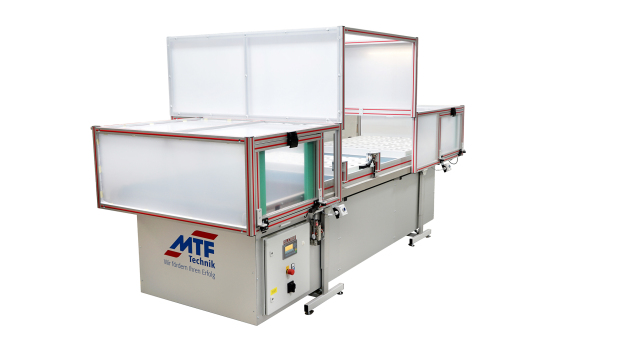
An industrial cleanroom manufacturing process places special demands on the design of conveyor technology. The primary goal is to prevent any contamination of the conveyor belt and the surrounding environment during transportation. In particular, product-contact parts must be FDA-compliant or EU-compliant, overall wear and abrasion of the conveyor system should be minimized, and easy cleaning of the equipment must be ensured.
MTF Technik has been supplying many manufacturers of medical technology products worldwide with conveyor belts, separation systems, and automation solutions for over 45 years. Thousands of devices have been successfully in continuous operation for decades. Over time, a great deal of know-how has been developed, which should be considered when designing conveyor technology for these specialized industries.
Basically, MTF Technik uses conveyor belts for cleanroom applications that have FDA approval or EU conformity. Regarding materials, PU materials with a smooth and hard surface are generally recommended, which can be easily cleaned. For special applications, FDA-approved PVC or silicone belts are also used (e.g., at very high product temperatures or when certain transport capabilities must be guaranteed). The color of the belt can also be used effectively to make any contamination visible.
Essential for abrasion prevention is the straight running of the flexible plastic belt on the conveyor. The company has always preferred belt centering using conically wound drive and idler rollers. This automatically centers the belt on the middle of the conveyor. The guidance works through the conical rollers without contact between the moving belt and the fixed frame.
The entire construction of the MTF conveyor is designed for ease of cleaning. Aluminum profiles with anodized surfaces are offered, which contain extensive know-how in detail. For example, the side sealing profiles are attached to the main guide profile via a clip mechanism, allowing easy adjustment to the belt thickness and minimizing or maximizing the gap between the fixed profile and the moving belt. The clip mechanism eliminates the need for screws in the product-contact area, resulting in completely smooth surfaces that are easy to clean and free of sharp edges. Clamping and loop effects are also avoided through this special design.
For unpackaged food or other pharmaceutical or medical products, there is often a requirement for product-contact parts made of stainless steel. The conveyor technology can be easily designed to include, for example, side guides and edge covers. Particular emphasis is placed on seamless welding and smooth, polished surfaces.
This naturally also applies to separation systems, such as diverters under the tooling of an injection molding machine. These can also be made entirely of stainless steel and even equipped with a patented abrasion-free rotary chute.
The topic of ease of cleaning and abrasion prevention is especially relevant when selecting the appropriate motor for a conveyor belt. MTF Technik often uses smooth-shell motors without cooling fins, which are very easy to clean. Even more elegant is the integration of motor and gearbox into the drive roller, e.g., as a drum motor. This results in fewer protrusions and no air turbulence caused by motor cooling, as the heat is dissipated through the belt.
Contamination of products by the environment can be effectively prevented by using covers or enclosures for the conveyor. These covers can be made from various materials, e.g., PET, aluminum, stainless steel, etc., and in different designs, e.g., snap-on or with handles. The customer is advised on the appropriate cover for their specific cleanroom environment, and the functional aspects for optimal conveying are naturally taken into account. This allows even fully enclosed conveyor lines from the production machine into the cleanroom to be realized, up to a complete buffer system.
Last but not least, static charging is a particular problem in the manufacturing of plastic parts. Besides the danger of electric shocks, static charges in cleanrooms have the negative side effect of attracting dust. To prevent this, components must be discharged. MTF Technik uses different ionization devices from various manufacturers depending on the application. These devices are typically mounted on conveyor covers or transfer hoods to apply ionized air to the conveyed goods accordingly.

MTF Technik Hardy Schürfeld GmbH & Co. KG
Stadionstraße 8
51702 Bergneustadt
Germany
Phone: +49 2261 94310
Fax: +49 2261 943131
email: info@mtf-technik.de
Internet: https://www.mtf-technik.de