


- Building technology
- Translated with AI
Dr. Jakob Hoiss
Collecting germs in compressed gases - for medical-pharmaceutical applications - Which method is optimal?
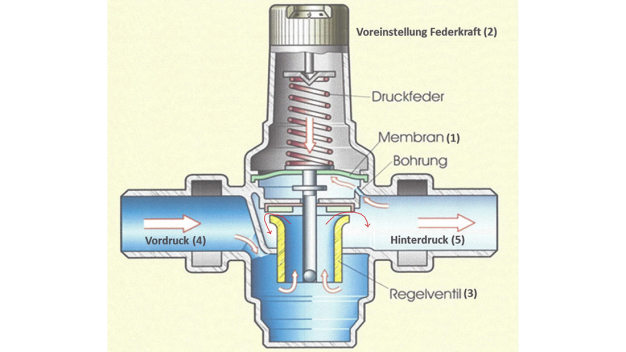
Standard reducing valve
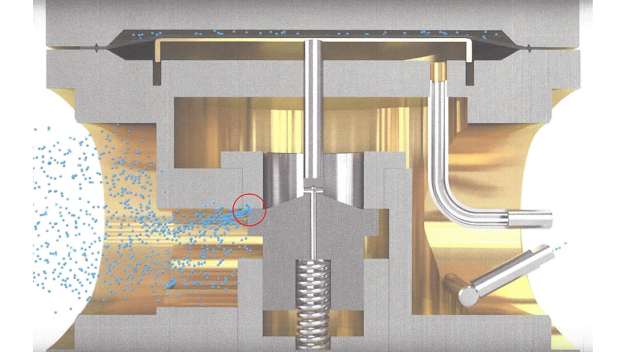
Throttle opening in the valve closed
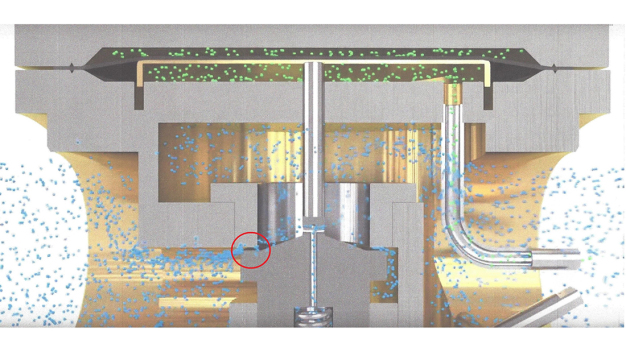
Throttle gap in the valve slightly opened
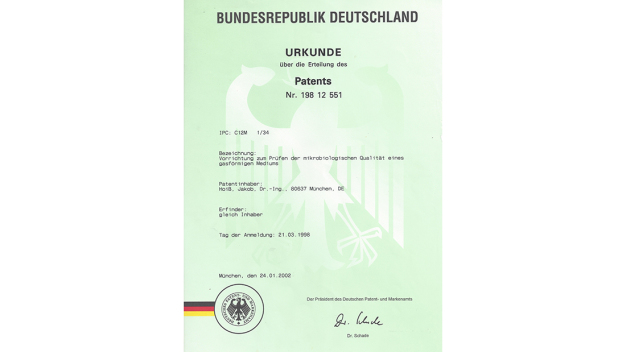
Patent:
In the relevant literature, various methods for collecting vegetative germs in gases can be found. With the devices developed for this purpose, determination and evaluation of germ counts can be performed.
Especially currently, in times of Corona, the detection of bacterial germs through their property of also being carriers for viruses is more important than ever.
A brief overview is provided here of the physical principles applied in the various collection devices, along with an assessment. The main criteria (without claim to completeness) are highlighted. The recommended device is introduced based on its key properties.
Sedimentation (Decantation method)
Particles are either deposited onto nutrient surfaces in Petri dishes by gravity (passive collection) or by centrifugal forces (to concentrate the collection volume, e.g., in aerosols - active collection).
Due to the different particle sizes, the collection is not representative, as the mass of the particles, the time factor for sedimentation, or adhesion to the nutrient solution play an important role. These factors/parameters are difficult to quantify.
Assessment: unsuitable for compressed gases.
Impaction (impact on solid nutrient surfaces)
A strong acceleration of particles / germs through deflection, also via cascade systems or nozzles, generates the force necessary to deposit on solid surfaces.
Mass inertia ensures that particle sizes can be easily fractionated (cascade system) and also adhere better to surfaces.
Assessment: partially suitable if a pressure reduction device is present before applying the particles / germs (with restrictions, see "What matters" – last chapter).
Centrifugation (centrifugal force method)
Particles and thus germs are set into rotation in the gas and accelerated strongly by the generated centrifugal force at high trajectory speeds, depending on the radius of the path. They can then be captured on impact surfaces coated with nutrient solution.
When used for gases, no liquid should generally be injected into the gas stream (to achieve enrichment in liquid droplets). Otherwise, the liquid must be validated together with the system.
Typically, gases are blown over Petri dishes via a nozzle.
Assessment: partially suitable if a pressure reduction device is present before applying the particles / germs (with restrictions, see "What matters" – last chapter).
Impaction (gas washing method)
This is a special type of collection based on the principle of mass inertia (see Impaction).
The gas (aerosol) is drawn through a capillary tube under vacuum and directed via a nozzle into a liquid collection medium. Speeds up to the speed of sound can be achieved. This can damage cells or lead to unwanted growth in the medium due to separation. Usually, the medium is a pre-sterilized nutrient solution. Unwanted cell adhesion can also occur. Afterwards, the loaded medium is filtered through an aseptic filter.
This filter is then placed on a sterile Petri dish, filled with suitable nutrient medium, and subsequently incubated and examined.
Assessment: unsuitable for compressed gases.
Filtration
Here, the gas is directed through or over a suspended or membrane-like filter material. The mechanism relies again on the principle of mass inertia with its separation effect and/or diffusion and/or electrostatic attraction.
In membrane filtration, pre-sterilized filter discs (0.2 µm pore size) or water-soluble gelatin filters (0.45 µm pore size) are used.
The former is evaluated by placing on agar plates and incubating; then the colony-forming units (CFU) are determined.
For water-soluble gelatin filtration, it is dissolved in a liquid medium, and the germs are determined from it (e.g., influenza viruses).
Assessment: suitable for compressed gases.
What matters?
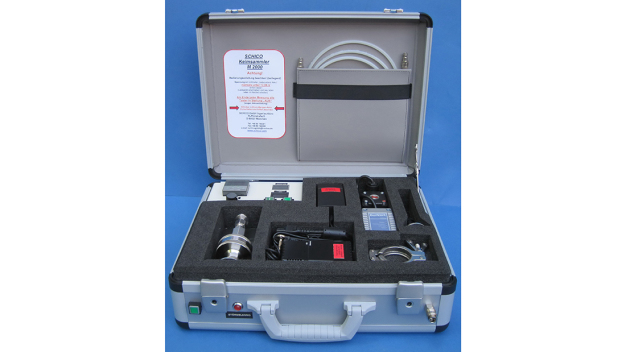
Among the market providers, there is only one germ collector specifically developed for compressed gases.
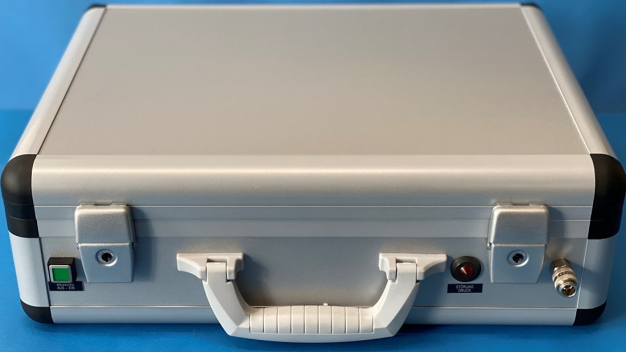
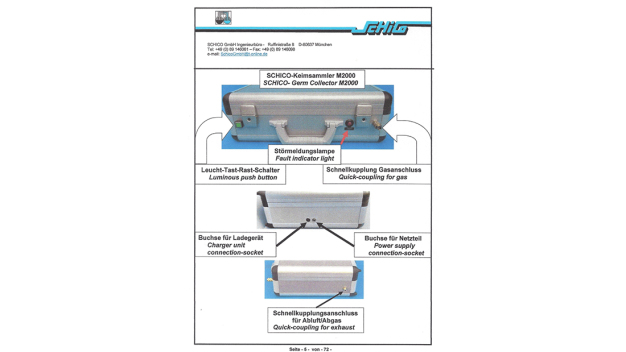
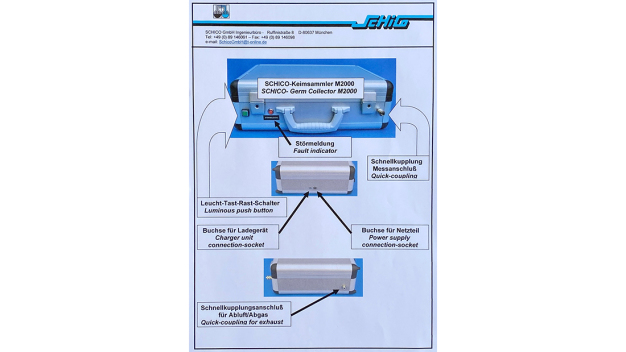
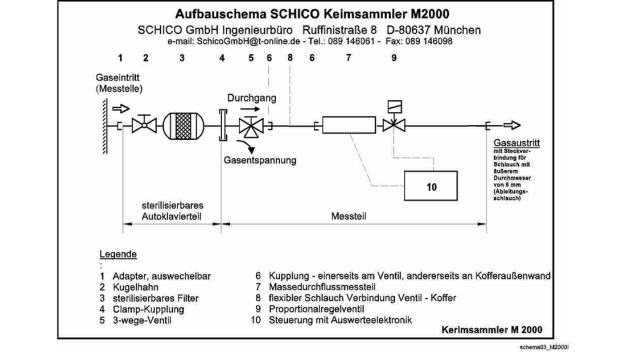
This is the SCHICO germ collector M2000, built according to the rules of DIN EN ISO 14698.
The system is validated (article published in: Pharm. Ind. 70, No. 2, 250–300 (2008)). A German patent has been granted for the device, see certificate.
In summary, the following criteria are proposed for method selection:
- Complete and exclusive collection of the gas volume to be tested (no secondary entry of other gases, especially ambient air).
- Simple and precise determination / setting of the measurement volume with high accuracy, automatically regulated (if pressure fluctuations are present in the network), adjustable range for gas amount/volume: 1-16 m³.
- Short time required to perform a measurement, e.g., about 15 minutes for 1 m³.
- Large, variably adjustable pressure range for the gas to be tested, e.g., 0.5 – 8 bar overpressure, without reduction devices (throttling devices), to test / collect the gas at the pressure used later in production.
This prevents vegetative germs from being killed before evaluation and thus not being detected by the usual method.
To illustrate, three images show the throttle device, as found in a typical pressure reducing unit. Shear stresses are effective in the throttle gap, leading to deactivation of vegetative germs. The cell membrane is broken, especially when the cell is in the division phase.
Pressure reduction also occurs in nozzles, similar to that in throttle devices; they also have a destructive effect. Since a sudden pressure relief occurs at the nozzle exit, this can also contribute to cell destruction.
Methods based on impaction and centrifugation reduce the pressure to a few millibars above atmospheric pressure.
Reducing the pressure from, for example, 10 bar to 5 bar, or from 5 to 1 bar, already decreases the vegetative germ content in the medium to be tested. It is therefore even more important to collect the germs at the pressure that will later be used in gas application, to detect as many germs as possible.
To generate the just-needed pressure for loading a nutrient-filled Petri dish or a similarly prepared strip in the gas stream, the pressure must be reduced to very small values. Therefore, these methods detect fewer vegetative germs than were present in the medium beforehand.
These methods also require very high precision, as nutrient media are introduced into the sampling room. If, due to technical or human errors, the nutrient solution escapes uncontrollably, it can contaminate the room even in small amounts.
- Nutrient media for evaluating germ counts should preferably not be introduced into the sampling room, especially in cleanrooms.
Risk of contamination!
- Furthermore: if the sampling location is a cleanroom, no excess gas should escape from the sampling device into the room. Care must be taken that exhaust lines (possibly sterilizable), attached to the device, do not significantly influence measurement accuracy (the differential pressure at the collection point/filter/device must be considered).
- For membrane filtration, the filter holder, including the adapter (coupling nipple), must be sterilizable and attached to the sampling site before measurement, using the best possible hygienic method. The shortest possible distance between measurement point and adapter should be maintained. Autoclaving these parts with steam for over 20 minutes at 121°C is sufficient.
- Shut-off and disconnect (closing the supply and drain lines) of the gas flow if the pre-pressure drops completely during measurement and an alarm is triggered.
- Since no devices that release particles or germs are allowed in the cleanroom, the necessary measurement parameters should be set outside the cleanroom. Afterwards, the housing (cleanroom-compatible) should be closed. Only then should it be connected to the sampling site and exhaust line.
- Use of various inert gases and compressed air (e.g., for air, oxygen, and nitrogen) with only one calibration of the volume measuring device (principle: mass flow) while maintaining the required accuracy.
- Battery operation of the device with a sufficiently rated battery to perform 15 measurements of 1 m³ each.
- Calibration, functional testing, and maintenance should be carried out exclusively by the manufacturer.
- As simple and straightforward operation of the device as possible.
Schico Ingenieurbüro für chemische, pharmazeutische und biomedizinische Anlagen und Verfahren GmbH
80637 München
Germany