


- Injection moulding
- Translated with AI
Moritz Bittner
Cleanroom-compatible deep drawing
Why medicine blister projects benefit
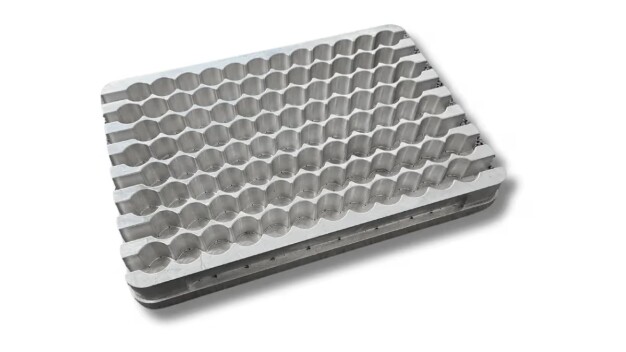
Illustration of a thermoforming tool made of aluminum © formary
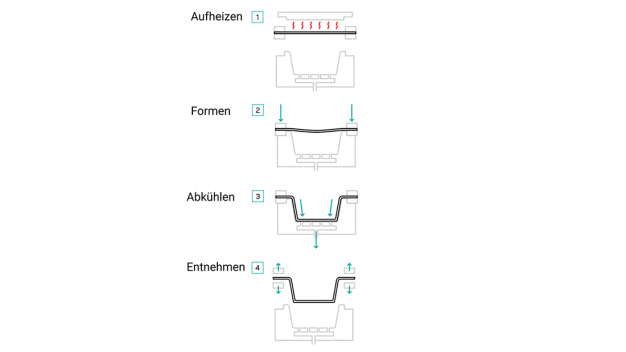
Drawing of the deep drawing process © formary
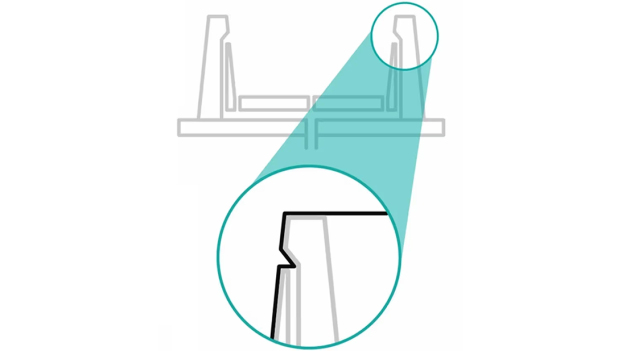
Illustration of a undercut © formary
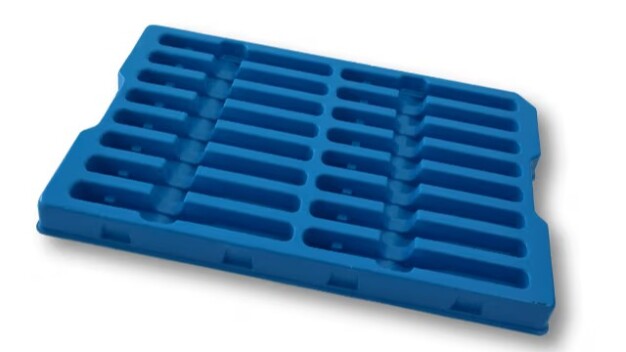
Illustration of a thermoformed blister for diagnostics & test kits © formary
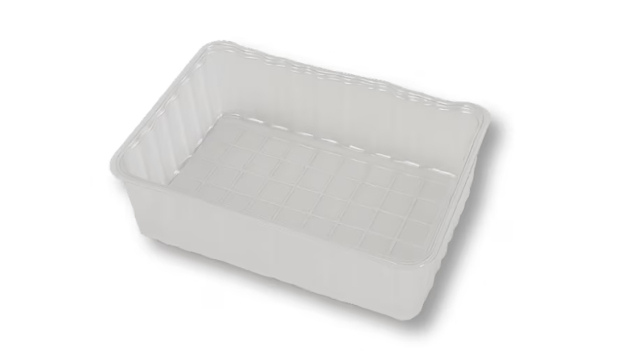
Container for surgical instruments and consumables made of PP plastic © formary
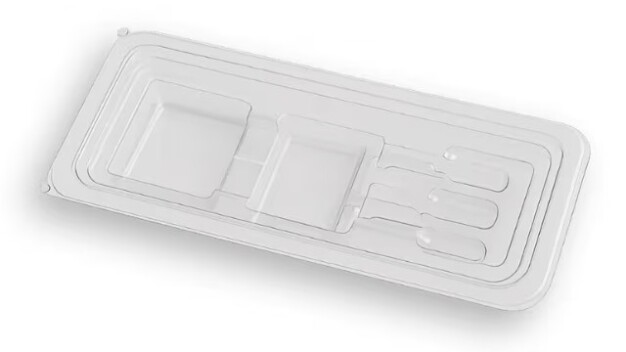
Example of a medical blister for syringes © formary
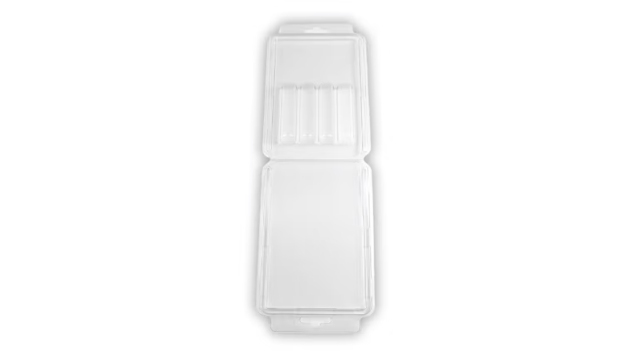
Lockable blister made of PET-G for dental sets © formary
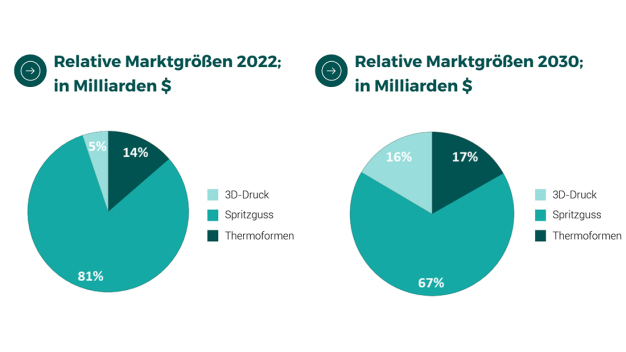
Market sizes of plastic manufacturing processes © formary
Medical thermoformed blisters, such as instrument trays or syringe inlays, are among the most inconspicuous but regulation-intensive components in medical technology. Because they must not only function mechanically but also maintain a sterile barrier throughout their entire shelf life, preventing microbes from entering, while simultaneously enabling sterile removal during use. This process does not only begin with the sterilization of the finished product but starts with the manufacturing environment itself.
Plastic thermoforming is often considered the simpler process for less critical applications, while injection molding is seen as the obvious choice for demanding medical products. This article demonstrates that this perception is too narrow. It describes how cleanroom manufacturing of thermoformed medical blisters works in practice, what requirements are placed on materials and sterilizability, where the advantage of tooling over injection molding becomes particularly evident, and where the process actually reaches its limits.
Why the demand is increasing right now
The number of surgical procedures is continuously increasing, driven by medical advances and an aging population. With each additional procedure, the need for individually sterilized instruments and implants grows. At the same time, medical devices tend to become smaller, more complex, and more sensitive. Catheters, sensors, and surgical instruments require custom protective packaging, which standard solutions often cannot provide.
Additionally, there is a trend that is directly noticeable for cleanroom operators: Medtech companies are increasingly focusing on their core business and outsourcing the development and validation of packaging. Therefore, partners who can flexibly produce small series, pilot batches for clinical trials, and customized products are in demand, without compromising time-to-market.
Injection molding or thermoforming: two paths to medical blisters
For manufacturing plastic packaging in the medical field, there are fundamentally two established processes: injection molding and thermoforming, also known as thermoforming. In injection molding, molten plastic is injected under high pressure into a closed mold, enabling very tight tolerances and complex three-dimensional geometries with undercuts. In thermoforming, a plastic sheet or film is heated and drawn over an open mold.
The key difference lies in the tooling itself. A thermoforming tool typically costs between 500 and 10,000 euros and is manufactured within one to two weeks. An injection mold, on the other hand, starts at around 20,000 euros and requires at least ten weeks for production. The economic crossover point between the two processes is usually between 5,000 and 50,000 units.
This trend increasingly favors thermoforming, as market data shows. Across industries, thermoformed plastics are projected to grow at 8.1 percent, significantly faster than injection molding at 4.8 percent. By 2030, the market share of thermoforming is expected to rise to 17 percent, while injection molding, also influenced by the growing 3D printing market, could lose as much as 14 percentage points.
Furthermore, thermoforming has also advanced technically. With the twin-sheet process, where two plastic sheets are heated simultaneously and formed into a closed hollow body, geometries previously reserved for injection molding can now be realized. High-quality, visible Class-A-like parts are now also being thermoformed, not just simple trays. Once a thermoforming tool is made from series materials like aluminum, it can be scaled to very high, six-figure quantities without rework.
However, these figures should be interpreted carefully in the medical sector. Injection molding will continue to play a central role here for the foreseeable future. The more likely development is not a competitive displacement but a gradual shift to thermoforming wherever technically feasible.
Why manufacture medical blisters in a cleanroom at all?
The MDR and ISO 11607 set increasingly stringent requirements for packaging of medical devices. Thermoformed blisters have established themselves as the standard solution, especially because the thermoforming process is considered automatable, thermally stable, and reproducible, making it well-suited for cleanroom conditions.
Additionally, there is the possibility of clear labeling, serialization, and barcoding, which are central to UDI and MDR compliance. Consistent quality and traceable documentation significantly facilitate audits and validations.
Which cleanroom class is relevant for medical blisters?
In practice, sterile primary packaging for medical devices is typically manufactured in a cleanroom of ISO class 8. This applies to instrument trays as well as combination blisters, such as for syringe and needle sets, or for syringe inlays. For packaging that does not need to be sterile, a clean production environment without full cleanroom classification is often sufficient.
Different systems exist for classifying these environments, depending on the industry: ISO 14644-1 distinguishes nine classes based on particle sizes between 0.1 and 5 µm. In pharmaceuticals, the EU-GMP guideline with Annex 1 is also common, dividing cleanrooms into classes A to D. The VDI guideline 2083 defines what constitutes a cleanroom and how it functions.
What changes under cleanroom conditions
At its core, the thermoforming process remains the same under cleanroom conditions. A plastic sheet or film is heated and drawn over a mold. What changes is the environment: the concentration of airborne particles is continuously monitored and controlled, personnel wear cleanroom clothing, and only materials and tools that meet the specified purity standards are allowed into the room. This includes, for example, plastics with particularly low particle abrasion.
Material selection: more than just purity
For medical blisters, plastics that offer sterilizability, chemical resistance, heat formability, as well as dimensional stability and toughness, are especially relevant. Different materials have become established depending on the application. PET is resistant to microbial attack, easy to seal, and highly transparent, facilitating visual inspection. PP offers excellent heat resistance, chemical and alcohol resistance, making it particularly suitable for sample and medication containers. PC scores with high impact resistance and good temperature stability. PET-G is often used for combination blisters where transparency and impact toughness are required.
The choice of sterilization method directly depends on the material. Ethylene oxide, gamma irradiation, and steam are common methods, but not all materials tolerate each process equally. For example, PP monomaterials provide biocompatibility and sterilizability across all three methods and are also highly recyclable.
Additionally, proof of biocompatibility is required whenever there is direct or indirect contact with the human body. Two standards are particularly important: USP Class VI, regarded by many authorities as the minimum requirement and applicable for all applications involving or contacting living tissue, and ISO 10993, an international series of standards for biological evaluation of medical devices. EU regulations REACH and RoHS are also relevant, and their compliance declarations should be requested early in procurement. All materials must come from suppliers who demonstrably meet these requirements.
Material selection is thus not just a procurement decision but a technical preliminary assessment, ideally completed before tooling design and not afterward.
The sterile barrier: what the blister must achieve
The blister must be designed to remain permanently sealed and still be opened in a controlled manner. In practice, this means, among other things, a continuous sealing edge that is flat and burr-free to ensure reliable sealing.
Rounded radii support safe handling, and sufficient material thickness ensures the necessary shape stability. Consistent documentation is crucial: serial numbers, barcodes, and clear markings ensure that packaging can always be documented and audits passed.
Where the process reaches its limits
Plastic thermoforming does not replace injection molding in every situation. At very high quantities, the cost advantage reverses because the higher tooling costs of injection molding only amortize beyond a certain batch size. For very complex geometries with pronounced undercuts such as hooks or ribs, and for very tight tolerances, injection molding is superior:
While tolerances of ± 1 mm are common in thermoforming, injection molding can achieve ± 0.1 mm, and for precision parts, even up to ± 0.025 mm. Achieving uniform wall thicknesses in complex shapes is also more difficult with thermoforming because the tool, unlike injection molds, only contacts the material on one side.
Conclusion
Cleanroom-compatible thermoforming is not a niche process for medical blisters. In many cases, it is even the more economical choice compared to injection molding, especially where batch sizes are small to medium and time is a critical factor. The real challenge lies less in the process itself than in the comprehensive documentation required by MDR and ISO 11607.
Moritz Bittner is co-founder of formary, a procurement platform for plastic thermoformed parts with a partner network of over 200 manufacturers, covering cleanroom manufacturing at various hygiene levels.
formary
71522 Backnang
Germany