




- Science
- Translated with AI
Kirsten Pötzke
Bringing innovative research into clinical practice
The ATMP-GMPDU Development Department at the Institute for Cell Therapeutics supports research groups in the development of new cellular medicinal products.
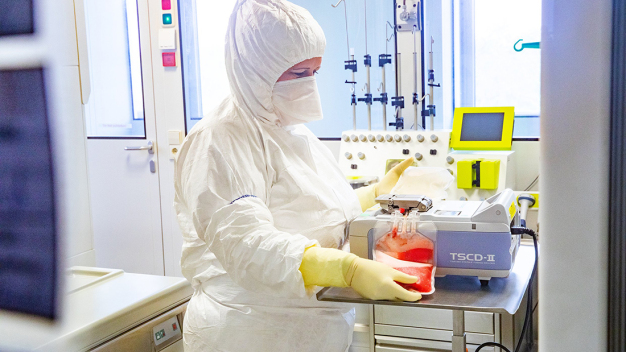
From laboratory development to production in the cleanroom: The Institute for Cell Therapeutics offers researchers advice and assistance in the manufacturing of new cell therapies. (Copyright: Karin Kaiser/MHH)
Using living cells for therapy is a promising alternative when traditional treatment methods fail in the fight against severe diseases. In addition to stem cell transplantation, therapies with genetically modified cells are now also approved as medicinal products for novel therapies in Europe. They are called Advanced Therapy Medicinal Products, or ATMPs for short, in their English designation. To prevent contamination with pathogens or unwanted effects, ATMPs must be produced under strictly controlled conditions according to the high quality standards of Good Manufacturing Practice (GMP) in cleanroom environments. This takes place at the MHH at the Institute for Cell Therapeutics, in the Cellular Therapy Centre (CTC) department. But the institute offers more than just manufacturing and quality control. One floor below, the ATMP-GMPDU development department provides research groups at MHH with their expertise and equipment to jointly realize innovative ideas for new cellular therapeutics.
Consulting from the start
"As a core facility, we support and advise research groups at MHH on how to implement their projects for the development of new cellular medicines according to GMP standards," says Dr. Ruth Esser, head of the development department. From the very beginning of a project, it is important to ensure that the requirements for later therapeutic application are met, emphasizes the cell biologist. This is especially true for the use of techniques and auxiliary substances. "From the start of the project, we already have the translation, the clinical application, in mind," explains the scientist. And there is much to consider, because even the best research idea can fail if it does not meet the later requirements of manufacturing facilities. "This sometimes involves trivial things like nutrient media or reagents that work flawlessly in the lab but are simply not approved for the production of a medicinal product and for use in patients," notes Dr. Esser. The core facility is aware of the specific requirements of potential industry partners and knows the strict regulations, manufacturing protocols, and systems of the responsible authorities such as the Gewerbeaufsichtsamt or the Paul-Ehrlich-Institut. As a link and translator between the scientists at MHH and the pharmaceutical companies, it ensures that research and manufacturing go hand in hand and reduces possible friction losses.
Risk of contamination excluded
However, the close collaboration between researchers and the GMPDU also has a very practical side. For certain phases of the experiment, MHH scientists can use the so-called Clinical Scale-Up Laboratory of the core facility, which offers them special equipment necessary for GMP-compliant work. This includes, for example, a device that allows the automatic production of cells. In this closed system, cells can be processed, genetically modified, and expanded in multiple steps. "With this cell processor, the risk of contamination is also eliminated without the addition of antibiotics," emphasizes Dr. Wolfgang Glienke, a scientific associate. Additional auxiliary devices, such as sterilized tubing connections or closures, are also necessary to work in compliance with GMP standards.
For preclinical research with cell cultures, the research unit also offers a large portfolio. "For example, we have developed standard procedures for isolating, activating, and expanding T and NK cells of the human immune system, which we make available to researchers at MHH as well as external companies," says Dr. Glienke. "Of course, we can also develop other cell culture models," adds the molecular biologist.
Fluorescence microscope enables long-term observation of cells
Before a newly developed cell therapeutic is put into production, it must of course be checked to see if it does what it is supposed to do. This is not so easy with living cells, because they need to be observed under conditions in which they can continue to survive. "For visual representation and long-term observation, we have a special fluorescence microscope with a dedicated incubation chamber that maintains temperature, humidity, and CO2 levels in the ideal range," says Dr. Glienke. It is also possible to investigate the interaction of different cell types and record it in a time-lapse video. A look through the microscope can show whether, for example, human T cells such as CARs and TRUCKs, genetically modified in the lab, actually recognize tumor cells better and attack them faster after activation. This service can also be used by research groups at MHH in collaboration with the core facility.
If the preclinical development of the new cell therapeutic is successfully completed, the process must still be checked at least three more times according to strict guidelines. This is done again in the cleanrooms of the CTC. "After validation is complete, the manufacturing license is applied for from the responsible state authority," says Dr. Lubomir Arseniev, head of the CTC. "A clinical trial is then decided at the federal level by the Paul-Ehrlich-Institut," he adds. Only after clinical testing does the new preparation have a chance to be approved on the market.
Medizinische Hochschule Hannover (MHH)
30625 Hannover
Germany



