

- Furnishing & equipment
- Translated with AI
Dirk Steil
BECKER Quick Out Material Lock
Innovation in lock technology
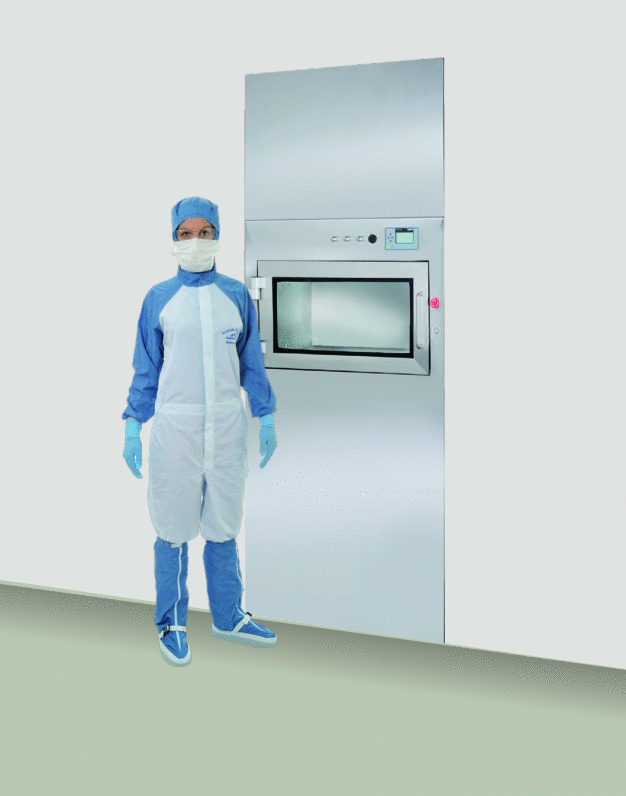
Interior view of the material lock in cleanroom class "B". Optimal integration into wall structures, even in existing rooms.
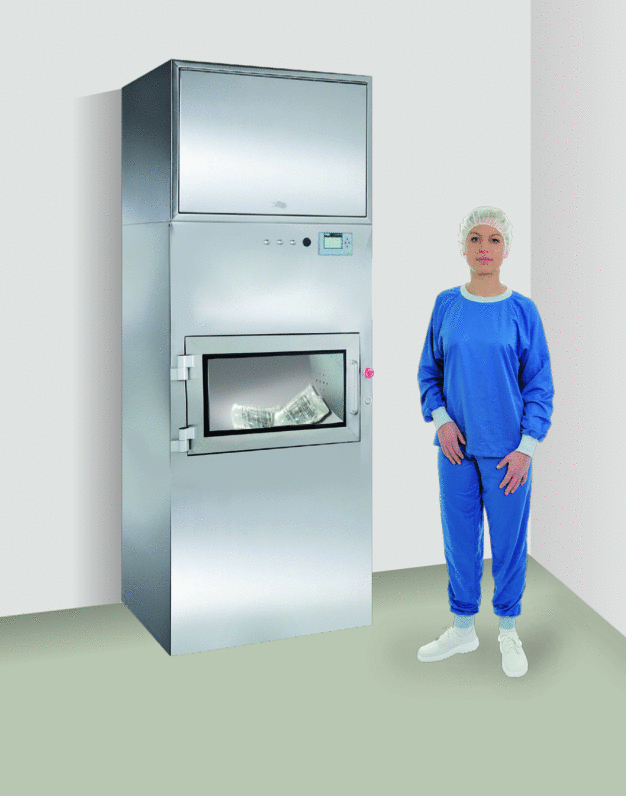
Exterior view in cleanroom class "E". Safe sampling possibility even from multiple products in one work step.
One essential characteristic of cleanrooms is the loading and unloading of materials and personnel across multiple cleanroom levels. In doing so, the material and personnel pathways are fundamentally separated to prevent cross-contamination. The following explanation focuses on the material pathway.
The material is transferred via so-called material lock chambers from one cleanroom class to the next after various cleaning and unpacking steps have been completed. These stages can, for GMP applications, be structured in up to four steps: from the unclassified environment into GMP Class D, from Class D to Class C, from Class C to Class B, and finally into the sterile area of Class A. The material lock chambers serve as a barrier between the cleanroom classes and form a small, enclosed space with interlocked doors. This ensures that the pressure differentials between the room classes are maintained and that there is no direct connection between the rooms. Additionally, the material lock chambers can be continuously flushed with H14-filtered air via active ventilation.
Another characteristic of working with lock chambers is that typically two persons are involved in the process: one person places the goods from the less clean side into the lock, and on the clean side, another person removes the goods. As described above, this process can be repeated multiple times until the goods reach the core of the cleanrooms. This is both sensible and necessary, as each step involves cleaning, unpacking, or disinfecting the product to ensure it arrives safely in the sterile area. At the same time, however, this process is also time-consuming and personnel-intensive.
Now, considering the unloading process of the finished and primary-packaged sterile product, it is reversed compared to the loading process and involves multiple steps with a similarly time-consuming transfer system. The difference from loading is that the product no longer needs to undergo individual processing steps before unloading; it is finished and protected, and could "actually" be transported outside via the fastest route.
This is precisely where the newly developed and patented "QuickOut" lock chamber from BECKER Cleanroom Technology comes into play: "actually," there is a desire for a quick route outside for the finished goods, but skipping multiple classes in a single unloading step has so far been very critical. Why? Conventional material lock chambers, as already described, consist of a lock chamber and two interlocked doors. The transfer process is usually such that the person on the clean side opens the door, places the goods into the lock, and then closes the door again. Only then can the door on the less clean side be opened to remove the goods. During this process, the person on the less clean side might leave contamination on the surface of the lock, for example with gloves, which could then be transferred into the cleaner area during the next loading. If one imagines that this process should occur across multiple classes (e.g., from B to D or from B to "E") in a single step, conventional solutions quickly reach the limits of process safety, as contamination can be transferred within a very short time.
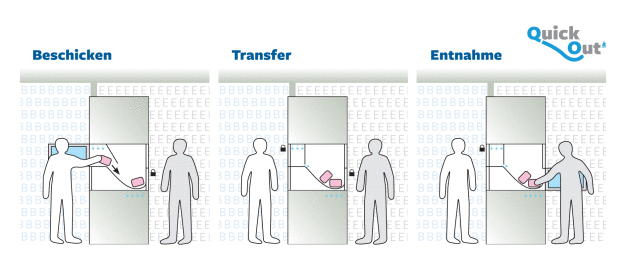
What does this new, patented solution look like? The goal was to ensure that no back-contamination into the clean area occurs when removing goods from the unclean area. This was implemented through a simple yet ingenious design: a lock chamber with two levels was developed; the goods in the upper, clean loading area are pushed through a flap and then slide by gravity into a lower, unloading area. Afterwards, both the flap and the clean door of the lock are electronically locked. Only then can the goods be removed from the lower, unclean unloading area. Due to the height difference of the levels and the locking of the passage flap, it is no longer possible to reach or contaminate the surfaces of the clean area from the unclean side; the clean area remains securely protected!
In addition to the spatial separation of the levels, active ventilation with H14-filtered air ensures continuous air exchange from the clean to the unclean side, preventing any airflow from the unclean into the clean area. The electronic locking of the two lock doors and the passage flap guarantees that there is always a closed space between the cleanroom classes, and the ventilation system can also create two additional pressure stages within a very small space.
Basically, the lock chamber can be filled from the upper area until a fill level indicator, using an optical sensor in the unloading area, reports: "Lock chamber full, please empty." Only then does the staff member from the unclean side come to empty the chamber.
The possible fill volume in the unclean area can be customized to the customer's requirements.
The entire construction is made of stainless steel 1.4301 in GMP-compliant processing. All surfaces are easy to clean, and due to its simple design, the lock chamber is also very low-maintenance.
The dimensions are individually adaptable, and thanks to its compact design, the QuickOut lock chamber is also ideally suited for retrofitting into existing cleanrooms.

BECKER Reinraumtechnik GmbH
Von-der-Heydt-Str. 21
66115 Saarbrücken
Germany
Phone: +49 681 753890
email: info@becker-reinraumtechnik.de
Internet: http://www.becker-reinraumtechnik.de