


- Translated with AI
A joint initiative against Corona: igus produces headbands for face shields
Thanks to injection molding, over 10,000 components leave the Cologne factory each week, speeding up assistance for doctors and caregivers.
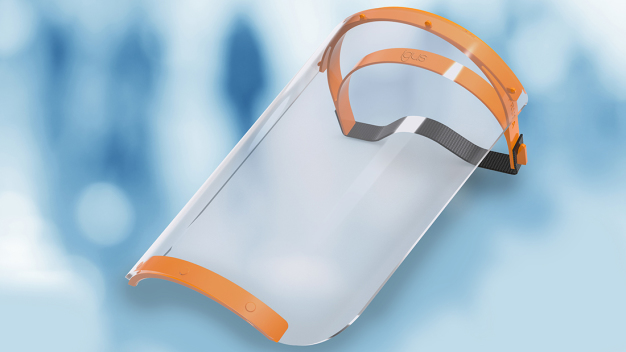
igus produces headbands for face shields at the Cologne site. Through the injection molding process, over 10,000 parts can be manufactured per week. (Source: igus GmbH)
Protection of medical personnel is currently one of the most important challenges. However, suitable equipment is not readily available in sufficient quantity and quality on the market. One solution includes face shields, which individuals and companies are currently manufacturing worldwide using 3D printing. igus has now addressed a key issue in production and is donating the first 100,000 injection-molded headbands.
To protect doctors, nursing staff, and other personnel working directly with patients, the 3D printer manufacturer Prusa has developed a face shield and made the design freely available for download online. The goal is to produce so-called "Face Shields" on as many 3D printers as possible. The project is already considered a success: individuals, maker networks, and companies worldwide are actively producing the face shields under high pressure through additive manufacturing. Initiatives like "Operation Shields Up!" in the USA are bringing volunteers together on their platforms. igus GmbH is participating in this global collaboration and is leveraging the advantages of the injection molding process.
Affordable mass production of face shields possible through injection molding
The design of a face shield is extremely simple: a 3D-printed plastic frame holds a replaceable plastic sheet that shields the face. These face shields are not a substitute for a mask worn additionally. However, they provide additional protection, especially for the eyes. They also reduce the natural reflex to touch the face and thus come into contact with the pathogen. Despite the simple construction, a central challenge remains. "Several makers have approached us asking if we, as a tribo-filament manufacturer, can provide material for this," recalls Tom Krause, Head of Additive Manufacturing at igus. "However, this does not solve the main problems: manufacturing the headband as a central component is relatively expensive with a 3D printer and takes more than two hours. Only a few parts can be produced per device each day." Therefore, igus relies on the advantages of another process, injection molding. Recycled material from iglidur A200 is used as the raw material. Dr. Thilo Schultes, head of toolmaking, explains: "With a suitable tool, over 10,000 headbands can be produced and delivered per week at the Cologne factory. This allows us to produce the headbands quickly in large quantities and at significantly reduced costs." igus manufactures the tooling at its own expense. The first 100,000 headbands are available free of charge; afterwards, they are available at manufacturing cost. Any net proceeds will be donated.
igus SE & Co. KG
51147 Köln
Germany