



- Visualisation
- Translated with AI
Which fog fluid is suitable for flow visualization according to GMP Annex 1?
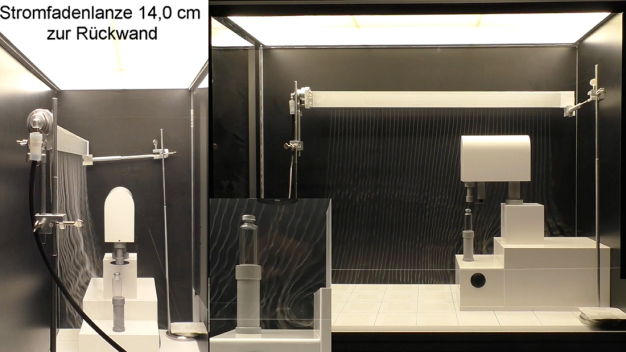
Test 1 – Visualization of the basic flow / Figure 2: Visualization of the basic flow with Nebula Fluid Extra Clean in the left image and via CFD simulation in the middle image. On the right, the visualization with water mist.
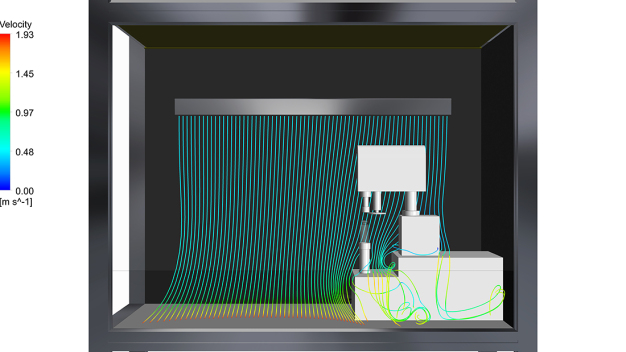
Test 1 – Visualization of the basic flow / Figure 2: Visualization of the basic flow with Extra Clean fog fluid in the left image and via CFD simulation in the middle image. On the right, the visualization with water mist.
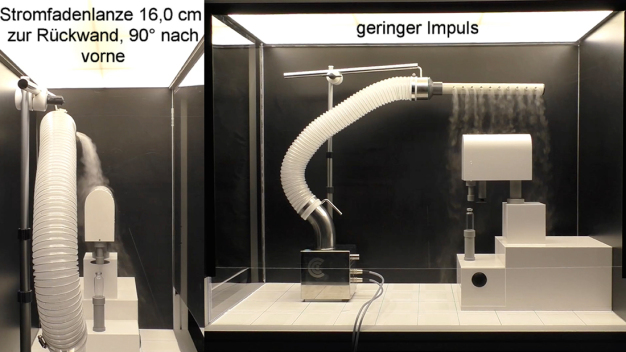
Test 1 – Visualization of the basic flow / Figure 2: Visualization of the basic flow with Extra Clean fog fluid in the left image and via CFD simulation in the middle image. On the right, the visualization with water mist.
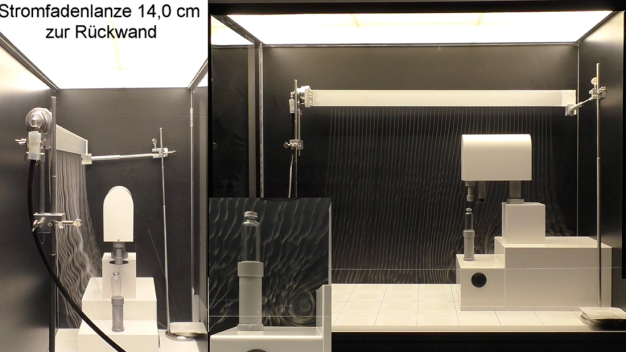
Test 2 – Visualization of vortex regions / Figure 3: Visualization of the vortex region with Extra Clean fog fluid in the left image, using CFD simulation in the middle image, and with water mist in the right image.
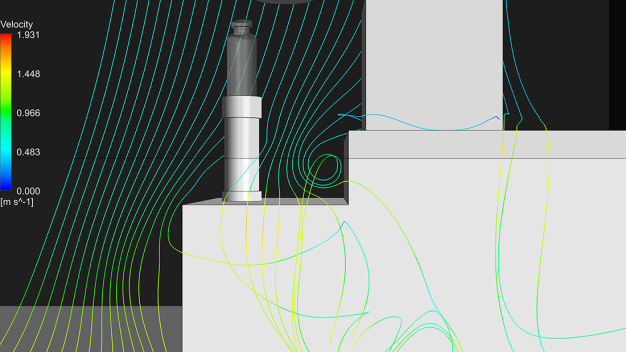
Test 2 – Visualization of vortex regions / Figure 3: Visualization of the vortex region with Nebelfluid Extra Clean in the left image, using CFD simulation in the middle image, and with water mist in the right image.
Test 2 – Visualization of Vortex Regions / Figure 3: Visualization of the vortex region with Nebula Fluid Extra Clean in the left image, via CFD simulation in the middle image, and with water mist in the right image.
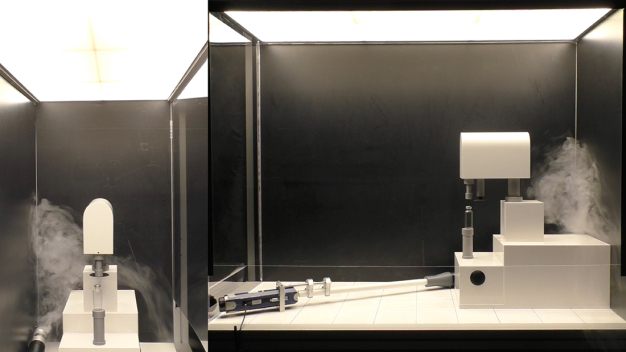
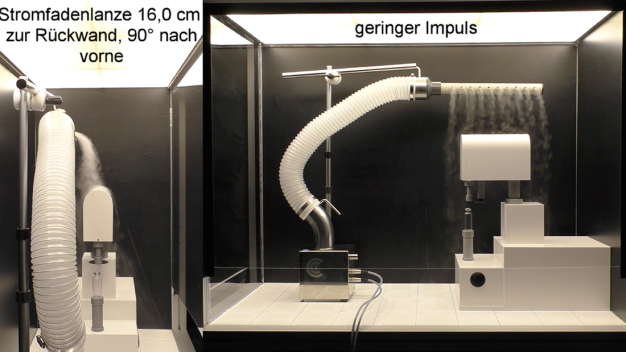
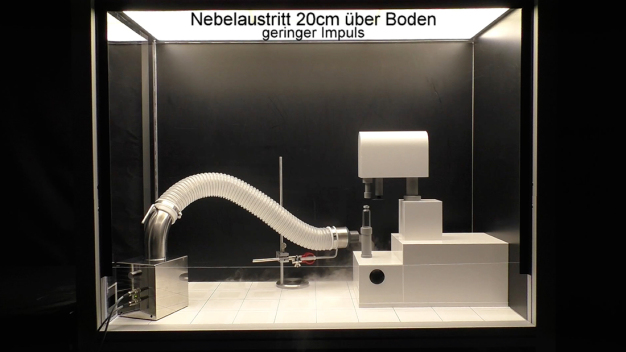
Test 3 – Visualization of the Fog Ascent Height / Figure 4: Visualization of the fog ascent height with Fog Fluid Extra Clean with low impulse in the left image. The middle image shows the visualization with water vapor with low impulse. The right image also shows water vapor but with high impulse
Test 3 – Visualization of the Fog Rise Height / Figure 4: Visualization of the fog rise height with Fog Fluid Extra Clean with low momentum in the left image. The middle image shows the visualization with water vapor with low momentum. The right image also shows water vapor but with high momentum.
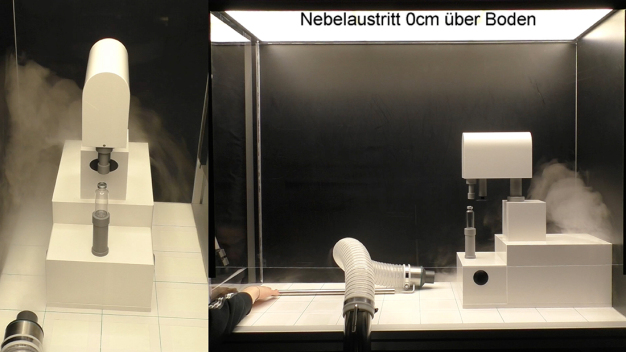
Test 3 – Visualization of the Fog Ascent Height / Figure 4: Visualization of the fog ascent height with fog fluid Extra Clean with low impulse in the left image. The middle image shows the visualization with water mist with low impulse. The right image also features water mist but with high impulse.
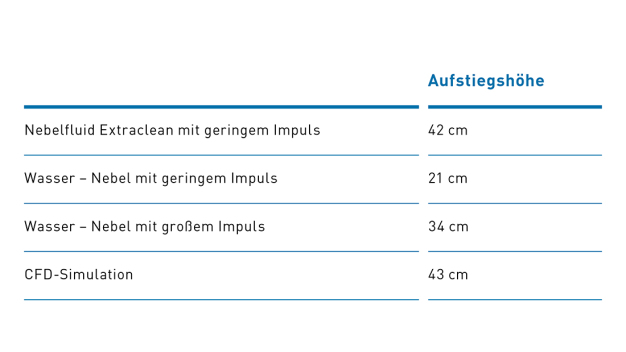
Table 2: Evaluation of the fog ascent height (see Figure 4)
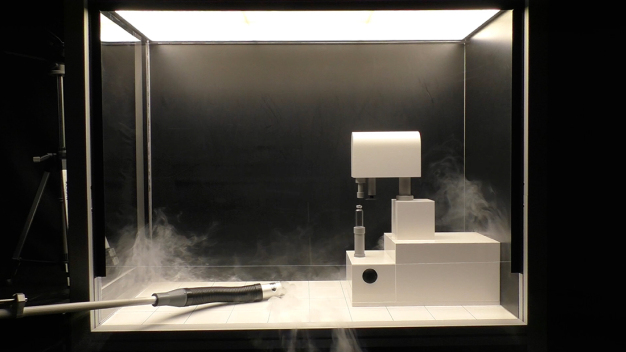
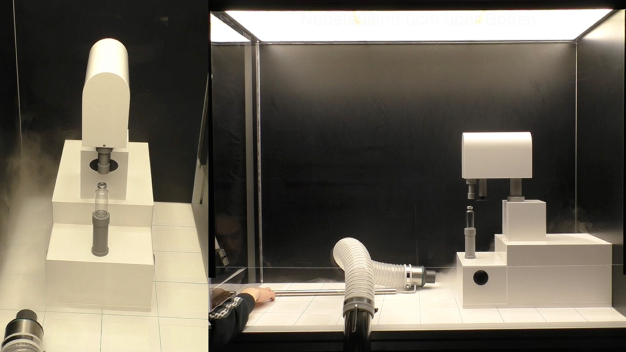
Test 4 – Visualization of cloud dispersion in vortex areas / Figure 5: Visualization of cloud dispersion with Nebelfluid Extra Clean with low momentum in the left image. The middle image shows a CFD simulation, and the right image displays water mist with low momentum
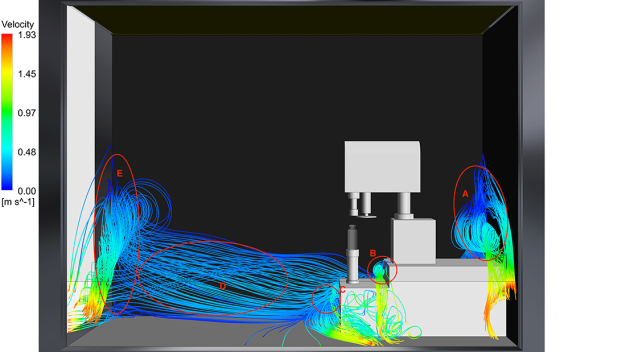
Test 4 – Visualization of cloud dispersion in vortex areas / Figure 5: Visualization of cloud dispersion with Nebelfluid Extra Clean with low impulse in the left image. In the middle image via CFD simulation and in the right image with water mist with low impulse
Test 4 – Visualization of fog dispersion in vortex areas / Figure 5: Visualization of fog dispersion with fog fluid Extra Clean with low momentum in the left image. In the middle image via CFD simulation and in the right image with water fog with low momentum
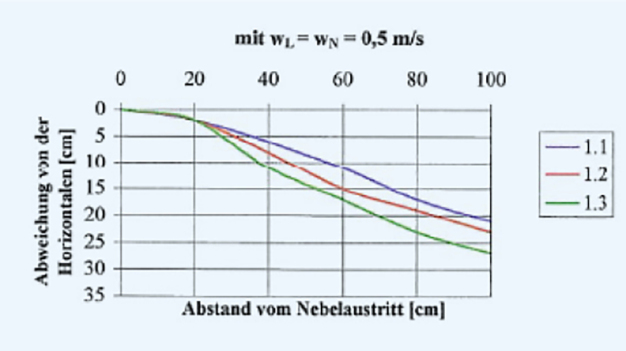
Figure 1: Sinking of the water fog with increasing distance from the fog outlet at three different fog densities (1.1, 1.2, 1.3) and initial horizontal velocity of 0.5 m/s in the horizontal flow area (Source: Diploma thesis)6
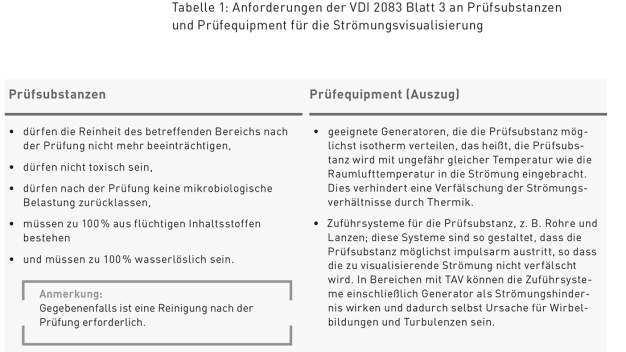
Table 1: Requirements of VDI 2083 Sheet 3 for test substances and test equipment for flow visualization.
The perfect fog fluid still does not exist. Pharmaceutical companies that perform or have performed airflow visualizations in critical cleanroom areas will find in this white paper comprehensive information to select the appropriate fog fluid for the specific application. A comparison between fog and CFD airflow visualization might also be helpful.
Introduction
Annex 1 to the GMP Guide 1) (hereinafter referred to as the new Annex 1) was published anew in August 2022. The old version from 2008 was extensively revised across all subject areas. This results in new requirements for cleanroom operators. The importance of airflow visualization has increased significantly due to the revision and is therefore more prominently featured during GMP inspections.
The new requirements for airflow visualization and the procedures for conducting airflow visualization have already been described in two white papers by STZ EURO 2). This white paper discusses which fog fluid is suitable for airflow visualization of TAV areas 3). The fog generators and fog delivery systems are also considered. The basis for the following explanations is a thesis completed at Hochschule Offenburg 4). Visualizations with fog were carried out as part of this work on a TAV unit (Flowbox) of STZ EURO. The 3D model of a Börde unit was provided by a pharmaceutical company. The CFD simulations were performed with ANSYS Fluent using the hardware and software of STZ EURO.
General information about test substances and testing equipment (see Table 1) can be found in VDI 2083 Part 3 5).
Typical Fog Fluids
– Water mist is usually generated using ultrasonic generators from pure water. The droplet spectrum produced ranges from 2 to 13 µm 6). The water droplets are mixed into an airflow within the fog generator. Due to the relatively high vapor pressure of water, the droplets evaporate quite quickly in the airflow. The energy for evaporation is drawn from the air. As a result, the air cools down (see Figure 1), and the air density increases.
– The fog fluid is heated to about 320°C using an evaporator and then mixed with room air 7). This creates droplets of 0.5 µm to 2 µm 7). These aerosols have a significantly lower vapor pressure compared to water and therefore remain longer in the airflow without evaporating. Since a large amount of room air is mixed at the outlet of the fog generator relative to the evaporated liquid, an almost isothermal fog results.
Note:
In addition, complex (computer-aided) visualization methods are possible (e.g., Particle Image Velocimetry (PIV), 3D velocity measurement with position and orientation detection, background-oriented schlieren method) 8).
Comparison of Test Substances Water and Fog Fluid Extra Clean (Test Results) 7
For the thesis prepared at STZ EURO, an ultrasonic fog generator and the associated equipment with a vaporizing fog generator were compared 4). An ultrasonic fog generator with a particularly small design from CCI – von Kahlden GmbH (Handy FOG) was used to minimize interference effects on the airflow. The vaporizing fog generator (Tiny CX) used special equipment from STZ EURO. In addition to airflow visualization, a CFD simulation was created as a reference for the test setup.
Test 1 – Visualization of Basic Airflow
The individual airflow streams are visible down to the floor. They run almost parallel and have low turbulence. The airflow pattern visualized with the flow probe and Fog Fluid Extra Clean matches very well with the CFD-calculated airflow pattern, especially in the relevant flow area near the glass vial (see Figure 3). The flow simulation reveals more details because the streamlines are colored according to airspeed and thus clearly visible against a white background.
Using a simple cylindrical lance and water mist (right image), individual flow streams can also be seen. Due to the geometry of the lance, even the introduction of fog into the airflow causes vortices. The fog is already so diluted after a short length of about 40 cm that the flow conditions in the area of the vial (see Figure 3) can no longer be fully recognized.
Test 2 – Visualization of Vortex Areas
By introducing fog at the bottom of the Flowbox, the vortex area formed between the wall and the Börde station becomes visible (see Figure 4). In this vortex area, the fog rises upward. Depending on the type of fog and the fog supply, different ascent heights of the fog are observed. The fog must be supplied impulsively to avoid influencing the airflow behavior. In the left and middle images with impulsive fog supply, it is evident that water mist rises significantly less. In the right image, also with water mist but with high impulse, nearly the same ascent height as in the left image is achieved, see also Table 2. According to VDI 2083 Part 3, fog addition should be impulsive. Therefore, the visualization method shown in the right image of Figure 4 would not be permissible.
Test 3 – Visualization of Fog Ascent Height
see table
Test 4 – Visualization of Fog Spread in Vortex Areas
Finally, the spread of fog in the vortex areas was analyzed by impulsively releasing fog at the bottom, enriching the existing vortex areas along the back wall of the Flowbox with fog (see Figure 5). It can be seen that the spread of fog using Fog Fluid Extra Clean (left image) corresponds well with the simulation (middle image). In all areas (A to E), fog is visible. In the visualization with water mist (right image), fog is only visible in area C. The airflow and thus the fog spread in areas D and E are blocked by the housing of the fog generator. Due to impulsive fog release, no fog is visible in areas A and B of the right image (see also the middle image of Figure 4).
Conclusion
– A good agreement between CFD simulation and experiment was achieved using the fog fluid Safex® Extra Clean F&D.
– This requires suitable equipment for fog application (size, impulse) that does not distort the airflow conditions.
– No agreement was found when using water mist with the simulation.
– Fog based on suitable fog fluids, comparable to the above, can be used without restriction for visualization in confined TAV areas, such as insulators, when combined with appropriate equipment from a flow technical perspective.
– Water mist is only conditionally suitable for visualization in confined TAV areas with the equipment used.
– Flow visualization in the GMP environment serves as proof to authorities that the airflow conditions meet the requirements of Annex 1. Therefore, visualization that accurately reflects the actual airflow conditions is of particular importance.
– CFD simulation can already contribute during the design phase to ensure that clean air systems meet flow technical requirements. This helps avoid deviations during flow visualization in qualification, saving time and costs.
Sources:
1) The Rules Governing Medicinal Products in the European Union Volume 4 EU Guidelines for Good Manufacturing Practice for Medicinal Products for Human and Veterinary Use, Annex 1, Manufacture of Sterile Medicinal Products GMP = Good Manufacturing Practice.
2) STZ EURO: Publications Whitepaper, stz-euro.de/publications/?_sfm_type=Whitepaper.
3) Areas with low-turbulence displacement flow (TAV), often also called laminar flow.
4) P. Moschberger: Comparison of experimentally and numerically determined flow conditions in a clean air system with low-turbulence displacement flow, February 2023.
5) VDI 2083 Part 3: Cleanroom technology measurement technology, August 2022.
6) Andreas Kaupp; Dietmar Thierer: Study on the behavior of tracer particles under flow conditions typical for cleanrooms. Diploma thesis, August 1996.
7) Günther Schaidt Safex Chemie GmbH: Data sheet for fog fluid Safex® Extra Clean F&D. January 2020.
8) N. Otto, M. Kuhn: Cleanroom measurement technology. The most important changes in the fully revised guideline VDI 2083 Part 3. TechnoPharm 12, No. 2, 92–101 (2022).
Author
Dipl.-Ing. (FH) Michael Kuhn, together with Benjamin Pfändler, heads the Steinbeis Transfer Center for Energy, Environment, and Cleanroom Technology (STZ EURO) in Offenburg.
He has contributed as chairman to the development of VDI 2083 Part 19 (Cleanroom tightness) and VDI 2083 Part 4.2 (Energy efficiency). Most recently, he helped develop the new VDI 2083 Part 3. Until 2019, he was a lecturer for cleanroom technology and ventilation technology at Offenburg University of Applied Sciences and Nordwestschweiz University of Applied Sciences. He is also a publicly appointed and sworn expert for air and climate technology, especially cleanroom technology.

STZ EURO Steinbeis-Transferzentrum
Energie-, Umwelt- und Reinraumtechnik Offenburg
Badstraße 24a
77652 Offenburg
Germany
Phone: +49 781 20354711
email: mkuhn@stz-euro.de
Internet: http://www.stz-euro.de