- Know How, Institute
- Translated with AI
Unbroken demand for the highest manufacturing quality as a growth driver in the large D-A-CH cleanroom market
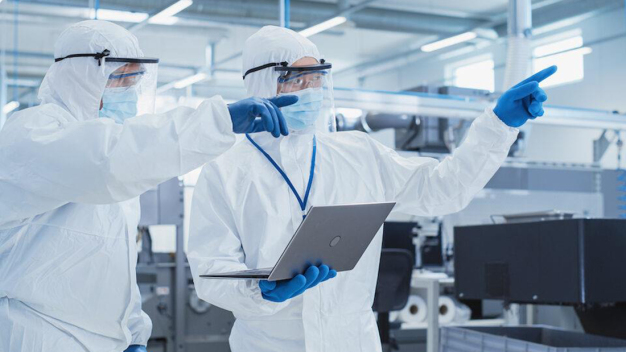
The cleanroom market in the D-A-CH region is an innovative, demanding, and highly dynamic market. That it is also a very large market with a total floor space of 3.3 million square meters was previously unknown. Since not only the two major industries of pharmaceuticals/chemicals/cosmetics and microelectronics are experiencing growth, but also sectors such as optics/laser, mechanical engineering, food, automotive, and recently battery cell manufacturing are increasingly requiring larger areas for production in cleanrooms, the German cleanroom market is growing at nearly 10% each year.
Industrial development has, since the invention of the steam engine, given rise to a wide variety of industries, from iron/steel, textiles, to chemical industries and many subsequent industries. Modern production methods now require increasingly pure manufacturing environments due to the growing complexity of products and heightened quality demands. A number of industries, primarily pharmaceuticals, chemicals, and microelectronics, can only carry out critical parts of their production under cleanroom conditions. One of the most unusual, interesting, and at the same time least transparent markets is therefore the cleanroom industry.
This structure has shaped the cleanroom industry for many years, but now large parts of modern industrial production are being affected by stricter quality management requirements, leading to increased cleanroom manufacturing in machinery, optics/laser, automotive, food, biotech, and battery cell production.
The cleanroom sector itself, as a cross-industry, consists of various individual sectors—from cleanroom planning, construction, to equipment (floors, ceiling/wall panels, climate/filter systems, special clothing, room furnishings, and devices).
Possibly, this segmentation has prevented a unified view of the market in its homogeneity, as until now, basic data on the German or European cleanroom market was lacking.
This gap was filled by macrom Marketingresearch & Consult with the first market analysis "The German Cleanroom Market 2024 (Excursion D-A-CH)".
The Central European D-A-CH cleanroom market, with 3.3 million square meters of existing space, is much larger than previously known. This is linked to strong past development in the GMP sector, primarily driven by the German and Swiss pharmaceutical and medical technology industries. But also the electronics/microelectronics sector, which is strong in Germany and partly in Austria, indicates a similarly strong positioning of ISO classes.
A new development now also encompasses new industries where production under cleanroom conditions is increasingly mandatory. In Austria and Switzerland, food has long been produced in cleanrooms to improve shelf life and minimize preservatives, whereas in Germany, this was not yet widespread.
Even suppliers in the automotive sector are increasingly being required by their clients to produce in cleanrooms, leading more operators in this industry to establish cleanrooms following the supply chain principle. The same trend is occurring in German and Swiss machinery manufacturing. Many startups with their innovative and complex products—such as battery-powered aircraft, biotech, etc.—also require cleanroom conditions for their production.
Unlike in Austria/Switzerland, especially in Germany, a market for the settlement of existing (semiconductor industry) and new technologies is developing, driven by strong public (national and EU) funding, which often involves large projects with significant cleanroom needs (Tesla/CATL, etc.). Soon, Microsoft will also invest in large data centers with high cleanroom requirements in the former lignite mining area of NRW.
Different industries also demand different cleanroom classes. For example, the pharmaceutical/chemical industry or medical technology previously required GMP classes, comparable to electronics/microelectronics in the ISO sector.
However, both sectors did so to a similar extent, resulting in a relatively balanced market share distribution when considering the market. In the GMP sector, the largest part of the market was concentrated in a single class, while a more differentiated structure was observed in the ISO class distribution. The dominance of the two main sectors in GMP (pharmaceuticals/chemicals/cosmetics and medical technology) and ISO (electronics/microelectronics) is gradually declining overall, as they lose significant market shares to other prospering sectors. These are almost exclusively in the ISO sector, which is experiencing sustainable growth, including the cleanroom classes associated with these industries. However, there is also a countertrend, strategically driven by supply security, reducing dependence on the Chinese market, and strengthening R&D projects in Europe, leading to the repatriation of pharmaceutical production to Europe. Additionally, outsourcing trends in German cleanroom manufacturing to other European countries are again observed.
The German cleanroom market is by far the most dynamic in the D-A-CH region, also acting as a kind of lead market for the region, as many functions such as cleanroom planning, construction, filter system manufacturing, or wall/ceiling panel production are concentrated in Germany.
As an independent service market within the German cleanroom market, the cleaning market is mainly covered by specialized cleaning service providers. This market is relatively concentrated, with significant market shares held by well-known large companies, covering the majority of the market. Residual market shares are held by regional, smaller companies as well as by the operators' own cleaning services.
The large number of cleanroom employees is also served by a group of specialized cleanroom clothing suppliers, providing disposable clothing as well as reusable clothing, often via rental textile services, which naturally require laundry, processing, and transport under cleanroom conditions. Both the clothing (only partially) and laundry services are carried out by designated cleanroom laundry specialists. The German laundry market is highly concentrated, and the few providers also serve operators in Switzerland. Recently, the German company Bardusch opened the first cleanroom laundry in Switzerland.
Overall, despite many indications of a homogeneous economic area with strong interconnections, the D-A-CH market is more differentiated, with varying market volumes, segmentations, and development dynamics.

macrom Marketingresearch & Consult
Kölner Str. 6
51429 Bergisch Gladbach
Germany
Phone: +49 (0)2204 963 555 1
Fax: +49 (0)2204 979 635 0
email: jansen@macrom.de
Internet: http://www.macrom.de