


- Science
- Translated with AI
Wolfgang Richter
TU experiment started in All
On March 11, 2025, at 10:15 AM CET, a high-altitude research rocket launched in Sweden
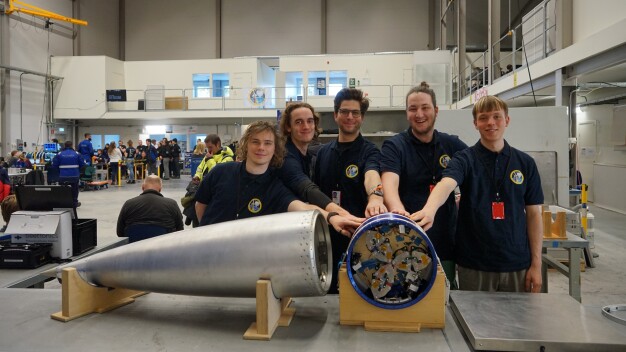
The student preparation team has been in Kiruna for a week: Felix Oesterle, Nima Mirrafati, Felix Schoetzau, Matteo Grube, Arved Dörpinghaus (l.r.) in front of the experiment module and rocket tip.
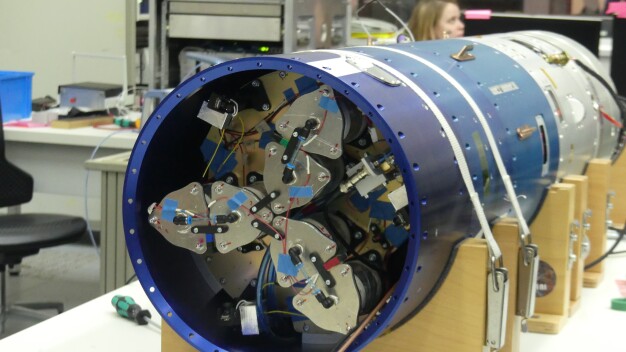
Experiment module in the body of the rocket
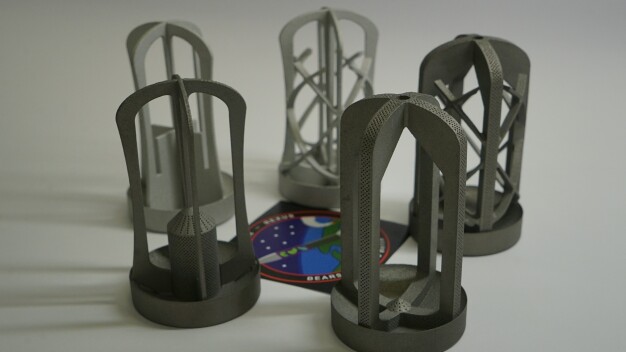
Propellant Management Devices produced by the team using 3D printing
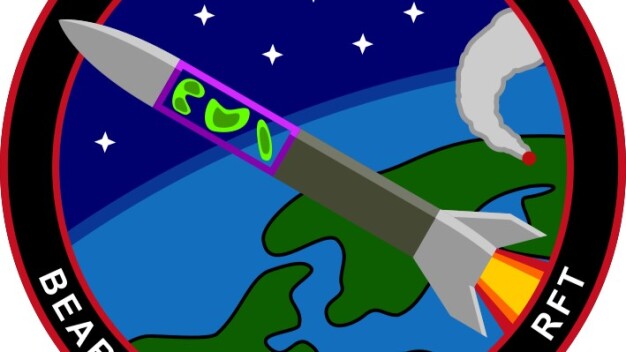
Traditionally, every space mission has its patch, the "patch," and so does WOBBLE2.
As part of the European program REXUS (Rocket Experiments for University Students), a high-altitude research rocket was launched on March 11, 2025, from the Esrange Space Center near the Swedish town of Kiruna. Included: an experiment from TU Berlin testing innovative, 3D-printed fuel tanks for space applications. A team from the "BEARS e.V." spaceflight club (Berlin Experimental Astronautics Research Student Team) at TU Berlin had successfully applied for REXUS. This student space program is supported by the German Aerospace Center (DLR) and the Swedish Space Agency SNSA. A team of five students had already been in Kiruna for a week, conducting final tests and installing the experiment into the rocket. Three more – one female student and two male students – traveled to launch. A total of eight teams participated in northern Sweden, deploying their experiments with two high-altitude research rockets towards space. For about two minutes, it was possible to conduct experiments under weightlessness.
"We are very pleased that the launch went so smoothly; after all, we have been working on this mission for almost two years," says Matteo Grube, a master's student in aerospace engineering. "Now, we are analyzing the measurement data collected during the weightless phase. That will keep us busy for a while." Test objects included six different rocket fuel tanks produced with 3D printing. This new manufacturing technology simplifies production and enables new designs at the same time.
Fuel must stay controlled in weightlessness
Liquid fuel in a rocket tank behaves very differently in weightlessness because, due to the absence of gravity, it is no longer pulled towards the Earth. The free-floating liquid could cause problems with the orientation control of rockets and satellites, as well as prevent the fuel from flowing optimally from the tank outlet towards the rocket engine. "So far, welded plates or hollow profiles have provided solutions," explains Grube. These structures are called "Propellant Management Devices" (PMDs). "We wanted to test various new designs for PMDs that can only be manufactured using additive manufacturing processes." Just over ten years ago, 3D printing was established for metals as well. Here, a laser beam melts metal powder at specific points, creating any three-dimensional shape.
Six different shapes for fuel tanks are being tested
Six different shapes for the PMDs have now been tested. Six cameras observed the tanks during the two-minute weightless phase. They were simply filled with water containing a fluorescent substance for the experiments. To film the behavior of the water, the outer shell of the tanks was made of Plexiglas. The experiment is also reflected in the acronym "WOBBLE2," which the team named: "Weightless Observation of Fluid Behaviour with Berlin Liquid Guidance Experiment." The number 2 indicates that the idea with the new tank designs almost made it into another competition—back then, an experiment was sought that German astronaut Matthias Maurer later took into space.
The project would not have been possible without generous support
"We are very happy that so many students from the team could fly to the Esrange Space Center," says Benedict Grefen from the TU Berlin Department of Aerospace Engineering, who supervises the student team and was the initiator of the project. "We received travel cost support multiple times from the Society of Friends of TU Berlin, including for a preparatory meeting last year in Kiruna." Additionally, the students received support from the company APWORKS GmbH for metal printing, and from Sensirion AG for sensor acquisition, as well as travel support and team T-shirt printing.
Technische Universität Berlin
10587 Berlin
Germany