


- Clothing & Packaging / Films
- Translated with AI
Fa. Pfennig Reinigungstechnik
Single-use? Reusable? The solution!
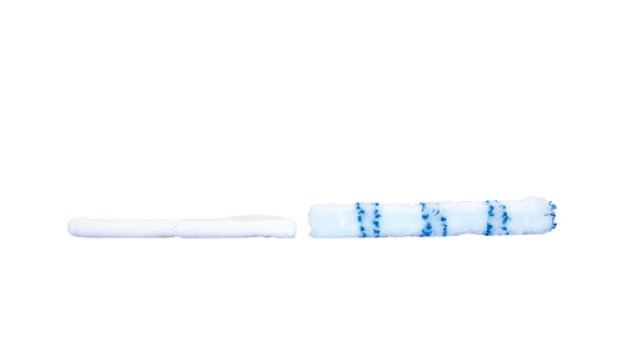
Fig. 1: Representation of the different material thicknesses between disposable mop cover (white) and reusable mop cover (white/blue).

Fig. 2: Fabric structure of a disposable wipe cover.
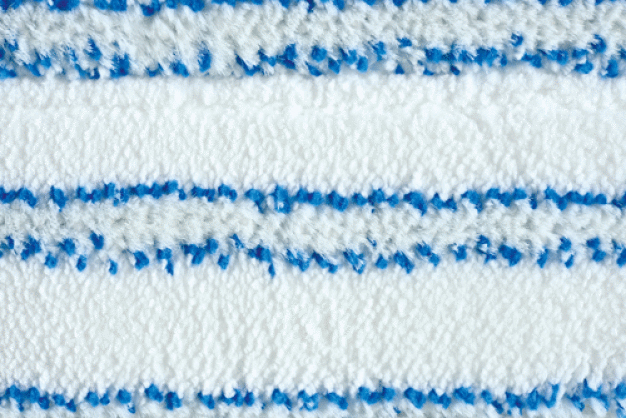
Fig. 3: Woven structure of a reusable wipe cover.
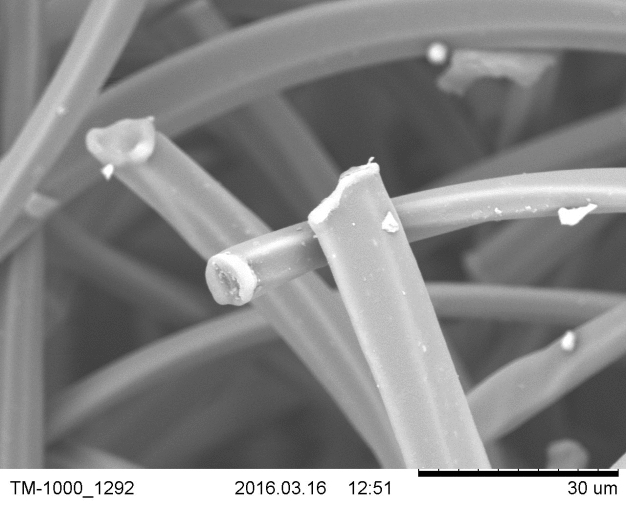
Fig. 4: SEM images of a reusable wipe cover to examine changes due to aging. a) B3W: 3 cycles washed and used, 2000x magnification b) B100W: 100 cycles washed and used, 2000x magnification c) B50WS: 50 cycles washed, sterilized, and used, 2000x magnification
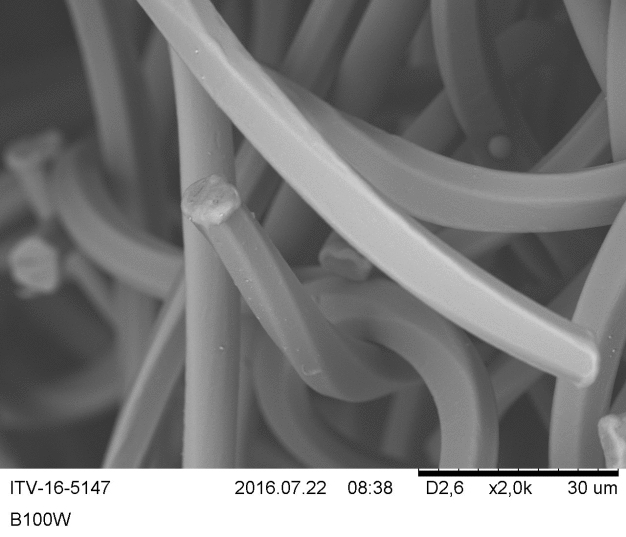
Fig. 4: SEM images of a reusable wipe cover used to examine changes due to aging. a) B3W: 3 cycles washed and used, 2000x magnification b) B100W: 100 cycles washed and used, 2000x magnification c) B50WS: 50 cycles washed, sterilized, and used, 2000x magnification
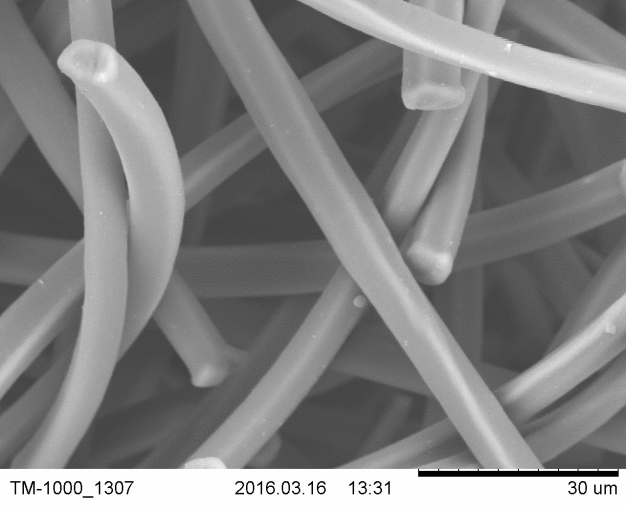
Fig. 4: SEM images of a reusable wipe cover used to examine changes due to aging. a) B3W: 3 cycles washed and used, 2000x magnification b) B100W: 100 cycles washed and used, 2000x magnification c) B50WS: 50 cycles washed, sterilized, and used, 2000x magnification

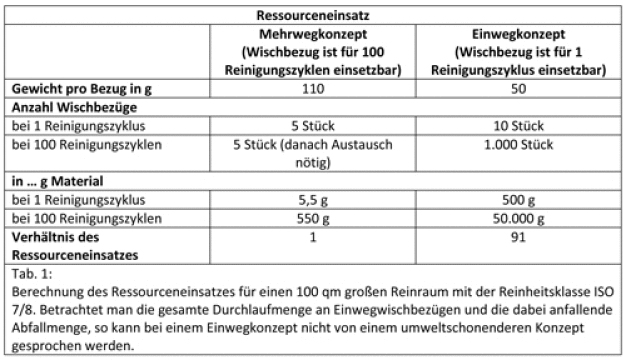
Table 1
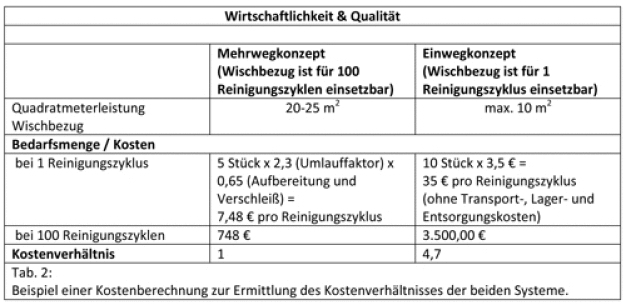
Table 2
When implementing a cleaning and disinfection concept for the manufacturing area in the cleanroom, many users face the question of whether a single-use concept or a reusable solution is more sensible. The answer depends on numerous factors that must be weighted differently within the company. Not only the weighting of individual factors is decisive in the decision, but also an overall view of the concept. Both the overall assessment and the company-specific weighting lead to the solution path.
The individual decision factors are described below.
Performance
The performance of a wiping textile includes the square meter performance (i.e., the area that can be wiped with one wiping textile) and the cleaning performance (i.e., the absorption capacity and binding ability of contaminants). To ensure the wetting of the wiped surface with a uniform liquid film, the liquid absorption capacity and the liquid release ability must be evaluated [1].
Generally, reusable textiles are manufactured more elaborately and processed more high-quality [Abb. 1 to 3], as they are used multiple times and the performance should be maintained over a longer lifespan [Abb. 4]. The high-quality manufacturing of reusable textiles significantly enhances overall performance [2]. Due to the woven manufacturing method of reusable wiping cloths, for example, the fiber surface area is considerably larger compared to single-use wiping cloths, enabling significantly higher liquid absorption and binding of contaminants. An additional backing, as only implemented in higher-quality reusable wiping cloths, provides an extra liquid reservoir. Therefore, depending on the application area and type, reusable cloths can be evenly wetted and effectively cleaned over an area of 15 to 25 sqm. Single-use wiping cloths reach about 7 to 10 sqm. With an additional inlay as a reservoir, up to 15 sqm can be covered.
Safety
A crucial factor in choosing a suitable cleaning and disinfection concept is safety. Regarding the suitability for purity (i.e., the appropriateness of a wiping cloth for use in the respective cleanroom and the defined process) and also concerning potential hazards, the spread of critical substances must be minimized. Additionally, process safety must be considered through validated results and secure application.
High hazards and risks exist through the spread of critical substances via the used wiping textiles and through the washing process. Therefore, single-use wiping textiles are especially needed in many sensitive industrial sectors where substances pose a high risk to humans and the environment. These substances include, for example, biological agents, highly active ingredients like antibiotics, and toxic substances such as cytostatics.
In facilities where the risk is defined by the introduction of unwanted contamination via the wiping textiles, safety is guaranteed through proof of suitability for purity. A wipe textile can introduce particles, especially textile filaments and fiber fragments, as well as foreign substances and microorganisms. The processing of textiles after production and before entering the cleanroom is therefore a critical process, as it influences the purity of the wiping textile. To enable a textile to perform optimally, it must be freed from technical auxiliaries necessary in textile manufacturing and washed at defined temperatures. This applies to both reusable and single-use textiles. The processing should be carried out according to the target cleanliness zone, i.e., with appropriately pure water and washing cycles that ensure the safe removal of all contaminants, including detergents. If sterilization is required, it must be ensured that the sterilization process used is actually suitable to produce a sterile wiping textile. For reusable wiping cloths, not only the initial processing is critical, but also subsequent processing cycles. It has been proven that the processing of wiping cloths in a cleanroom laundry, with validated processing procedures under cleanroom conditions, does not affect the suitability for purity of reusable wiping textiles [3]. Also, in use, purity-critical factors come into play, which are defined by performance.
Availability
Availability not only describes proximity to a suitable laundry but also the calculation of the necessary quantity of wiping textiles, including storage.
There are areas where no validated cleanroom laundry is available under cleanroom conditions, making a single-use concept safer. Also, in cleanrooms that are not used daily (e.g., in research, pharmacies, smaller manufacturing facilities, or facilities that only use the cleanroom for specific activities), a calculation of the required amount of wiping textiles may favor the single-use concept. When planning a single-use concept, storage must be considered. For large cleaning areas, an appropriately dimensioned storage must be available. At higher demand levels, a reusable concept with leasing options can be more cost-effective, as only the directly needed number of wiping textiles needs to be kept in stock. If there is a corresponding contract with a cleanroom laundry, pickup and delivery of the wiping textiles can be tailored to operational needs.
Ecology
Sustainability should also be a topic in the cleanroom. An ecological overall view includes not only the frequency of processing wiping textiles but also the type and amount of packaging that must be disposed of. Furthermore, the surface area performance of the wiping cloth, which influences the amount of textiles needed and resource consumption [Tab. 1], as well as transportation, are part of the overall balance (see Table 1).
The processing of reusable textiles takes place in validated and environmentally tested processes in cleanroom laundries. German and European cleanroom laundries demonstrably comply with regulatory requirements.
Manufacturing facilities working with hazardous substances have a disposal concept due to legal requirements. Disposal costs are accounted for from the outset. Facilities that do not produce under these conditions usually do not include disposal costs in their cost analysis.
To create a meaningful calculation, disposal of the textiles, product packaging, and transport packaging must be considered for single-use concepts. For reusable textiles, only the disposal of the inner packaging is necessary, depending on purity requirements. Wiping textiles and transport boxes are reused multiple times.
Ecology and sustainability also mean considering the transportation routes of wiping textiles, even if this does not directly affect the costs of a wiping textile initially. It should be kept in mind that the cleanroom laundry already transports the object in which the cleanroom is located to deliver the clothing. If the same cleanroom laundry is chosen for processing the wiping textiles as for the clothing, the delivery can be excellently combined. In contrast, with a single-use concept, the single-use textiles must first be transported from Asia and then delivered separately to the customer.
Costs
All the factors mentioned above play a role in cost considerations. Reusable textiles benefit from cheaper leasing agreements, which are usually concluded together with the necessary cleanroom clothing.
For better understanding, a cost calculation is performed below using an example. The prices are symbolic examples, as they depend on the requirements of the cleanroom and the respective cleanroom class, operational guidelines, processes, concepts, and quantities, which are negotiated customer-specifically. However, the relationships between the concepts correspond quite closely to market conditions.
The basis of the cost calculation is the size of the area to be wiped, from which the costs per square meter are derived. Changing the wiping cloth after a maximum of 10 m² is appropriate and sensible for a single-use mop. For reusable cloths in the ISO 7/8 range, it is easily assumed that 20-25 m² can be covered. In GMP areas, 15 – 20 m² are realistic. It can be approximately stated that the required amount of wiping cloths halves in the reusable concept compared to the single-use solution. Since the cloths need to be washed, a larger procurement quantity is naturally necessary to maintain the cycle. A factor of 2.3 is typical here.
The costs for processing in a cleanroom laundry, including the depreciation of the wiping cloth (leasing concept), are estimated at 50 to 80 cents per piece. The price for a single-use mop can be set at 2 to 5 euros (depending on quality and quantity), resulting in an average of about 3.50 euros. For simplicity, calculations are continued using the average of these two price ranges. Thus, for a hypothetical cleanroom of 100 square meters in a GMP C/D area, the following calculation is shown in Tab. 2 (see Table 2).
This exemplary calculation shows that the single-use concept is significantly more expensive. Transport, storage, and shipping costs, which must also be included in a total cost calculation, have not been considered. This means that (even with higher square meter performances of single-use wiping cloths or lower purchase prices), the single-use concept is only sensible overall if factors such as very small demand quantities or high safety regarding the possible spread of hazardous substances are weighted more heavily.
Conclusion
There are areas where a clear result in favor of single-use concepts emerges based on the weighting. This is especially the case when there is a risk to humans and the environment, and single-use wiping textiles must be disposed of immediately after use according to the hazard. Also, in research areas or smaller manufacturing facilities where work is irregular, a single-use concept is more cost-effective due to the low demand. The same applies if a local cleanroom laundry is not available. For all other applications, a comprehensive view of all factors (not just purchase prices) generally leads to the more cost-effective reusable solution.
Literature
[1] Witt-Mäckel M., Pfennig D. (2015). Suitability for Purity – A Challenge for Practice. Cleanroom Online 10/2015, pp. 15 - 17. www.reinraum.de.
[2] Pfennig D., Witt-Mäckel M. (2017). Cleanroom Cleaning and Disinfection. From Planning to Operation. PharmaTechnikJournal 06/2017, pp. 330-335. ECV-Verlag: Aulendorf.
[3] Schmeer-Lioe G., Witt-Mäckel M., et al. (2016). Reprocessing Suitability! Analyses of Aging of Reusable Wiping Cloths for Cleanroom Applications. Cleanroom Technology 05/2016, pp. 48–53. Weinheim: Wiley-VCH Verlag.

Pfennig Reinigungstechnik GmbH
Heubachstr. 1
87471 Durach
Germany
Phone: +49 831 561220
Fax: +49 831 61084
email: info@pfennig-reinigungstechnik.com
Internet: http://www.pfennig-reinigungstechnik.com