

- R+D & Community of Interest
- Translated with AI
Research on 3000 square meters
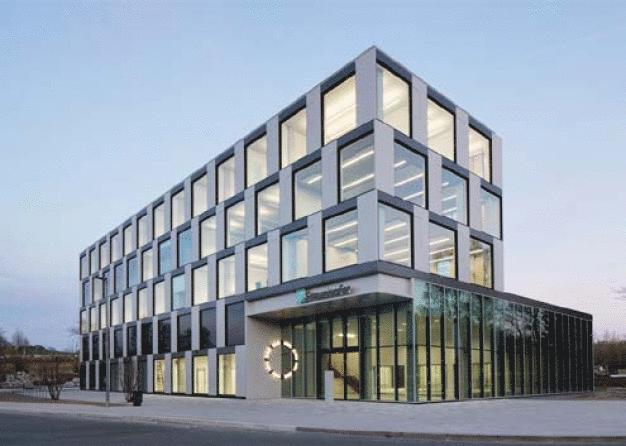
On an area of around 3000 square meters, the 44 employees of the project group have plenty of space. (Photo: Werner Huthmacher)
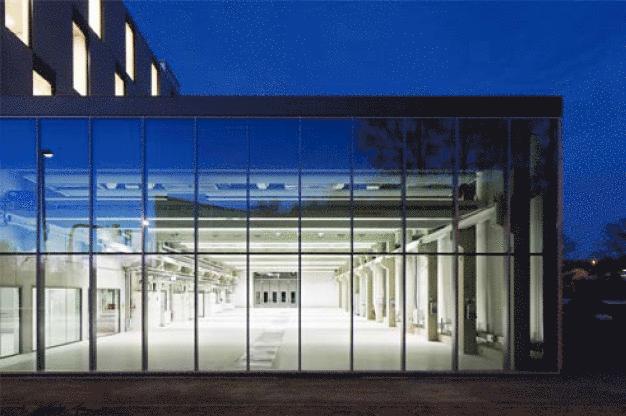
In the Technikum Hall, several learning factories are being set up where SMEs can apply methods of regenerative production. (Photo: Werner Huthmacher)
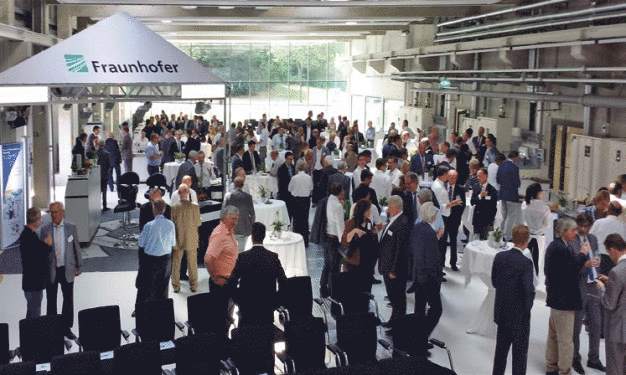
At the opening ceremony on August 6, 2015, 200 invited guests from politics and business attended. (Source: Fraunhofer IPA)
On August 6, 2015, the Fraunhofer Project Group Process Innovation in Bayreuth opened its new building. After only two years of construction and without additional budget, the 44 employees moved into the new workplace. About 200 invited guests attended the celebration, including Bavarian State Secretary Franz Josef Pschierer and the Mayor of Bayreuth, Brigitte Merk-Erbe.
The new building offers plenty of space for the 44-member team led by Professor Rolf Steinhilper, head of the project group, and over 60 student assistants. "The approximately 3,000 square meters of space include a technical hall, two laboratories, numerous offices, and five meeting rooms," explains Dr. Stefan Freiberger, member of the management team and construction manager of the project group. Previously, the team was housed at the Chair of Environmentally Friendly Production at the University of Bayreuth. Since the group has grown sevenfold since its founding in 2006, it was gradually becoming too cramped here.
The new premises, which directly border the university campus, impress both inside and out: "The basic framework of the facade is made of real wood, and the intermediate spaces are made of glass. This creates a pleasant working atmosphere and also looks modern," informs Freiberger. An advanced combined heat and power plant provides heating, generating electricity and heat simultaneously. The proximity to the university was also particularly important for the project group: "Then our student assistants don't have to travel as far," says Freiberger.
On the nose with construction time and budget
The project group succeeded in completing the new building within the planned timeframe and the limited budget of 8.4 million euros. This precision was achieved because Freiberger, as the construction manager, always kept the schedule and costs in view: "We met monthly with all architects and checked the construction situation," the engineer explains. This way, the team could respond immediately to unforeseen expenses: "For example, we had to invest an additional 250,000 euros to compensate for the load-bearing capacity of the ground. In return, we simplified the staircase design of the architect and opted for a lower air exchange rate in the technical hall," describes Freiberger his approach.
SMEs can learn regenerative production
The Bavarian Ministry of Economic Affairs approved the new building in 2012. Besides the personnel growth of the project group, the research topic "Regenerative Production" was particularly decisive, says Steinhilper. Today, it is about more than industrial production and logistics. "Companies are not only working towards selling a product. Instead, they expand their revenue opportunities into service engineering, i.e., customer support with spare parts and additional services," explains the head of the project group. Examples include new technologies for remanufacturing exchange parts.
At the opening ceremony, Steinhilper presented plans for a modern learning factory to the numerous companies from Upper Franconia, which is to be built in the technical hall. Here, companies can experience the methods of lean production. A second learning factory, the Green Factory, is intended to demonstrate how components made from carbon fiber reinforced plastics (CFRP) can be produced energy-efficiently.

Fraunhofer-Institut für Produktionstechnik und Automatisierung IPA
Nobelstraße 12
70569 Stuttgart
Germany
Phone: +49 711 970 1667
email: joerg-dieter.walz@ipa.fraunhofer.de
Internet: http://www.ipa.fraunhofer.de