


- Translated with AI
Reinstwasseranlage goes into operation
Hager + Elsässer executes prestige project for Russian semiconductor manufacturer
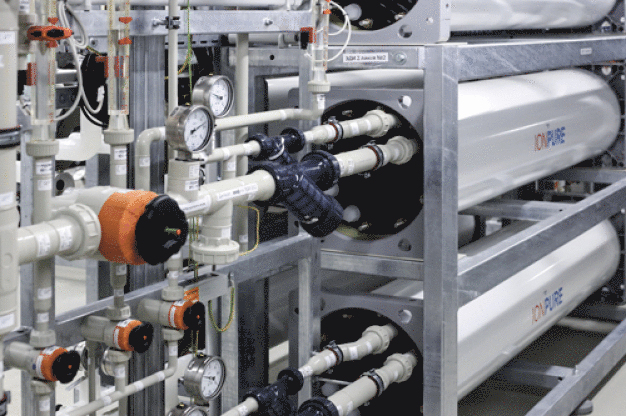
The production of pure water is achieved through a combination of reverse osmosis and electrodeionization.
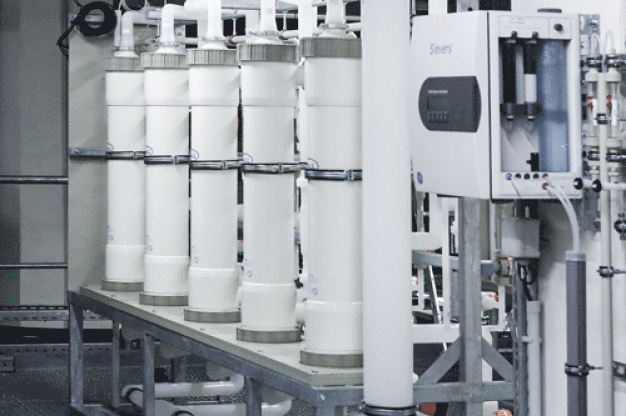
The pure water membrane degassing for oxygen removal.
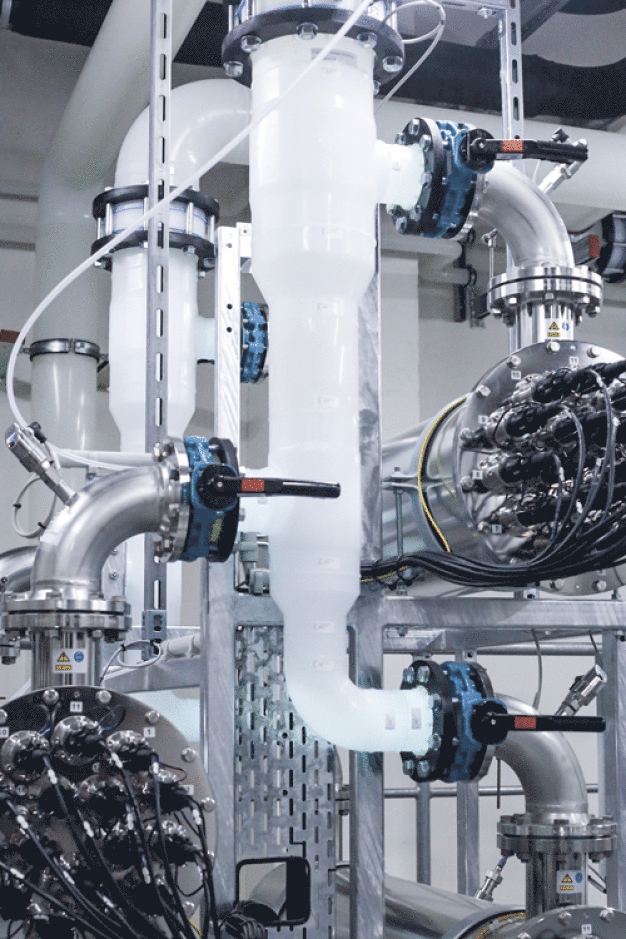
The pure water UV system for TOC reduction and disinfection.
The system manufacturer Hager + Elsässer commissioned an UPW system (Ultra Pure Water) in November 2015 for the production of ultrapure water for the Russian semiconductor manufacturer Angstrem-T. The system, built as part of a new facility for the state-of-the-art wafer manufacturer, produces 100 m3 of ultrapure water per hour. Hager + Elsässer convinced the client with a system concept that significantly reduces chemical consumption and produces ultrapure water with very low residual contaminant levels. This is one of the largest projects realized so far for the semiconductor industry in Russia.
Water is one of the most important components in the manufacturing of microelectronic devices. Ultrapure water is used for producing chemical solutions, rinsing wafers, and other technological processes, as well as for rinsing crystals on circuit boards. The quality requirements for water used in the microelectronics industry are particularly high.
The current standards for semiconductor manufacturing distinguish four types of water depending on the size of the semiconductor components for which the water is used. In the UPW system at Angstrem-T in Zelenograd, ultrapure water is produced for structure sizes of 90 to 130 nm. Additionally, a reserve exists for transitioning to technologies with structure sizes of 65 nm and smaller. The smaller the nanometer range of the products being manufactured, the higher the purity of water required for the production process. “The quality of ultrapure water always has a decisive influence on product quality and manufacturing efficiency in the semiconductor industry. After all, 30% of the processes involve rinsing silicon wafers,” explains Anatoly Sukhoparov, Managing Director of Angstrem-T AG. Planning for the new system began in April 2013. The Russian semiconductor manufacturer invested approximately €11.5 million in the new system, with Hager + Elsässer providing a turnkey solution—from concept to commissioning. “We have been successfully working with Hager + Elsässer since the early 1990s. Once again, we were able to find an optimal solution within this project, which convinced us both in terms of cost and quality,” says Anatoly Sukhoparov.
The system installed by Hager + Elsässer consists of several treatment stages that bring the water up to the required quality: pre-treatment, desalination, deep cleaning (deionization), degassing, UV treatment, ion exchange, and ultrafiltration. For pre-treatment of the raw water, a multi-layer filter and an activated carbon filter are used. In the “Make-up” process step, the pre-treated water is freed from unwanted particles, organic and inorganic impurities, and ions through a process combination of reverse osmosis and a two-stage electrodeionization (EDI).
A special boron polisher ensures compliance with boron specifications according to the guidelines of the “International Roadmap for Semiconductors.” The final cleaning is carried out in the so-called polishing loop. “This two-stage process has a particularly high cleaning effect. It allows for significantly longer service intervals and thus savings in resin changes in the polisher and regeneration,” explains Eugen Martens, project manager at Hager + Elsässer.
The new UPW system removes almost all inorganic and organic contaminants and ions from the raw water used. Therefore, the process meets the strict requirements regarding minimal residual contaminants.
H+E GmbH
70565 Stuttgart
Germany