



- Translated with AI
Protective effect according to SWKI 99-3 and DIN 1946-4
Reference Aerosol System RAS 3000
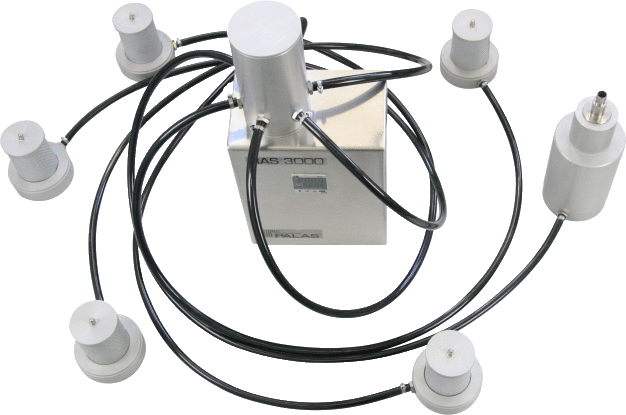
RAS3000
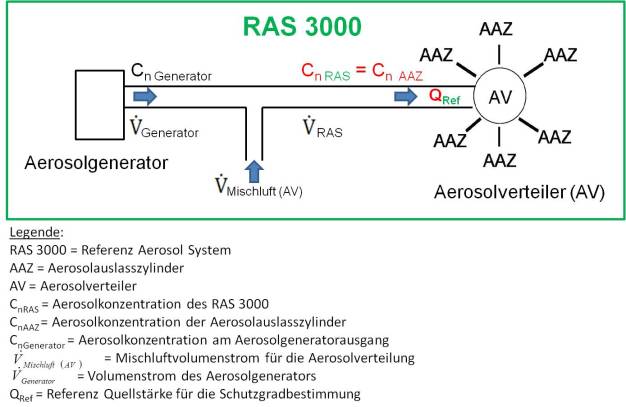
Schematic diagram of the RAS 3000
With the Reference Aerosol System RAS 3000 from Palas®, the protection level determination according to SWKI 99-3 and DIN 1946-4 can be carried out reliably, reproducibly, and cost-effectively.
State of the Art before the RAS 3000
According to SWKI 99-3 Edition 400/5/2004 and DIN 1946-4 Edition December 2008, the protection level SGx is calculated using the formula SGx = - log (Cx/CnRef).
Cx = measured particle concentration
CRef = reference particle concentration of the reference value
The more accurately the reference value can be set, the more reliable and reproducible the SG can be determined. In the two standards mentioned, a source flow QRef is defined to reliably and reproducibly compare operating rooms operated with different ventilation and air purification systems. Both standards leave open how QRef or CRef are measured. The standards should require on-site measurement of these critical reference values. This is not currently the case! Since this verification can be easily performed with the RAS 3000 and the practical implementation is described in various publications, the fundamental requirement will need to be included in the revision of the above standards.
In ISO 21501-4, the function and various device parameters, such as the lower counting efficiency—corresponding to the lower detection limit of optical particle counters (OPCs)—are described for applications in cleanrooms. According to ISO 21501-4 Edition 2007, the lower detection limit can vary by ±20% even for identical devices. The volumetric flow rate of an OPC can vary by ±5%. This means that measurement results obtained with different OPCs, for example in determining the protection level of operating rooms, can vary by up to 50%.
With the RAS 3000, the lower counting efficiencies of up to five OPCs can be calibrated simultaneously against a reference OPC with an accuracy of 6%. The RAS 3000 thus enables the protection level determination of cleanrooms and the calibration of OPCs to be performed reliably, reproducibly, and economically.
The equality of the concentration CnAAZ at the AAZ1 – AAZ6 must also be verified on-site.
Innovation in Protection Level Determination
The RAS 3000 makes it possible to generate a defined aerosol with the required reference source flow QRef at six different locations simultaneously in the operating room for protection level (SG) determination according to SWKI 99-3 and DIN 1946-4.
The RAS 3000 is characterized by the quick and reproducible setting of the required reference source flow QRef.
The six aerosol task cylinders (AAZs) of the RAS 3000, as required by the standard, have a perforated shell. The key advantage of the RAS 3000 is that the source strength QRef can be reliably checked at all six AAZs with any suitable optical particle counter (OPC). The concentration differences between the six AAZs are only a maximum of 4%. The same applies to fluctuations in particle concentration over a measurement period of, for example, three hours.
The reference source flow QRef must be verified in the operating room through measurement, as the lower counting efficiency of the particle counters used per ISO 21501-4 can vary by ±20% and the volumetric flow rate by ±5%. Measurement results obtained within these tolerances can therefore differ by up to 50%.
Attention: It makes no sense if a supplier of an aerosol distributor system (AV) states that their AV has the required QRef = 6.3 x 10⁹ P/min preset at the factory, because different OPCs can measure different concentrations at the same measurement point. According to ISO 21501-4, the concentrations measured by two OPCs can differ by up to 50%.
The SWKI guideline 99-3 and DIN 1946-4 require this reference source flow QRef, which is why QRef must also be verified by measurement. We recommend verifying both QRef and the concentrations at measurement points MP1– MP3 with the same OPC.
Literature:
2012 Six at a stroke. Simultaneous calibration of up to six particle counters; ReinRaumTechnik 8/2012, L. Mölter, J. Blattner, A. Machmüller,
2012 Calibration system for optical particle counters;
ICCCS 2012, L. Mölter, S. Schütz (+ presentation)
2012 Determination of the protection degree according to SWKI 99-3 and DIN 1946-4;
ICCCS 2012, L. Mölter, S. Schütz (+ presentation)
2011 Mobile calibration system for particle counters;
VDI Reports No. 2125 (2011), L. Mölter, S. Schütz (+ presentation)
2010 Healthy air – determination of the protective effect of ventilation systems in operating rooms; ReinRaumTechnik 4/2010, pp. 40 – 42, L. Mölter, K. Hildebrand, R. Külpmann
2009 New ISO standards: higher accuracy with optical particle counters;
VDI Reports No. 2083 (2009), L. Mölter, S. Schütz, G. Lindenthal (+ presentation)
2007 Reliable determination of the protection degree for operating rooms;
VDI Reports No. 1973 (2007), L. Mölter, S. Schütz, K. Hildebrand, R. Külpmann (+ presentation)
Palas® GmbH
76187 Karlsruhe
Germany