



- Trade fair
- Translated with AI
New solutions for cleanliness control and in service
CleanControlling at parts2clean 2021 in Stuttgart, October 5 – 7.
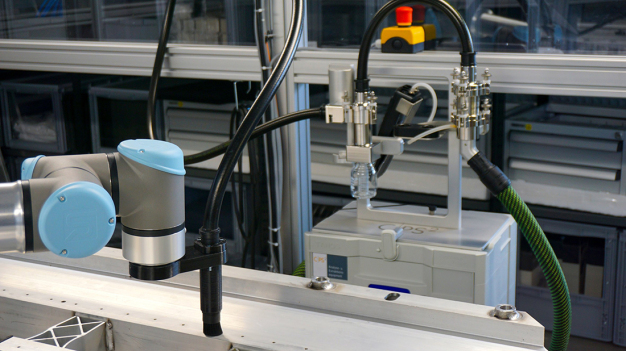
Unlike manual nozzle operation, the dry particle suction extraction is reproducible with the robot. (Image source: CleanControlling)
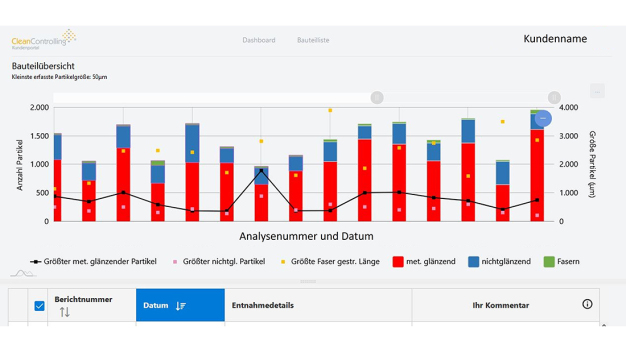
The new customer portal offers a visually optimized overview of all conducted analyses. (Image source: CleanControlling)
CleanControlling presents various innovations and further developments at this year's parts2clean (Hall 4, Stand B 58) in Stuttgart. These include an innovative customer portal and a new fully automated solution for dry, reproducible, and efficient particle suction extraction from large components.
The shift towards electromobility and the increasing importance of component cleaning as a quality factor in nearly all industrial sectors also require new and adapted solutions for controlling technical cleanliness. These will be presented by the company CleanControlling, which specializes in analyses of technical and film cleanliness for the automotive and supplier industry as well as general industry, from October 5 to 7 at this year's parts2clean in Stuttgart, Hall 4, Stand B 58.
New Customer Portal – clearer, more informative, and more efficient
With the new customer portal, CleanControlling has developed a forward-looking tool that provides comprehensive and visually optimized access to analysis data. All components for which cleanliness tests are conducted are displayed as photos in a tile format and can be accessed individually. A click on the display is enough to show all analyses and evaluations for the respective workpiece across locations – including the history – with individual analyses being able to be shown or hidden. The clear numerical presentation of data and diagrams, as well as photos of the particles detected, sorted by size and type (metallic, non-metallic, and fibers), provide a very illustrative, understandable, and quick overview.
Customers can add information to individual analyses via a notes function, such as which system the cleaning was performed in or after which cleaning attempt the analysis was carried out. Furthermore, comparisons across different locations and trend displays of analysis information back to 2012 are possible. Based on this, conclusions can also be drawn about the stability of the cleaning process. The essential information and visualizations can be printed. Retrieval of test protocols in PDF format, as previously customary, is also available.
Reproducible particle suction extraction for large components
With the rise of electromobility, not only components are changing, but also the requirements for particle extraction for cleanliness control. For components such as battery trays and E-Compartments, where individual inspections of circuit boards, electronic parts, and wiring harnesses are also necessary, traditional wet extraction is no longer suitable. Additionally, in electric vehicles, cleanliness checks are shifting into assembly areas, requiring dry particle extraction here as well. To obtain comparable results in analysis, a reproducible extraction process is necessary even for large parts.
For these tasks, CleanControlling has developed a robot-based solution that is likely to be a highlight at this year's parts2clean. The robot equipped with the proven and further developed particle suction extraction system C|PS² allows for reproducible, full-surface or partial sampling on surfaces up to 4,600 x 2,600 mm. Since the robot system has seven degrees of freedom, particles can also be automatically extracted from three-dimensional areas. Specially designed suction nozzles are available to access areas such as recesses, holes, or undercuts. Programming the robot requires no special knowledge: the movement sequence for extraction is simply created by a one-time manual teaching process and can be saved as a component-specific program in the system. Due to the easy and quick program generation, the robot system can also be efficiently used for repeatable, precise particle extraction on smaller components.
An additional advantage is that the particle suction extraction unit can be unplugged from the robot and used as a manual system. This allows it to be easily transported to other production and assembly areas to validate processes – for example, whether particles generated during a screwing process stay within permissible limits.
Between analyses, a blank measurement is required, which is made not only easier but also safer through an advancement of the particle extraction system. Previously, all components relevant to testing, such as hoses, cyclones, and filtration units, had to be cleaned manually. Now, a wet cleaning solution is available for this purpose. The entire particle extraction system is turbulently rinsed with the cleaning solution and then dried.
CleanControlling GmbH
78576 Emmingen-Liptingen
Germany