


- Buildings & Rooms
- Translated with AI
Microspraying in the cleanroom
New concept of machine connection
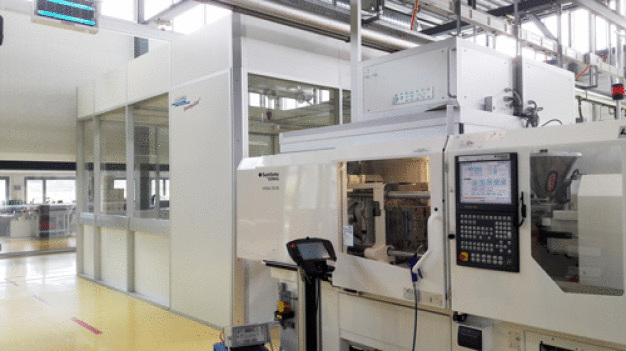
Cleanroom solution with attached injection molding machine
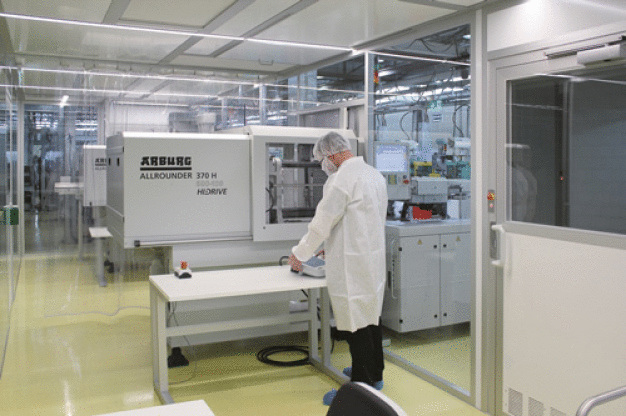
In the cleanroom CleanCell4.0®, the manufactured parts can be removed directly.
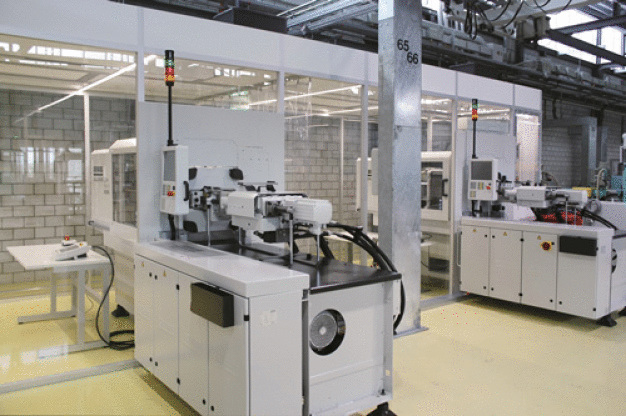
The injection molding units with high thermal loads remain outside the fully glazed cleanroom.
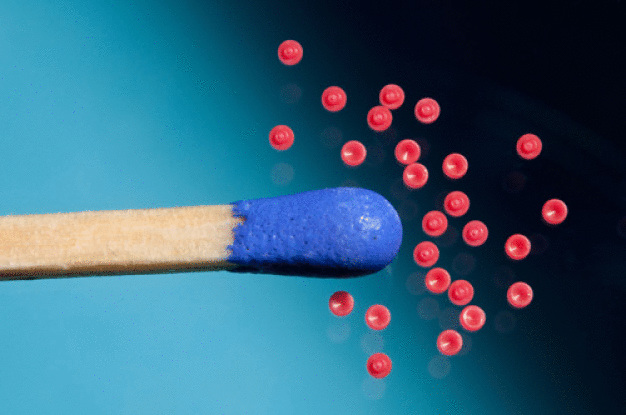
Medical components manufactured by micro-injection molding
Micro-injection molding processes enable precise and cost-effective production of tiny plastic components. To meet the highest requirements for product safety and quality, production, especially of medical products, is usually carried out in cleanrooms. Stamm AG has invested in a new cleanroom with a new approach to machine integration. The micro-injection molding machines are partly located inside and partly outside the cleanroom.
Hallau in Switzerland appears at first glance to be a cozy wine town where time seems to pass more slowly. However, as is often the case, hidden within these small towns are medium-sized companies producing innovations at the highest global level. The Hallau-based Stamm AG undoubtedly belongs to these creative, forward-looking companies. The plastics processor is dedicated to the world of micro and miniature parts. And with great success. By manufacturing tiny components such as gears, connectors, or tips, Hallau pushes the boundaries of what is possible. In the particularly sensitive field of medical technology, production takes place under controlled cleanroom conditions.
Micrometer-precise work
The smaller the products, the more complex and careful the manufacturing process must be. Every speck of dust can impair function or even cause failure. When the products are used in the medical field, such as in minimally invasive surgery, absolute hygiene and contamination-free delivery must be guaranteed. Maintaining constant environmental conditions during production and packaging plays a significant role. Stamm AG has been operating micro-injection molding of medical components under controlled cleanroom conditions for many years. The Swiss company has invested in new micro-injection molding machines and has expanded its cleanroom capacity with an additional ISO 7 class cleanroom.
Detlef Moll, CEO of Stamm AG, explains the necessity of the investment: "We manufacture tiny plastic components. This requires the highest precision. Our technicians develop injection molds that operate in the micrometer range during micro-injection molding. The details of the finished products are often no longer visible to the naked eye but are important components of our customers' overall concept. Every particle contaminating the production can lead to failure of the sensitive parts. In addition to the precision of the process, we also ensure a controlled production environment."
Stamm AG gained initial experience in cleanroom technology with a small cleanroom tent of a few square meters used for quality control of the produced parts. Convinced by the quality improvement, the Hallau-based company soon invested in a complete cleanroom system, to which the injection molding machines were docked. In this solution, the machines were still positioned outside the cleanroom as usual and equipped with a laminar flow enclosure that allows controlled air purity within the clamping unit. The micro-parts are then removed by robots and automatically fed into the cleanroom via sealed cleanroom conveyor belts, where final inspection and packaging take place.
Innovative concept for injection molding integration
With expertise in highly sensitive manufacturing, the Swiss plastics specialists' order volume grew again, necessitating further investment in two new micro-injection molding machines with cleanroom capability.
In collaboration with their long-standing cleanroom supplier SCHILLING ENGINEERING, the Swiss opted for a new concept. In the newly commissioned 60 m² cleanroom facility, which achieves an ISO Class 7 air purity, the machines are installed half inside and half outside the cleanroom. For this purpose, a special outlet was constructed in the cleanroom wall.
Detlef Moll explains the advantages of this variant: "With the new compact solution, we save space and transport routes. The molded products can be directly removed from the machine inside the cleanroom. However, the injection unit itself remains outside the cleanroom, so the thermal loads do not occur in the controlled area. This positively impacts temperature control and air conditioning. This concept is entirely new and was developed together with our long-term partner SCHILLING ENGINEERING."
State-of-the-art, energy-efficient cleanroom system
The newly installed cleanroom system, CleanCell4.0®, guarantees cleanroom air quality of ISO Class 7. Separate personnel and material airlocks with interlocking doors ensure safe entry and exit of personnel and the packaged final product.
The cleanroom system is equipped with high-performance ULPA filters of class U15. An innovative recirculation and exhaust air management within the fully glazed cleanroom walls ensures precise cleanroom flushing and has high energy efficiency, as the already filtered and cooled air is recirculated within the air exchange system. Wall and ceiling modules of the modular cleanroom are connected with a silicone-free GMP sealing clip system.
Additional safety is provided by the integrated control system CRControl®. Through the interactive monitor of the control system, connections are established to the sensors measuring pressure, humidity, and temperature, as well as to filter modules, climate cabinets, door and lighting functions, and other components. All key functions are monitored and can be individually controlled and regulated. This also enables easy remote maintenance.
Detlef Moll is pleased with the new investment: "We were able to put the new cleanroom into operation already, and it meets all our expectations. The installation of the injection molding machines inside the cleanroom has proven to be a good development. The cleanroom operates as usual without disruptions and is safe, quiet, and equipped with very good LED lighting and full glazing, making working conditions easier for our staff in the cleanroom."
The cleanroom was offered by SCHILLING ENGINEERING as a turnkey solution. Planning, production, installation, and qualification were completed within two months.

Schilling Engineering GmbH
Industriestraße 26
79793 Wutöschingen
Germany
Phone: +49 7746 927890
email: info@schillingengineering.de
Internet: http://www.schillingengineering.de