


- Science
- Translated with AI
Microplastic investigations in cleanroom atmosphere at PHWT
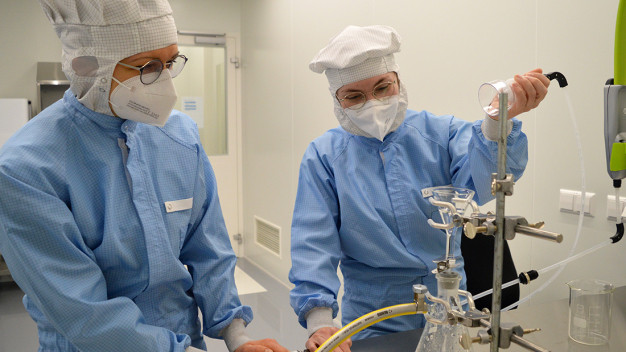
Doctoral candidate Emma-Elena Bratge and BA student Sofie Runnebohm during microplastic analysis in the cleanroom at the PHWT Technology Forum - Anuschka Bacic
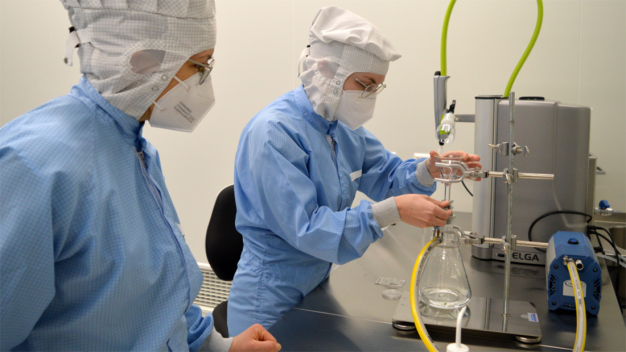
Doctoral candidate Emma-Elena Bratge and BA student Sofie Runnebohm during microplastic analysis in the cleanroom at the PHWT Forum of Technology - Anuschka Bacic
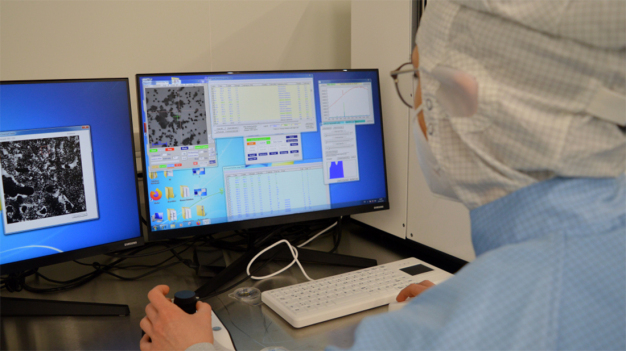
Doctoral candidate Emma-Elena Bratge and BA student Sofie Runnebohm provide insights into their work in the cleanroom at the PHWT - Bacic forum
Cleanroom in the new Forum of Technology offers an exclusive environment for scientific research. Microplastics are everywhere – but how can they be detected and studied? PhD student Emma-Elena Bratge and BA student Sofie Runnebohm give us insights into their work. In microplastic analysis, this special environment prevents the intrusion of additional particles that could distort the results. The topic of microplastics is gaining increasing attention. Based on this, among other things, microplastics in mineral water are analyzed as part of a bachelor's thesis.
The Private University for Business and Technology is currently constructing a new building at the Diepholz university campus, the Forum of Technology. A laboratory in the new building is equipped as a cleanroom laboratory, where appropriate air circulation and filtration technology create such a clean and pure working environment that research activities in the field of microplastic analysis in food are possible.
The emergence of microplastics (plastic particles < 5 mm) is a constantly present topic in today's society. Several studies have detected microplastics in oceans, soils, air, and also in food. However, there are still many gaps in the data. To close these gaps, food is being examined for microplastic particles at PHWT in Diepholz. PhD student Emma-Elena Bratge analyzes, as part of her doctorate, the process steps in which microplastic particles enter food. Students at PHWT are involved in the research. For example, mechanical engineering student Sofie Runnebohm from Lohne is investigating different samples for their microplastic concentration within the framework of the research project. The samples are examined spectroscopically for particles up to a size of 2 μm. Molecules in the particles are excited to vibrate using a laser. This produces spectra that are characteristic of a material, allowing determination of whether it is actually microplastic or other particles.
When analyzing the samples, care must be taken to prevent contamination from foreign plastic particles from the environment, such as plastic fibers from clothing. This foreign contamination could alter the results of the investigation and lead to false conclusions. To prevent foreign contamination as much as possible, microplastic analysis at PHWT now takes place in the newly built cleanroom in the Forum of Technology. In this special environment, high standards of cleanliness are maintained. Filter systems that draw in and filter the ambient air significantly reduce existing particles in the air. To prevent additional particles from entering the cleanroom from outside, researchers must wear special clothing and shoes that do not shed fibers or particles when entering the cleanroom.
“For me personally, it is an interesting experience to work under these unusual conditions and at the same time contribute to research results. The research conditions created here are really great!” reports Sofie Runnebohm about her experiments for her bachelor’s thesis. With the completion of the cleanroom in the Forum of Technology at PHWT, excellent opportunities arise for the university to conduct scientific work and contribute to current research questions. Additionally, it provides students with further insights into science and issues that go beyond the theoretical content of their studies.
Private Hochschule für Wirtschaft und Technik (PHWT)
49377 Vechta
Germany