

- R+D & Community of Interest
- Translated with AI
International cleanliness standards for the automotive industry
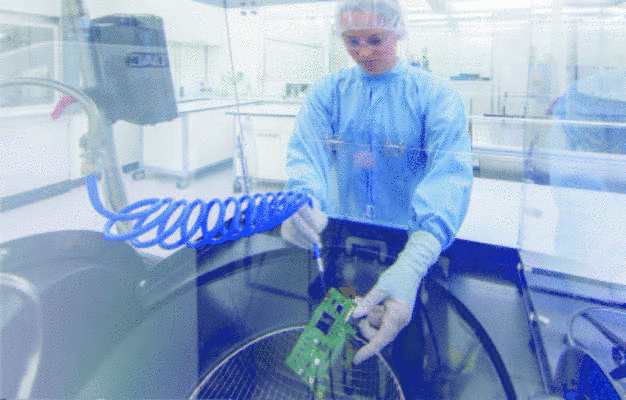
Extraction of particles from a component according to VDA Volume 19.1.
Already in 2001, the purity technology specialists at Fraunhofer IPA addressed the topic "Technical Cleanliness in the Automotive Industry." The scientists developed the first version of VDA 19, which was valid until early 2015. "Until then, the contents of VDA 19 and its international counterpart ISO 16232 were still consistent," explains Dr. Markus Rochowicz, Group Leader of Cleanliness Technology at Fraunhofer IPA. Between 2012 and 2014, however, the German standard was fundamentally revised. Since the new edition was published at the beginning of 2015, manufacturers have found it difficult to compare the technical cleanliness of their components internationally. "More and more automakers and suppliers are demanding a uniform guideline," the expert states.
Strong Consortium with Experience in Measurement Technology
This task is now being undertaken by the cleanliness technology experts from Fraunhofer IPA. Together with companies from the automotive industry and measurement technology, the scientists aim to adapt ISO 16232 to the German standard VDA 19.1. "Among others, Daimler, Mahle, Bosch, VW, and Zeiss are involved," Rochowicz informs. The group leader is pleased to have a strong alliance behind him. "When successful companies from Germany with years of experience demand standards, the guideline quickly gains international acceptance," Rochowicz is convinced. Vehicle manufacturing countries around the world are also interested in the standard: "Companies from Japan, the USA, France, and Sweden have also expressed interest in participating in the standard," Rochowicz is pleased.
Fewer Parameters and Defined Procedures
With the new guideline, the Stuttgart-based experts aim to ensure internationally comparable measurement results. "The problem with technical cleanliness is that it must be determined using multiple procedures in the laboratory," Rochowicz explains. Residual dirt from components is extracted, filtered, and then microscopically analyzed. "So far, there are neither clear guidelines for the procedure nor fixed values for parameters," Rochowicz notes. The result are measurement outcomes with deviations of up to a factor of four — "a disaster for quality inspectors," Rochowicz emphasizes. A new ISO 16232 is intended to finally bring clarity: "We want to significantly limit the variety of parameters, as in VDA 19.1. Additionally, we specify how the measurement must be carried out. The revised standard should, for example, specify which extraction method to use, which filter to select, and how to set up the microscope," explains the group leader. The consortium's kick-off meeting took place on September 30, 2015, at Fraunhofer IPA in Stuttgart. Four meetings per year with international participation are planned. After twelve months, the team aims to publish a consensus-based foundational document for a new ISO 16232.

Fraunhofer-Institut für Produktionstechnik und Automatisierung IPA
Nobelstraße 12
70569 Stuttgart
Germany
Phone: +49 711 970 1667
email: joerg-dieter.walz@ipa.fraunhofer.de
Internet: http://www.ipa.fraunhofer.de