



- R+D & Community of Interest
- Translated with AI
Intelligent robot solutions for assembly automation
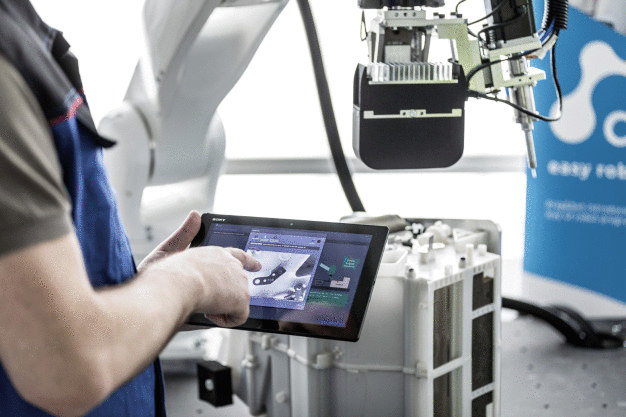
Depending on process requirements, drag&bot is modularly expandable. (Source: Fraunhofer IPA / Photo: Rainer Bez)
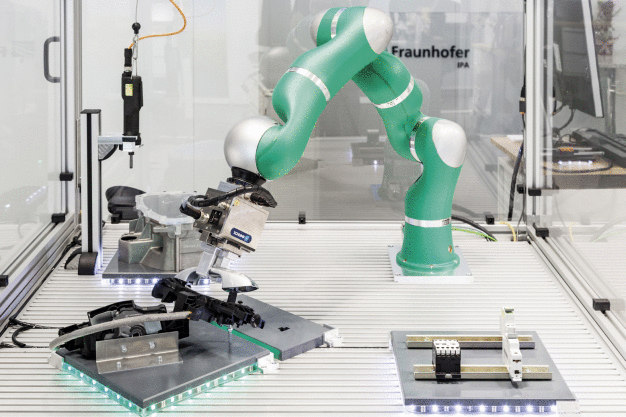
With Pitasc, various assembly processes can be automated. (Source: Fraunhofer IPA/Photo: Rainer Bez)
Increase the level of automation in assembly with new technologies and thus unlock economic and qualitative potentials: The Fraunhofer Institute for Production Technology and Automation IPA develops innovations for this purpose and translates them into industrial applications. At the International Trade Fair for Production and Assembly Automation Motek from October 8 to 11, 2018, in Stuttgart, visitors can experience various robot applications at the IPA booth. Additionally, the institute will introduce a new app for the first time, enabling a digitalized automation potential analysis.
Small and medium-sized enterprises have so far rarely utilized the potential inherent in the use of robots. One reason: Programming is comparatively complex, and external specialists are often needed to set up a robot. "In times of intuitively operated smartphones and tablets, such costly and elaborate robot programming is no longer appropriate," says Martin Naumann, group leader at Fraunhofer IPA.
With a few clicks to a robot program
The researcher from Fraunhofer IPA has therefore developed the software drag&bot together with his colleagues, which minimizes programming effort. The clever part: drag&bot provides ready-made program modules that can be quickly and intuitively assembled into complex robot applications via a graphical user interface. Additionally, user and input aids simplify the parameterization of the modules. "This means that expert knowledge is no longer required to reprogram robots from different manufacturers," Naumann points out. Visitors to the Motek can experience how easy it is to operate drag&bot themselves by programming an application with just a few clicks.
The software solution pitasc for force-controlled assembly processes is also demonstrated. It enables the automation of processes previously performed manually, such as assembling control cabinets, in a cost-effective manner. The software is innovative because the once-modeled task can be transferred to new workpiece variants, different robot types, and robots from other manufacturers. Moreover, it is structured similarly to a modular system: it contains many ready-to-use and reusable program modules that system integrators can assemble individually for setting up a robot system and deploy directly. Additionally, pitasc is integrated into drag&bot and can thus be used easily.
Plan automation solutions via app
If a company wants to automate assembly processes more extensively, it is crucial to identify the technically and economically suitable processes. Fraunhofer IPA offers the automation potential analysis for this purpose, providing companies with well-founded decision-making knowledge about all their assembly workplaces and lines in production and suitable automation options. This allows "quick wins" to be systematically identified and concepts to be developed and implemented based on them.
This analysis is now being conducted for the first time using an app, which Ramez Awad, also a group leader at IPA, will present at the fair. "This allows us not only to accelerate the analysis but also to obtain a data basis that, for example, enables comparison between a newly planned solution and an already implemented one," explains Awad. "This can significantly simplify the planning process."
More at the 37th Motek – International Trade Fair for Production and Assembly Automation, October 8-11, 2018, Stuttgart, Hall 7, Stand 7102.

Fraunhofer-Institut für Produktionstechnik und Automatisierung IPA
Nobelstraße 12
70569 Stuttgart
Germany
Phone: +49 711 970 1667
email: joerg-dieter.walz@ipa.fraunhofer.de
Internet: http://www.ipa.fraunhofer.de