- Translated with AI
Wolfgang Pendl
High-end injection molding in cleanroom
Manufacture of in-vitro diagnostic device
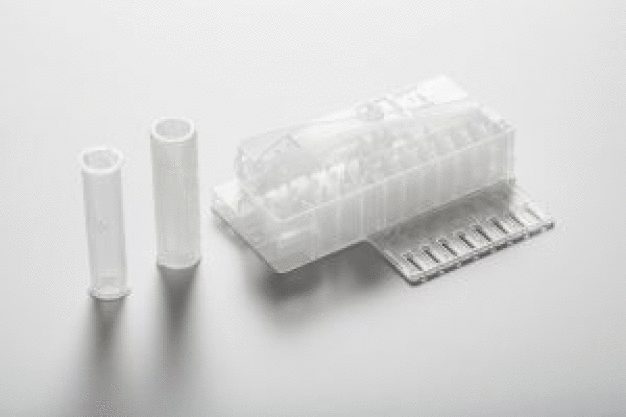
The central parts of the analysis device are the cartridge (right) and the "TC" (middle) – a 2-component injection-molded part made of PP and TPE, in which the liquids are transported during the investigations. On the far left of the image, the hard component of the "TC" can be seen. (Image source: all 1zu1 prototypes / Darko Todorovic)
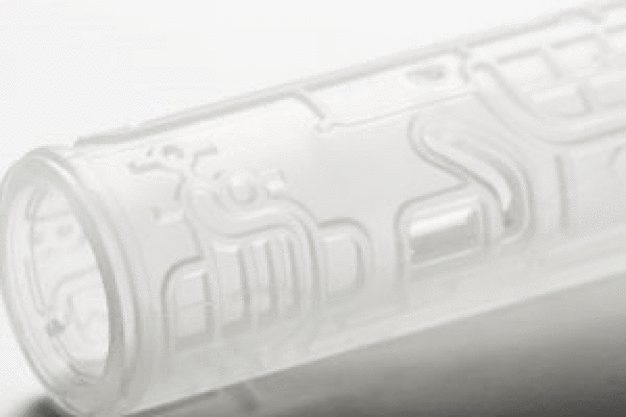
The manufacturing of the 2-component injection-molded part "TC" with its extremely fine structures was a special challenge.
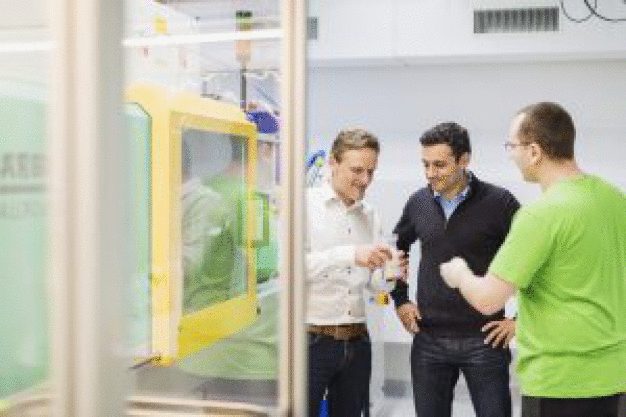
Wolfgang Spiegel, 1zu1 Prototypes (left), and Daniel Quidiello, Weidmann Medical Technology (center), examine the produced injection-molded parts.
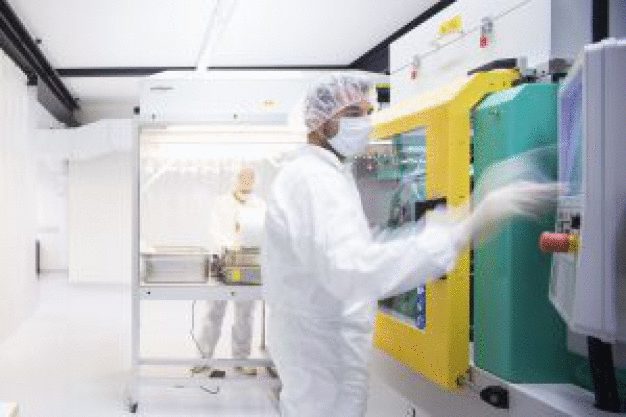
For the medical tests, 1:1 prototypes produced the injection-molded parts in the newly opened cleanroom.
Fine details in two-component injection molding, tight mold and position tolerances, burrs with a maximum of two hundredths of a millimeter, up to 20,000 pieces from one aluminum tool, cleanroom quality despite the overmolding process: In developing a device for in-vitro diagnostics, the involved project partners pushed the boundaries of what is feasible.
At the end of 2015, the company's long-planned cleanroom at 1zu1 Prototypes in Dornbirn, Austria, was completed — just in time for an order from Swiss Weidmann Medical Technology. The Austrian specialist was to produce a dozen different parts in the cleanroom using its aluminum tools, each up to 20,000 pieces. The order marked the culmination of more than two years of development for an internationally active medical technology company. The goal: a device for in-vitro diagnostics, capable of analyzing samples, such as blood, saliva, plasma, or tissue, directly at the doctor’s office or hospital for viruses and bacteria.
Until now, doctors often had to send such samples to central laboratories and wait days for results. The new analysis device delivers diagnoses for up to 22 pathogens within minutes. "Fast and precise diagnosis of diseases like meningitis or influenza is thus possible directly at the point of care," explains Daniel Quidiello, project manager at Weidmann.
Diagnosis in the tightest space
In summer 2013, the medical technology company commissioned Weidmann Medical Technology to develop the cartridge, which forms the core of the new device. It consists of twelve individual parts, is about 15 centimeters long, and contains several chambers with liquids to microbiologically analyze the samples. For the prototype construction, Weidmann contacted 1zu1 Prototypes in summer 2013. The two companies have a close collaboration spanning more than ten years. At the end of September, Weidmann awarded the contract for the first nine injection molding tools. Six weeks later, the molded parts were on the customer’s table by Lake Zurich.
"Nine tools at once is already an extraordinary order," says Wolfgang Spiegel, product manager for rapid tooling at 1zu1 Prototypes. The Vorarlberg-based company manufactures tools for prototypes and small series in aluminum injection molding. They are modular, with individual parts that can be quickly and precisely produced on modern turning and milling machines and later adjusted or exchanged if needed. Not only the scope of the project was a challenge, but also many specifications. "This was a high-end project. All requirements were slightly higher than usual," recalls product manager Spiegel. Project leader Quidiello from Weidmann openly admits: "Initially, we were skeptical about the sustainable feasibility. The big question for us was: Can we achieve the required quality for large batch production?"
The very fine structures of the parts initially posed high quality demands: For various microbiological analyses, liquids are transported and mixed within the cartridge. There are more than 20 variants, with channels sometimes having cross-sections of less than a millimeter. The tiny valves must be absolutely airtight while maintaining good mobility.
Otherwise, tightness is particularly important for this device. "Imagine if the patient sample with pathogens leaked out at the doctor’s," describes Quidiello. The closure hinges in some areas of the cartridge must seal just as tightly as the chambers with the analysis liquids. These are sealed after filling with a special process that requires a high surface quality of the injection-molded parts. Burrs or floating membranes are only permissible within a hundredth of a millimeter here.
Success together
To meet the requirements, both companies worked closely together in designing the tools. "We questioned every design for cost efficiency and safety, motivated each other to implement tool-technological innovations," recalls rapid tooling expert Wolfgang Spiegel. Feedback from the end customer was repeatedly incorporated. The success confirms both companies: The aluminum tools not only produced very good results on the first shot but proved to be extremely durable. Originally, 1zu1 Prototypes guaranteed 2,500 pieces per tool. Ultimately, the tools produced up to 20,000 pieces while maintaining the high quality demanded.
Transition into the cleanroom
During two prototype phases in standard injection molding, the parts were tested for technical functionality in the first two years of development, 2013 and 2014. Thanks to the modular design, modifications to existing tools could be made with minimal effort. From early 2016, testing focused on medical-technical aspects. Production was therefore moved into 1zu1 Prototypes’ new cleanroom, which meets ISO Class 8 standards, though the surface tests often yield even better results. The parts are produced from raw materials approved for medical applications. "Microbiological examinations require absolute cleanliness. Foreign DNA in the chambers with the analysis liquids would distort the results," emphasizes Spiegel.
An additional challenge in the cleanroom was the parts in two-component injection molding. They must be manually transferred between the two machines. "In the cleanroom, every manual intervention poses a risk of contamination," says the company’s rapid tooling manager. "But we also mastered this hurdle with great care."
Pre-series eliminated
Thanks to the high stability of the tools, pre-series tools, which Weidmann Medical Technology usually produces after the prototype phase, could be omitted during the project. "The collaborative partnership in this project was truly extraordinary," praises Wolfgang Spiegel. His counterpart, Daniel Quidiello, also commends the open communication: "We both gained a lot and learned a great deal." During the project, the two partners tested different material colors and surface structures to make the high-tech device’s aesthetics visible even externally. Quidiello finds this worthwhile: "The user-friendly, simple yet elegant design makes the analyzer a real eye-catcher."
1zu1scale
6850 Dornbirn
Austria