


- Translated with AI
Green algae decompose plastic – get hands-on experience early in your studies
Still available spots in the Bachelor's program in Biology
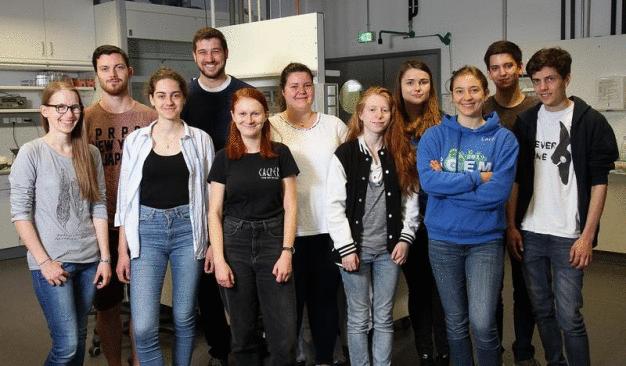
The iGEM team of TU Kaiserslautern. (Photo: Koziel/TUK)
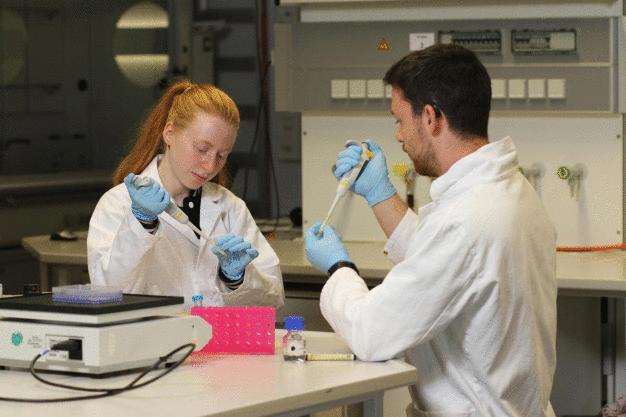
Practical work plays a major role in biology studies at TU Kaiserslautern. (Photo: Koziel/TUK)
At the Technical University of Kaiserslautern (TUK), practical content is given great importance in the Bachelor's degree program in Biology. A student team also benefits from this. They are currently developing a green algae that is supposed to break down plastic. The work is part of an international competition in Synthetic Biology. The students' learned knowledge in theory and practice is put to good use here. The six-semester Bachelor's program in Biology is open admission. Interested individuals can still enroll until August 31 for the upcoming winter semester.
These days, the students from Kaiserslautern participating in the international Genetically Engineered Machine competition, called iGEM, are kept very busy. At the end of the year, they will present their work before a jury at the Massachusetts Institute of Technology (MIT) in Boston. Their goal: to make a green algae that can break down plastic. The main focus is on the plastic PET. The abbreviation stands for Polyethylene Terephthalate. PET is the most commonly occurring plastic worldwide.
For green algae to be able to break down PET, they need two specific enzymes. "These split the plastic into two basic components," says student Lukas Punstein. Japanese scientists discovered these enzymes a few years ago in bacteria that had decomposed plastic on a landfill.
Currently, many research groups worldwide are working with these enzymes. The Kaiserslautern team has already successfully incorporated both genes into the algae's genome so that the algae can decompose the plastic. "That already works quite well," the student continues.
In the next steps, the team needs to investigate how much plastic the algae can break down and in what time frame. "The process can be used in a bioreactor," says team member Adrian Engels. The two substances into which PET is broken down can be reused. These are terephthalic acid and ethylene glycol. Both substances can, for example, be used in the chemical industry in many areas. "We would have a closed recycling system where no plastic ends up in the environment." It is conceivable, for example, that the technology could be used in a wastewater treatment plant.
The fact that students work independently on their own research project already during their Bachelor's studies is also thanks to their practical training. "We place a lot of emphasis on applying theoretical knowledge in practice," says Dr. Dorothea Hemme, the managing director of the Department of Biology. "The study program includes many practical lab work and teaches current techniques and methods so that students learn to conduct research projects independently and develop solution-oriented thinking."
Furthermore, the Bachelor's program imparts essential foundational knowledge in botany, ecology, biodiversity, genetics, human genetics, animal and plant physiology, biotechnology, microbiology, neurobiology, biophysics, and cell biology. In the final year, students can deepen their basic knowledge in two elective fields. The program also includes an internship in industry or research to help students orient themselves professionally early on.
At the end of the program, students complete their Bachelor's thesis, working on their own project in the lab. The TUK also offers a seamlessly connected Master's program, in which students can choose from four specializations: biotechnology of microorganisms and plants, molecular and biochemistry cell biology, the structure and functioning of the nervous system, and ecology and biodiversity of lower organisms.
Prospective students still have until August 31 to enroll.
The Kaiserslautern iGEM team is currently still seeking support; they have launched a crowdfunding campaign until the end of July. More information: https://www.startnext.com/chlamy-yummy
Questions answered by:
Dr. Dorothea Hemme
Managing Director, Department of Biology
Tel.: 0631-2052602
Email: hemme[at]bio.uni-kl.de
Technische Universität Kaiserslautern
67663 Kaiserslautern
Germany