


- Translated with AI
Glamox lighting tested in the world's purest cleanroom
Fraunhofer IPA Institute, Department of Cleanroom and Microproduction, confirms the quality of Glamox cleanroom lights
Fraunhofer3_CopyrightGlamox
Fraunhofer2_CopyrightGlamox
Fraunhofer Dr. Frank Buerger Copyright Glamox
Fraunhofer4_CopyrightGlamox
Glamox offers specialized lighting solutions for hospitals, healthcare facilities, food processing industries, and large kitchens. Especially in operating rooms, intensive care units, or laboratories, high hygiene standards are required, which the lighting must meet. Accordingly, Glamox invested heavily in the development of its own cleanroom luminaires. In addition to product testing by its own research and development department, the Norwegian lighting manufacturer relies on the reliable and reputable quality assessment of Fraunhofer IPA for cleanroom and microproduction. The department is considered a leading global research and testing facility for clean production.
For over 30 years, the Fraunhofer Institute for Production Technology and Automation, located near the University of Stuttgart, has been the center for researching clean environments. From ceiling systems to robots and process tools, everything undergoes various cleanroom tests offered by Fraunhofer IPA. For Glamox, it is therefore important that all cleanroom luminaires are tested here, as the cleanroom certification provided by Fraunhofer offers an objective and reliable evaluation of Glamox products. This provides new and existing customers with an important decision-making basis when comparing lighting solutions in project tenders with products from other manufacturers.
2,100 tested cleanroom products
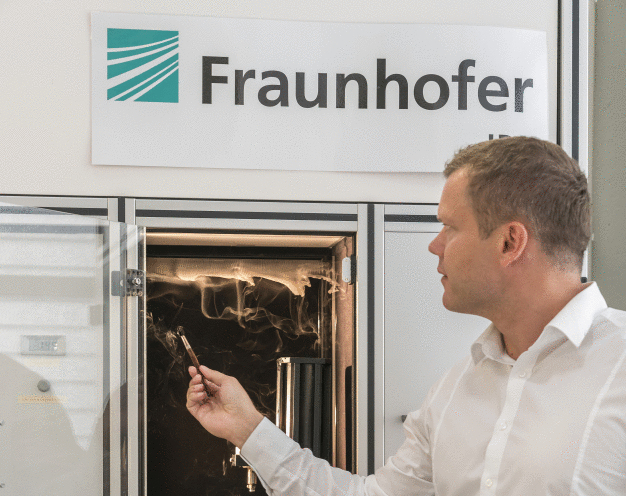
“We can offer more than 40 different tests, depending on the product and application. In our database, we have over 2,100 tested cleanroom products from the past ten years,” says Dr. Frank Bürger, who has been working for Fraunhofer IPA for 13 years. Prior to that, he gained experience in the semiconductor manufacturing industry with a US company, which has the highest cleanroom requirements in the industry. However, product testing is only one part of the activities of the cleanroom and microproduction department. The main focus is applied research and science. It must be ensured that the standards set by the cleanroom industry are always up to date. “We are the driving force behind the development and improvement of international standards used in the testing of cleanroom products,” says Bürger. He anticipates increasing demand for cleanroom testing in the coming years. “We see more and more industries manufacturing their products under strict cleanroom conditions.”
Particle emission testing
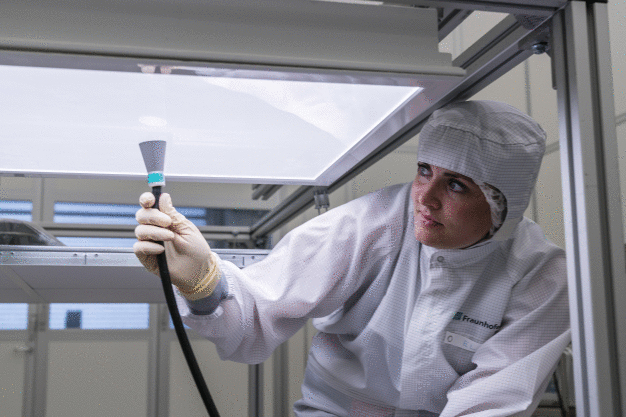
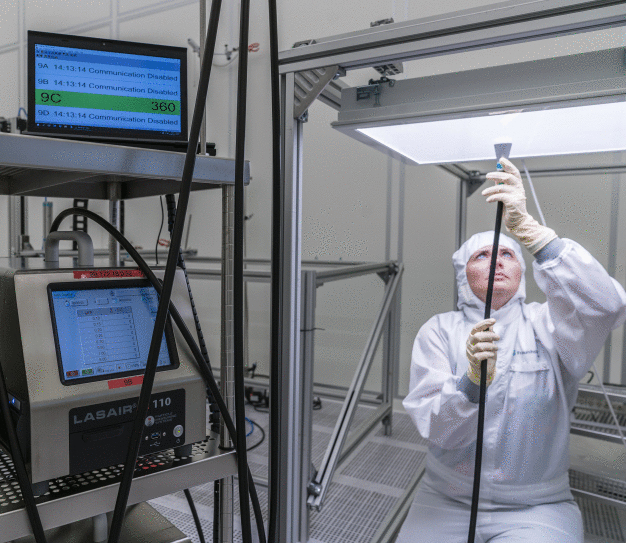
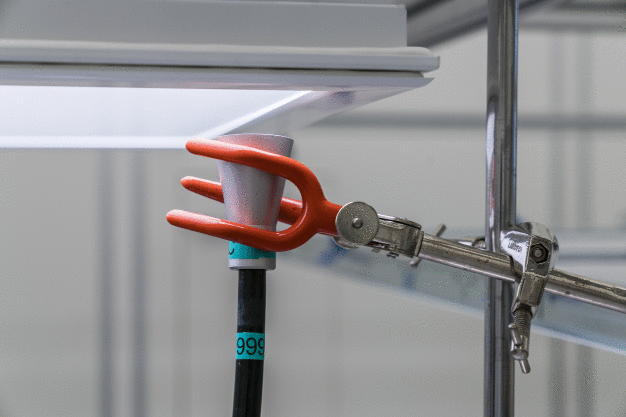
Two tests are particularly important for Glamox cleanroom luminaires: The first is the particle emission test, which is conducted and classified according to ISO 14644-14 and ISO 14644-1. This test is performed in Fraunhofer IPA’s own cleanroom, which is at least ten times cleaner than the air purity requirements of ISO Class 1. To achieve such extreme purity, laminar airflow is required. This means that air flows only from the ceiling downward to the floor. The floor is perforated to allow air to pass through, and filters in the ceiling capture particles. To create the ideal conditions for a reference cleanroom, the air in the 250-square-meter room is exchanged every twelve seconds. The minimum size and number of particles that can be detected in this test are almost unimaginable. For ISO 1 air cleanliness class, only ten particles not larger than 0.1 micrometers (1 micrometer is one-thousandth of a millimeter) are allowed per cubic meter of air. The fact that a dust particle in a semiconductor manufacturing plant can ruin microchips worth millions illustrates why such a high level of purity is necessary. The particle emission test begins with locating the sources of particles, colloquially called “sniffing.” This involves a particle counter that uses lasers to measure the size and count airborne particles. The counter is equipped with a sampling head with an intake capacity of 28.3 liters of air per minute. The technician examines the luminaire from all sides to identify points where particles accumulate. Once an appropriate number of measurement points is determined, measurement heads are mounted at fixed positions, where they remain for a testing period of 100 minutes.
Cleanability test
The second test is also very important for Glamox: the cleanability test. To evaluate the cleanability of the luminaires, a mixture containing riboflavin is applied to their surface. The contamination fluoresces yellow and is clearly visible under UV light. The contamination is then removed through a reproducible cleaning process. For smooth surfaces, a cleaning simulator is used to achieve comparable results. The success of the cleaning process is evaluated based on the presence of residual contamination. Using a fluorescent pigment allows areas that are difficult to clean to be clearly visualized. This test is conducted according to the VDMA sheet “Riboflavin test for low-microbial or sterile process techniques – Fluorescence test for cleaningability.”
Custom lighting
Glamox’s cleanroom luminaires can be delivered with RGB or Tuneable White technology. RGB and Tuneable White are used to optimize lighting for various purposes by adjusting color temperature and intensity. Experiences from hospitals, for example, show that using green light during surgery reduces eye strain and fatigue for surgeons, which in turn improves the quality of procedures.
Glamox GmbH
28307 Bremen
Germany