


- R+D & Community of Interest
- Translated with AI
German nanotechnology research in the Sleeping Beauty slumber
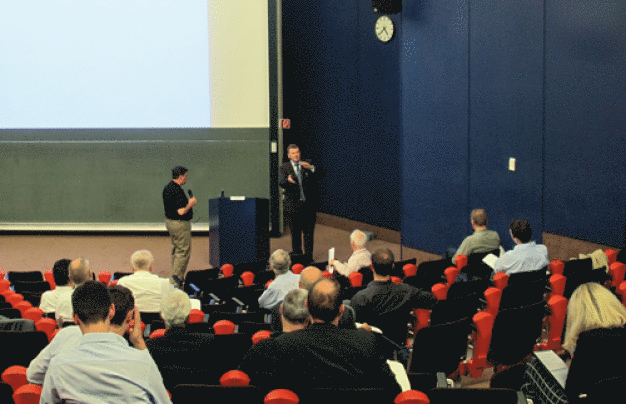
Ivica Kolaric, Head of the "Functional Materials" Department at Fraunhofer IPA, spoke on September 17th at the "6th Stuttgart NanoDays" in front of around 60 participants about the influence of social media on nanotechnology.
From 0 to 100 and back – this is how the hype around nanotechnology in Germany can be described. While the new materials are still being intensively researched in Asian countries, the nano-euphoria in Germany is waning. The reason for this is the lack of scaling procedures to translate the nanoscale into the real world. Aiming to advance German research in this field, the Fraunhofer IPA established the "Stuttgart NanoDays" conference in 2006. This year, the international participants met from September 17 to 19 at the Max Planck Institute in Stuttgart-Büsnau.
Nanocarbon materials possess extraordinary material properties due to their electrochemical effects. These include, among others, lossless electrical conductivity, extremely high strength, as well as chemical and thermal stability. However, these potentials are currently only usable at the nanoscale level. Ivica Kolaric, Head of the "Functional Materials" department at Fraunhofer IPA, sees an urgent need for research in this area. "The ratio of one nanometer to one meter corresponds to that of a tennis ball to the Earth. To benefit from these materials, we first need to transform them into industrially usable sizes," he explains.
Close exchange with international research, politics, and industry
While continuous efforts are being made in Asia to develop scaling methods, German research in this field is falling behind. "We are increasingly falling into a Sleeping Beauty sleep. However, practical results can only be achieved if we stay active," says Kolaric. To make progress in this promising research area, the "Functional Materials" department launched the "Stuttgart NanoDays" in 2006. The goal was to enable pragmatic exchange among research, politics, and industry. International experts from basic and applied research present their latest findings every year. "Besides knowledge transfer, we also want to shed light on which application fields are worthwhile," Kolaric explains about the conference.
Approximately 60 participants gathered at this year's "6th Stuttgart NanoDays." Leading researchers, including from Japan, China, New Zealand, the USA, France, Austria, and Ireland, participated in the discussions. Ivica Kolaric kicked off with his opening lecture on Wednesday. The focus was on the influence of social media on nanoresearch. Particularly on the video platform YouTube, consumer expectations are being raised that cannot be met. "Social media helps increase the visibility of nanotechnology, but they often oversimplify the procedures. This leads to disappointments among users and hampers research progress," Kolaric explained in his presentation. According to the expert, it is essential to highlight the challenges and discuss them. The subsequent lectures, also interdisciplinary, addressed similar issues. Sivaram Arepalli from "NanoScience and Technology Consultants LLC" in Hampton, USA, for example, discussed the use of nanomaterials in resource-efficient energy generation.

Fraunhofer-Institut für Produktionstechnik und Automatisierung IPA
Nobelstraße 12
70569 Stuttgart
Germany
Phone: +49 711 970 1667
email: joerg-dieter.walz@ipa.fraunhofer.de
Internet: http://www.ipa.fraunhofer.de